Thank you for visiting SNEWPapers!
Sign up free
The Kentucky Gazette
Lexington, Fayette County, Kentucky
What is this article about?
In a 1789 letter to the New-York Daily Advertiser, A.E. advocates opening a land office to sell western public lands, arguing it would provide steady revenue to pay the army and domestic debt, while directing American emigrants to U.S. territory instead of British or Spanish lands, thus preserving national strength despite Atlantic depopulation concerns.
Clipping
OCR Quality
Full Text
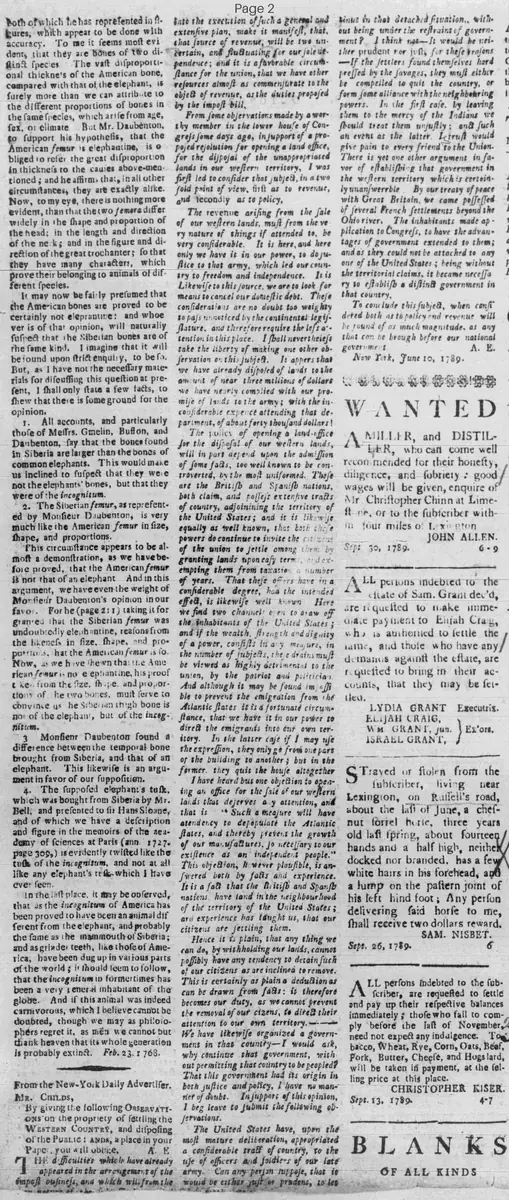
MR. CILDS,
By giving the following Observations on the propriety of settling the Western Country, and disposing of the Public Lands, a place in your Paper, you will oblige,
A. E.
The difficulties which have already appeared in the arrangement of the impost duties, and which will from time to time arise in the execution of such a general and extensive plan, make it manifest, that that source of revenue, will be too uncertain, and fluctuating for our sole dependence; and it is a favorable circumstance for the union, that we have other resources almost as commensurate to the object of revenue, as the duties proposed by the impost bill.
From some observations made by a worthy member in the lower house of Congress some days ago, in support of a proposed resolution for opening a land office, for the disposal of the unappropriated lands in our western territory, I was first led to consider that subject, in a two fold point of view, first as to revenue, and secondly as to policy.
The revenue arising from the sale of our western lands, must from the very nature of things if attended to, be very considerable. It is here, and here only we have it in our power, to do justice to that army, which led our country to freedom and independence. It is likewise to this source, we are to look for means to cancel our domestic debt. These considerations are no doubt too weighty to pass unnoticed by the continental legislature, and therefore require the less attention in this place. I shall nevertheless take the liberty of making one other observation on this subject. It appears that we have already disposed of lands to the amount of near three millions of dollars; we have nearly complied with our promise of lands to the army: with the inconsiderable expense attending that department, of about forty thousand dollars!
The policy of opening a land-office for the disposal of our western lands, will in part depend upon the admission of some facts, too well known to be controverted, by the most uninformed. These are the British and Spanish nations, both claim, and possess extensive tracts of country, adjoining the territory of the United States; and it is likewise equally as well known, that both these powers do continue to invite the citizens of the union to settle among them: by granting lands upon easy terms, and exempting them from taxation a number of years. That these offers have in a considerable degree, had the intended effect, is likewise well known. Here we find two channels open to draw off the inhabitants of the United States; and if the wealth, strength and dignity of a power, consists in any measure, in the number of subjects, these drains must be viewed as highly detrimental to the union, by the patriot and politician.
And although it may be found impossible to prevent the emigration from the Atlantic states it is a fortunate circumstance, that we have it in our power to direct the emigrants into our own territory. In the latter case if I may use the expression, they only go from one part of the building to another; but in the former, they quit the house altogether.
I have heard but one objection to opening an office for the sale of our western lands that deserves any attention, and that is "Such a measure will have a tendency to depopulate the Atlantic states, and thereby prevent the growth of our manufactures, so necessary to our existence as an independent people."
This objection, however plausible, is answered both by facts and experience. It is a fact that the British and Spanish nations have land in the neighbourhood of the territory of the United States; and experience has taught us, that our citizens are settling them. Hence it is plain, that any thing we can do, by withholding our lands, cannot possibly have any tendency to detain such of our citizens as are inclined to remove. This is certainly as plain a deduction as can be drawn from facts: it therefore becomes our duty, as we cannot prevent the removal of our citizens, to direct their attention to our own territory.
We have likewise organized a government in that country--I would ask, why continue that government, without permitting that country to be peopled? That this government had its origin in both justice and policy, I have no manner of doubt. In support of this opinion, I beg leave to submit the following observations.
The United States have, upon the most mature deliberation, appropriated a considerable tract of country, to the use of officers and soldiers of our late army. Can any person suppose, that it would be either just or prudent, to let those men remain in that detached situation, without being under the restraint of government? I think not--It would be neither prudent nor just, for these reasons--If the settlers found themselves hard pressed by the savages, they must either be compelled to quit the country, or form some alliance with the neighbouring powers. In the first case, by leaving them to the mercy of the Indians we should treat them unjustly; and such an event as the latter, I trust would give pain to every friend to the Union.
There is yet one other argument in favor of establishing that government in the western territory which is certainly unanswerable. By our treaty of peace with Great Britain, we came possessed of several French settlements beyond the Ohio river. The inhabitants made application to Congress, to have the advantages of government extended to them; and as they could not be attached to any one of the United States: being without the territorial claims, it became necessary to establish a distinct government in that country.
To conclude this subject, when considered both as to policy and revenue will be found of as much magnitude, as any that can be brought before our national government.
A. E.
New York, June 10, 1789.
What sub-type of article is it?
What themes does it cover?
What keywords are associated?
What entities or persons were involved?
Letter to Editor Details
Author
A. E.
Recipient
Mr. Cilds
Main Argument
opening a land office to sell western public lands would generate substantial revenue to fulfill promises to the army and pay domestic debts, while directing emigration to u.s. territory to prevent loss of citizens to british and spanish lands, countering fears of atlantic depopulation.
Notable Details