Thank you for visiting SNEWPapers!
Sign up free
Editorial
November 27, 1798
Virginia Argus
Richmond, Virginia
What is this article about?
This editorial by PHILODEMOS argues that the federal Sedition Act is unconstitutional, citing ratification debates, enumerated powers, lack of implied authority, and Bill of Rights protections for speech and press freedoms.
Clipping
OCR Quality
75%
Good
Full Text
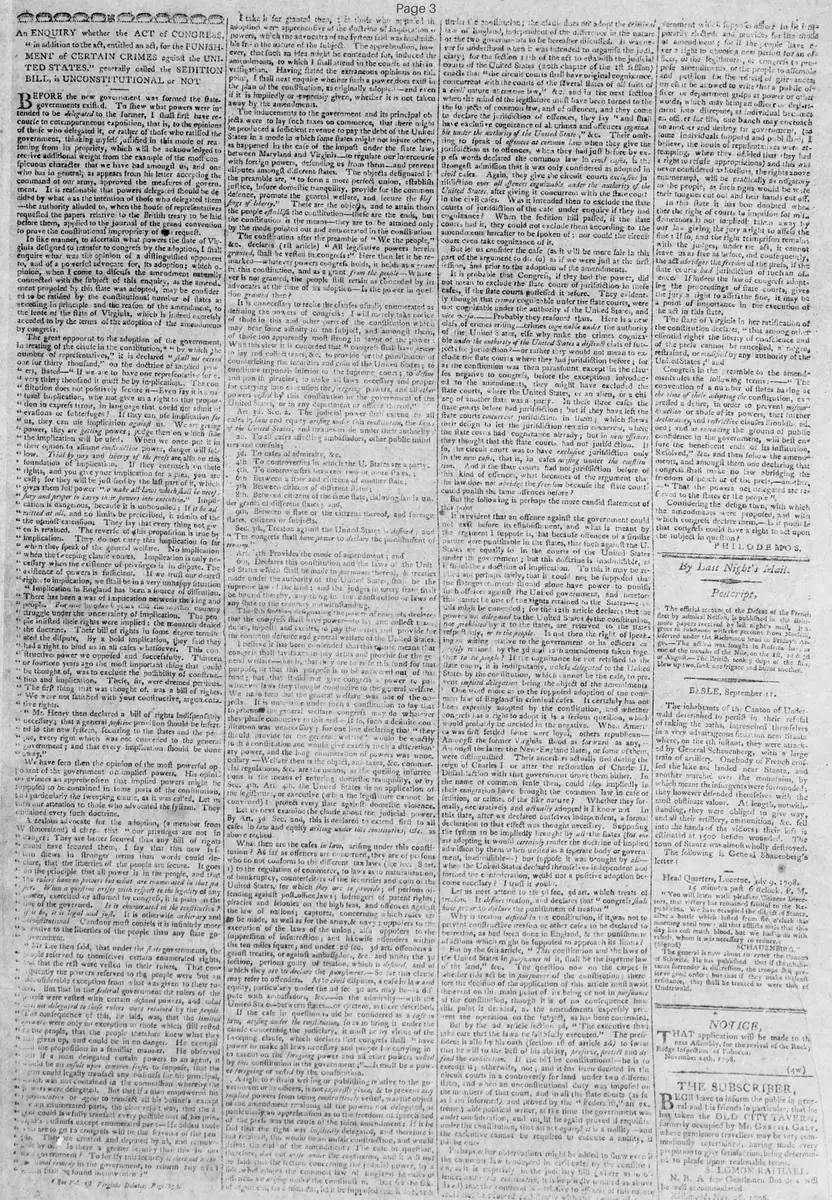
An ENQUIRY whether the ACT of CONGRESS,
"in addition to the act, entitled an act, for the PUNISHMENT of CERTAIN CRIMES against the UNITED STATES," generally called the SEDITION BILL, is UNCONSTITUTIONAL or NOT
BEFORE the new government was formed the state governments existed. To shew what powers were intended to be delegated to the former, I shall first have recourse to cotemporaneous exposition, that is, to the opinions of those who delegated it, or rather of those who ratified the government, thinking myself justified in this mode of reasoning from its propriety, which is if it be acknowledged to receive additional weight from the example of the most conspicuous character that we have had amongst us, and one who has in general, as appears from his letter accepting the command of our army, approved the measures of government. It is reasonable that powers delegated should be decided by what was the intention of those who delegated them --the authority alluded to, when the house of representatives requested the papers relative to the British treaty to be laid before them, applied to the journal of the grand convention to prove the constitutional impropriety of its request.
In like manner, to ascertain what powers the state of Virginia deigned to transfer to congress by the adoption, I shall enquire what was the opinion of a distinguished opponent to, and of a powerful advocate for, its adoption; which opinion, when I come to discuss the amendment naturally connected with the subject of this enquiry, as the amendment proposed by this state was adopted, may be considered to be ratified by the constitutional number of states as acceding in principle. and the reason of the amendment, to the sense of the state of Virginia, which is indeed expressly acceded to by the terms of the adoption of the amendments by congress.
The great opponent to the adoption of the government, in treating of the clause in the constitution, * "by which the number of representatives," it is declared "shall not exceed one for thirty thousand," on the doctrine of implied powers, stated-"If we are to have one representative for every thirty thousand it must be by implication. The constitution does not positively secure it--Even if it is a natural implication, why not give us a right to that proportion in express terms, in language that could not admit of evasions or subterfuges? If they can use implication for us, they can use implication against us. We are giving power, they are getting power; judge then on which side the implication will be used. When we once put it in their option to assume constructive power, danger will follow. Trial by jury and liberty of the press are also on this foundation of implication. If they encroach on these rights, and you give your implication for a plea, you are caught; for they will be justified by the last part of it, which gives them full power "to make all laws which shall be necessary and proper to carry their powers into execution." Implication is dangerous, because it is unbounded: If it be admitted at all, and no limits be prescribed, it admits of the utmost extension: They say that every thing not given is reserved. The reverse of this proposition is true by implication. They do not carry this implication so far as when they speak of the general welfare. No implication when the sweeping clause comes. Implication is only necessary when the existence of privileges is in dispute. The existence of powers is sufficient. If we trust our dearest rights to implication, we shall be in a very unhappy situation. Implication in England has been a source of dissension. There has been a war of implication between the king and his people. For one hundred years did that great country struggle under the uncertainty of implication. The people insisted their rights were implied: the monarch denied the doctrine, Their bill of rights in some degree terminated the dispute, By a bold implication, they said they had a right to bind us in all cases whatsoever. This constructive power we opposed and successfully. Thirteen or fourteen years ago the most important thing that could be thought of, was to exclude the possibility of construction and implication. These, sir, were deemed perilous. The first thing that was thought of, was a bill of rights, We were not satisfied with your constructive, argumentative rights-
Mr. Henry then declared a bill of rights indispensably necessary; that a general positive provision should be inserted in the new system, securing to the states and the people, every right which was not conceded to the general government; and that every implication should be done away."
We have seen then the opinion of the most powerful opponent of the government on implied powers. His opinion evinces an apprehension that implied powers might be supposed to be contained in some parts of the constitution, and particularly the sweeping clause, as it was called. Let us turn our attention to those who advocated the system. They disdained every such doctrine.
A zealous advocate for the adoption, (a member from Westmoreland) declared- that "our privileges are not in danger: They are better secured than any bill of rights could have secured them. I say that this new government shows in stronger terms than words could declare, that the liberties of the people are secure. It goes on the principle that all power is in the people, and that those rulers have no powers but what are enumerated in that paper. When a question arises with respect to the legality of any power, exercised or assumed by congress, it is plain on the side of the governed. Is it enumerated in the constitution? If it be, it is legal and just. It is otherwise arbitrary and unconstitutional Candour must confess it is infinitely more attentive to the liberties of the people than any state government.
Mr Lee then said, that under the state governments, the people reserved to themselves certain enumerated rights, and that the rest were vested in their rulers. That consequently the powers reserved to the people were but an inconsiderable exception from what was given to their rulers. But that in this federal government the rulers of the people were vested with certain defined powers, and what was not delegated to those rulers were retained by the people. In consequence of this, he said, was, that the limited powers were only an exception to those which still rested in the people, that the people therefore knew what they had given up, and could be in no danger. He exemplified the proposition in a familiar manner. He observed that if a man delegated certain powers to an agent, it would be an insult upon common sense, to suppose, that the agent could legally transact any business for his principal, which was not contained in the commission whereby the powers were delegated. But that if a man empowered his representative or agent to transact all his business except a few enumerated parts, the clear result was, that the agent could lawfully transact every possible part of his principal's business except enumerated parts--he added those who are to go to congress will be the servants of the people. They are created and deputed by us, and employed by us. Is there a greater security than this in any government? To fortify this security is there not a constitutional remedy in the government, to restore any right that may be found inconvenient?"
I take it for granted then, that those who ratified the adoption were apprehensive of the doctrine of implication powers, which the advocates of the system said was inadmissible from the nature of the subject.The apprehension, however. that such an idea might be contended for, induced the amendments, to which I shall attend in the course of this investigation. Having stated the extraneous opinions on this point, I shall next enquire whether such a power does exist in the plan of the constitution, as originally adopted-and even if it is impliedly or expressly given, whether it is not taken away by the amendments.
The inducements to the government and its principal objects were to lay such taxes on commerce, that there might be produced a sufficient revenue to pay the debt of the United States in a mode in which some states might not injure others, as happened in the case of the impost under the state laws between Maryland and Virginia-to regulate our intercourse with foreign powers, defending us from them and prevent disputes amongst different states. The objects designated in the preamble are, "to form a more perfect union, establish justice, insure domestic tranquility, provide for the common defence, promote the general welfare, and secure the blessings of liberty." These are the objects, and to attain them the people establish the constitution--these are the ends, but the constitution is the means---they are to be attained only by the mode pointed out and enumerated in the constitution The constitution after the preamble of "We the people," &c. declares (1st article) "All legislative powers herein granted, shall be vested in congress:" Here then let it be remarked--whatever powers congress holds, it holds as a grant in this constitution. and as a grant from the people- Whatever is not granted, the people still retain as conceded by its advocates at the time of its adoption-Is the power in question granted then?
It is unnecessary to recite the clauses usually enumerated as defining the powers of congress: I will merely take notice of those in this and other parts of the constitution which may bear some affinity to the subject, and amongst them, of those so apparently most strong in favor of the power : With this view it is conceded that "congress shall have power to lay and collect taxes, &c. to provide for the punishment of counterfeiting the securities and coin of the United States; to constitute tribunals inferior to the supreme court; to define and punish piracies; to make all laws necessary and proper for carrying into execution the foregoing powers, and all other powers vested by this constitution in the government of the United States, or in any department or officer thereof."
Art 3d. Sec. 2. The judicial power shall extend to all cases in law and equity arising under this constitution, the laws of the United States, and treaties made under their authority; 2d. To all cases affecting ambassadors, other public ministers and consuls; 3d. To cases of admiralty, &c. 4th To controversies in which the U. States are a party. 5th. To controversies between two or more states. ; 6th Between a state and citizen of another state; 7th Between citizens of different states; 8th. Between citizens of the same state, claiming lands under grants of different states; and, 9th. Between a state or the citizens thereof, and foreign states, citizens or subjects.
Sec. 3d. Treason against the United States defined ; and "The congress shall have power to declare the punishment of treason."
Art. 5th Provides the mode of amendment ; and 6th, Declares this constitution and the laws of the United States which shall be made in pursuance thereof, & treaties made under the authority of the United States, shall be the supreme law of the land : and the judges in every state shall be bound thereby. any thing in the constitution or laws of any state to the contrary notwithstanding.
The 8th Section designating the power of congress declares that the congress shall have power-to lay and collect taxes, duties, impost: and excises, to pay the debts and provide for the common defence and general welfare of the United States.
I believe it has been contended that this clause means that congress shall lay taxes to pay debts and provide for the general welfare-that is, that they are to raise this fund for that purpose, or that this purpose is to be answered out of that fund; but that it did not give congress a power to pass whatever laws they thought conducive to the general welfare. We have seen that the general welfare was one of the objects It is untenable under such a constitution to say that to promote the general welfare congress may do whatever they please conducive to this end -If so, such a definite constitution was unnecessary; for one line declaring that "they should provide for the general welfare' would be exactly such a constitution and would give exactly such a discretionary power, and the long enumeration of powers was unnecessary -Welfare then is the object, and taxes, &c. commercial regulations, &c. are the means, as the quelling insurrections is the means of ensuring domestic tranquility, or by Sec. 4th. Art 4th. the United States is on application of the legislature, or executive (when the legislature cannot be convened t protect every state against domestic violence.
Let us next examine the clause about the judicial power. By Art. 3d. Sec, 2nd, this is declared to extend first to all cases in law and equity arising under this constitution, &c. as above recited What then are the cases in law, arising under this constitution ? As far as offences are concerned, they are of persons who do not conform to the different tax laws (see sec. 8 art. 1) to the regulation of commerce, to laws as to naturalization, of bankruptcy, counterfeiters of the securities and coin of the United States, for which they are to provide; of persons offending against post-office laws; infringers of patent rights; piracies and felonies on the high seas, and offences against the law of nations; captures, concerning which rules are to be made, as well as for the army.& navy ; opposers to the execution of the laws of the union; as opposers to the suppression of insurrection; and likewise offenders within the ten miles square; and under 2d sec. 3d art. offenders against treaties, or against ambassadors, &c. and under the 3d section, persons guilty of treason, which is defined, and of which they are to declare the punishment.-So far thus clause may refer to offenders. As to civil disputes, a case in law and equity, particularly under the 2d sec 3d art. may be--a dispute with ambassadors, &c---in the admiralty--with the United States-between states--or citizens, as there described. If the case in question should be considered as a case in law, arising under the constitution, so as to bring, it under the clause concerning the judiciary, it must be by virtue of the sweeping clause, which declares that congress shall "have power to make all laws necessary and proper for carrying into execution the foregoing power and all other powers vested by this constitution in the government :"-It must be a power foregoing or vested by the constitution. , A right to restrain writing or publishing relative to the government: or its officers, is not expressly given, & to prevent any implied powers from being constructively vested, was the object of the amendment reserving all the powers not delegated, as particularly an apprehension as to the freedom of speech and of the press was the cause of the third amendment: If it be said that the right was impliedly delegated, and therefore is not retained, that would be an unfair construction, and would defeat the end of the amendment: The case to question, therefore, does not arise under the constitution, and it will not be said that the section concerning the judicial power, by a straddling adopts the common law of England in cases of libel, as it does in cases arising under the constitution. But the she fact. of gun e, lar a mie, cn, k: it De fopyofed (a. h doe, it h
Under the constitution; the clause does not adopt the criminal law of England, independent of the difference in the nature of the two governments to be hereafter discussed. it was never so understood nor was it intended to organize the judiciary; for the Section 11th of the act to establish the judicial courts of the United States (2d chapter of the 1st session) enacts that"the circuit courts shall have original cognizance concurrent with the courts of the several states of all suits of a civil nature at common law," &c. and in the next section when the mind of the legislature must have been turned to the subjects of common law; and of offences, and they come to declare the jurisdiction of offences, they say " and shall have exclusive cognizance of all. crimes and offences cognizable under the authority of the United States " &c. Their omitting to speak of offences at common law when they give the jurisdiction as to offences, when they had just before by express words declared the common law in civil cases. is the strongest admission that it was only considered as adopted in civil cases. Again, they give the circuit courts exclusive jurisdiction over all offences cognizable under the authority of the United States, after giving it concurrent with the state court in the civil cases. Was it intended then to exclude the state courts of jurisdiction of the case under enquiry if they had cognizance? When the sedition bill passed, if the state courts had it, they could not exclude them according to the amendments hereafter to be spoken of; nor could the circuit court even take cognizance of it.
But let us consider the case (as it will be more fair in this part of the argument to do) as if we were just at the first session. and prior to the adoption of the amendments. It is probable that Congress, if they had the power, did not mean to exclude the state courts of jurisdiction in these cases, if the state courts possessed it before. They evidently thought that crimes cognizable under the state courts, were not cognizable under the authority of the United States, and vice versa..Probably they reasoned thus. Here is a new class of crimes arising-crimes cognizable under the authority of the United States, else why make the crimes cognizable under the authority of the United States a distinct class of subjects for jurisdiction ?-or rather they would not mean to exclude the state courts where they had jurisdiction before; for as the constitution was then paramount except in the clauses negative to congress, before the exceptions introduced to the amendments, they might have excluded the state courts, where the United States, or an alien. or a citizen of another state was a party. In these three cases the state courts before had jurisdiction; but if they have left the state courts concurrent jurisdiction in them; which shews their design to let the jurisdiction remain concurrent, where the state courts had cognizance already; but in new offences they thought that the state courts had not jurisdiction. It follows. the circuit court was to have exclusive jurisdiction only in the new cases, that is, in cases arising under the constitution. And if the state courts had not jurisdiction before of this kind of offence, what becomes of the argument that the law does not abridge the freedom because the state courts could punish the same offences before ?
But the following is perhaps the more candid statement of this point It is evident that an offence against the government could not exist before its establishment, and what is meant by the argument I suppose is, that because offences of a similar nature were punishable in the states, that such against the U. States are equally so in the courts of the United States under the government; but this doctrine is inadmissible, as it should be a doctrine of implication. To this it may be replied and perhaps fairly, that it could not be supposed that the state governments should alone have power to punish such offences against the United government, and therefore this must be one of the rights retained to the States-never which might be conceded; for the 10th article declares that the powers not delegated to the United States by the constitution. nor prohibited by it to the states, are reserved to the states respectively, or to the people. Is not then the right of speaking or writing relative to the government or its officers expressly retained by the 1st and 3d articles of amendments taken together to the people? If no cognizance be not retained to the state courts, it is indisputably, unless delegated to the United States by the constitution, which cannot be the case, to prevent implied delegation being the object of the amendments One word more as to the supposed adoption of the common law of England in criminal cases. It certainly has not been expressly adopted by the constitution, and whether congress has a right to adopt it is a serious question, which would probably be decided in the negative. When America was first settled some were loyal, others republican- Amongst the former Virginia stood as forward as any, - Amongst the latter the New-England states, or some of them. were distinguished Their ancestors actually fled during the reign of Charles I or after the restoration of Charles II. Dissatisfaction with that government drove them hither. In the name of common sense then, could they impliedly in their emigration have brought the common law in case of sedition, or crimes of the like nature? Whether they formally, declaratively and actually adopted it I know not In this state, after we declared ourselves independent, a formal declaration to that effect was thought necessary. Supposing the system to be impliedly brought by all the states (for one not adopting it would certainly render the doctrine of implied admission by them when united as a separate body or government, inadmissible-but suppose it was brought by all-- when the United States declared themselves independent and formed the confederation, would not a positive adoption become necessary ? I trust it would.
Let us next attend to the 3d sec. 3d art. which treats of treason.It defines treason. and declares that "congress shall have power to declare the punishment of treason." Why is treason defined in the constitution, if it was not to prevent constructive treason or other cases to be declared to be treason, as had been done in England, & the punishment of actions which might be supposed to approach its limits ? But by the 6th article," This constitution and the laws of the United States in pursuance of it, shall be the supreme law of the land," &c. The question now on the carpet is whether this act be in pursuance of the constitution; therefore the decision of the application of this article must await the event on this main point of its being or not in pursuance of the constitution, though it is of no consequence how this point is decided, as the amendments expressly prevent the operation on the subject, as has been contended.
But by the 2d article section 3d, "The executive shall take care that the laws be faithfully executed." The president is also by his oath (section 1st of article 2d) to swear that he will to the best of his ability, preserve, protect and defend the constitution. If the bill be constitutional-he is to execute it; otherwise, not; and it has been decided in the circuit courts in a controversy for land under two different states, and when an unconstitutional duty was imposed on the members of that court, and in all the state courts (as far as I am informed) and proved by the "Federalist," an extremely able political writer, at the time the government was under consideration, and in it be again proved if requisite under the constitution, that an act against it is a nullity -and the executive cannot be required to execute a nullity, in this case Perhaps other observations might be added to shew even if the common law is adopted in civil cases by the constitution ; or, as it is expressly in the judiciary bill where we go to offences and its cognizance, it is impliedly included as above dael ahatthe tontwn arelGveto off xr nf thn na use .owi mu: e slopedculllen'y whb th: :aure of a
vernment was supposed afhet lo be lt- poratiy ch Cledy and ptovides for the toda of amendmen: ; for if the genple have 5- rer a right to choote a new perion toran of. Seer, or the tegitlature, or congres to proe poe airendintnts, or the people to affemble and petiion fox the edrels of grievancess un efs it be allowed to vrite that a public of- ficer or department gnips at power of other wo:ds. whieh may brinant oticer or depart- ment joto diurepute, at individual becvance an offi. er for life, one banch may enctoach on anot r and deitroy te governmen', (as fome individuals foppold and publ thed, I believe, the houle of reprefentatives wete at- tempting, when they deided that hey had a right to reiufe appropriations) aad this waa never conidered as lioeilors, therights apove enumerated, will be pradically as nujgatory to the people, as such rigus wouid be w ere their tongues cut oui ahd heir bands cut off. In thisftate it has ben doubted whes ther the rightof courts to imprilon fot mil. demeanors in not impliedl taken away by our lau giving the jury aright to afels the fine : If o, and the right tcimprifon remains witb the judges, uader ne aat, it cannot leave us as free as before,ind confequently, the aft abridger the freedom of the prels, if the ftate ccuris bad juritdicton of tuchan of. 'ence. If indeed the law of congrefs adopt- ing the proceedings of state courts, givee the jury a tight to aesstbe fine, it may bo a point of inportance in the execution of :he act in this tate.
The ftate of Virginia in her ratification of the constitution declares, "that anong other efential rights the liberiy of confcience and of the prcio cannot be cancelled, a riegeds retrained. or modijied by any authority of the- Uni.edStates ;" and Congres in the ; reamble to the amende ments ufes the following terms;-m" The coavention of a nuz.ber of stetes having ac the time of their adopting the conligution, ex preiled a defire, in order to prevent mifcont hasclion or abule of its powers, that turther declaratory,and serrictive claufesfloukdb ad. ded; and us extendingthe ground of public confidence in the goverament, will beft en fure the beneficent encisof its inftitutioo, Refolved."&c. and then fohow the amend ments, and amongst them one declariug that congrcss shal make no law abridging the freedom ofpccch or of tic prels,-anuther. -" That the powers not delegated ate re- ¶ rved to the states or the people " Conlidering the defign then, with which the anendments were propoled, and with which congrefs declare them,--Is it poilicle that congres could have a righr to act upon the iubjeét in queft:on?
PHILODEMOS.
"in addition to the act, entitled an act, for the PUNISHMENT of CERTAIN CRIMES against the UNITED STATES," generally called the SEDITION BILL, is UNCONSTITUTIONAL or NOT
BEFORE the new government was formed the state governments existed. To shew what powers were intended to be delegated to the former, I shall first have recourse to cotemporaneous exposition, that is, to the opinions of those who delegated it, or rather of those who ratified the government, thinking myself justified in this mode of reasoning from its propriety, which is if it be acknowledged to receive additional weight from the example of the most conspicuous character that we have had amongst us, and one who has in general, as appears from his letter accepting the command of our army, approved the measures of government. It is reasonable that powers delegated should be decided by what was the intention of those who delegated them --the authority alluded to, when the house of representatives requested the papers relative to the British treaty to be laid before them, applied to the journal of the grand convention to prove the constitutional impropriety of its request.
In like manner, to ascertain what powers the state of Virginia deigned to transfer to congress by the adoption, I shall enquire what was the opinion of a distinguished opponent to, and of a powerful advocate for, its adoption; which opinion, when I come to discuss the amendment naturally connected with the subject of this enquiry, as the amendment proposed by this state was adopted, may be considered to be ratified by the constitutional number of states as acceding in principle. and the reason of the amendment, to the sense of the state of Virginia, which is indeed expressly acceded to by the terms of the adoption of the amendments by congress.
The great opponent to the adoption of the government, in treating of the clause in the constitution, * "by which the number of representatives," it is declared "shall not exceed one for thirty thousand," on the doctrine of implied powers, stated-"If we are to have one representative for every thirty thousand it must be by implication. The constitution does not positively secure it--Even if it is a natural implication, why not give us a right to that proportion in express terms, in language that could not admit of evasions or subterfuges? If they can use implication for us, they can use implication against us. We are giving power, they are getting power; judge then on which side the implication will be used. When we once put it in their option to assume constructive power, danger will follow. Trial by jury and liberty of the press are also on this foundation of implication. If they encroach on these rights, and you give your implication for a plea, you are caught; for they will be justified by the last part of it, which gives them full power "to make all laws which shall be necessary and proper to carry their powers into execution." Implication is dangerous, because it is unbounded: If it be admitted at all, and no limits be prescribed, it admits of the utmost extension: They say that every thing not given is reserved. The reverse of this proposition is true by implication. They do not carry this implication so far as when they speak of the general welfare. No implication when the sweeping clause comes. Implication is only necessary when the existence of privileges is in dispute. The existence of powers is sufficient. If we trust our dearest rights to implication, we shall be in a very unhappy situation. Implication in England has been a source of dissension. There has been a war of implication between the king and his people. For one hundred years did that great country struggle under the uncertainty of implication. The people insisted their rights were implied: the monarch denied the doctrine, Their bill of rights in some degree terminated the dispute, By a bold implication, they said they had a right to bind us in all cases whatsoever. This constructive power we opposed and successfully. Thirteen or fourteen years ago the most important thing that could be thought of, was to exclude the possibility of construction and implication. These, sir, were deemed perilous. The first thing that was thought of, was a bill of rights, We were not satisfied with your constructive, argumentative rights-
Mr. Henry then declared a bill of rights indispensably necessary; that a general positive provision should be inserted in the new system, securing to the states and the people, every right which was not conceded to the general government; and that every implication should be done away."
We have seen then the opinion of the most powerful opponent of the government on implied powers. His opinion evinces an apprehension that implied powers might be supposed to be contained in some parts of the constitution, and particularly the sweeping clause, as it was called. Let us turn our attention to those who advocated the system. They disdained every such doctrine.
A zealous advocate for the adoption, (a member from Westmoreland) declared- that "our privileges are not in danger: They are better secured than any bill of rights could have secured them. I say that this new government shows in stronger terms than words could declare, that the liberties of the people are secure. It goes on the principle that all power is in the people, and that those rulers have no powers but what are enumerated in that paper. When a question arises with respect to the legality of any power, exercised or assumed by congress, it is plain on the side of the governed. Is it enumerated in the constitution? If it be, it is legal and just. It is otherwise arbitrary and unconstitutional Candour must confess it is infinitely more attentive to the liberties of the people than any state government.
Mr Lee then said, that under the state governments, the people reserved to themselves certain enumerated rights, and that the rest were vested in their rulers. That consequently the powers reserved to the people were but an inconsiderable exception from what was given to their rulers. But that in this federal government the rulers of the people were vested with certain defined powers, and what was not delegated to those rulers were retained by the people. In consequence of this, he said, was, that the limited powers were only an exception to those which still rested in the people, that the people therefore knew what they had given up, and could be in no danger. He exemplified the proposition in a familiar manner. He observed that if a man delegated certain powers to an agent, it would be an insult upon common sense, to suppose, that the agent could legally transact any business for his principal, which was not contained in the commission whereby the powers were delegated. But that if a man empowered his representative or agent to transact all his business except a few enumerated parts, the clear result was, that the agent could lawfully transact every possible part of his principal's business except enumerated parts--he added those who are to go to congress will be the servants of the people. They are created and deputed by us, and employed by us. Is there a greater security than this in any government? To fortify this security is there not a constitutional remedy in the government, to restore any right that may be found inconvenient?"
I take it for granted then, that those who ratified the adoption were apprehensive of the doctrine of implication powers, which the advocates of the system said was inadmissible from the nature of the subject.The apprehension, however. that such an idea might be contended for, induced the amendments, to which I shall attend in the course of this investigation. Having stated the extraneous opinions on this point, I shall next enquire whether such a power does exist in the plan of the constitution, as originally adopted-and even if it is impliedly or expressly given, whether it is not taken away by the amendments.
The inducements to the government and its principal objects were to lay such taxes on commerce, that there might be produced a sufficient revenue to pay the debt of the United States in a mode in which some states might not injure others, as happened in the case of the impost under the state laws between Maryland and Virginia-to regulate our intercourse with foreign powers, defending us from them and prevent disputes amongst different states. The objects designated in the preamble are, "to form a more perfect union, establish justice, insure domestic tranquility, provide for the common defence, promote the general welfare, and secure the blessings of liberty." These are the objects, and to attain them the people establish the constitution--these are the ends, but the constitution is the means---they are to be attained only by the mode pointed out and enumerated in the constitution The constitution after the preamble of "We the people," &c. declares (1st article) "All legislative powers herein granted, shall be vested in congress:" Here then let it be remarked--whatever powers congress holds, it holds as a grant in this constitution. and as a grant from the people- Whatever is not granted, the people still retain as conceded by its advocates at the time of its adoption-Is the power in question granted then?
It is unnecessary to recite the clauses usually enumerated as defining the powers of congress: I will merely take notice of those in this and other parts of the constitution which may bear some affinity to the subject, and amongst them, of those so apparently most strong in favor of the power : With this view it is conceded that "congress shall have power to lay and collect taxes, &c. to provide for the punishment of counterfeiting the securities and coin of the United States; to constitute tribunals inferior to the supreme court; to define and punish piracies; to make all laws necessary and proper for carrying into execution the foregoing powers, and all other powers vested by this constitution in the government of the United States, or in any department or officer thereof."
Art 3d. Sec. 2. The judicial power shall extend to all cases in law and equity arising under this constitution, the laws of the United States, and treaties made under their authority; 2d. To all cases affecting ambassadors, other public ministers and consuls; 3d. To cases of admiralty, &c. 4th To controversies in which the U. States are a party. 5th. To controversies between two or more states. ; 6th Between a state and citizen of another state; 7th Between citizens of different states; 8th. Between citizens of the same state, claiming lands under grants of different states; and, 9th. Between a state or the citizens thereof, and foreign states, citizens or subjects.
Sec. 3d. Treason against the United States defined ; and "The congress shall have power to declare the punishment of treason."
Art. 5th Provides the mode of amendment ; and 6th, Declares this constitution and the laws of the United States which shall be made in pursuance thereof, & treaties made under the authority of the United States, shall be the supreme law of the land : and the judges in every state shall be bound thereby. any thing in the constitution or laws of any state to the contrary notwithstanding.
The 8th Section designating the power of congress declares that the congress shall have power-to lay and collect taxes, duties, impost: and excises, to pay the debts and provide for the common defence and general welfare of the United States.
I believe it has been contended that this clause means that congress shall lay taxes to pay debts and provide for the general welfare-that is, that they are to raise this fund for that purpose, or that this purpose is to be answered out of that fund; but that it did not give congress a power to pass whatever laws they thought conducive to the general welfare. We have seen that the general welfare was one of the objects It is untenable under such a constitution to say that to promote the general welfare congress may do whatever they please conducive to this end -If so, such a definite constitution was unnecessary; for one line declaring that "they should provide for the general welfare' would be exactly such a constitution and would give exactly such a discretionary power, and the long enumeration of powers was unnecessary -Welfare then is the object, and taxes, &c. commercial regulations, &c. are the means, as the quelling insurrections is the means of ensuring domestic tranquility, or by Sec. 4th. Art 4th. the United States is on application of the legislature, or executive (when the legislature cannot be convened t protect every state against domestic violence.
Let us next examine the clause about the judicial power. By Art. 3d. Sec, 2nd, this is declared to extend first to all cases in law and equity arising under this constitution, &c. as above recited What then are the cases in law, arising under this constitution ? As far as offences are concerned, they are of persons who do not conform to the different tax laws (see sec. 8 art. 1) to the regulation of commerce, to laws as to naturalization, of bankruptcy, counterfeiters of the securities and coin of the United States, for which they are to provide; of persons offending against post-office laws; infringers of patent rights; piracies and felonies on the high seas, and offences against the law of nations; captures, concerning which rules are to be made, as well as for the army.& navy ; opposers to the execution of the laws of the union; as opposers to the suppression of insurrection; and likewise offenders within the ten miles square; and under 2d sec. 3d art. offenders against treaties, or against ambassadors, &c. and under the 3d section, persons guilty of treason, which is defined, and of which they are to declare the punishment.-So far thus clause may refer to offenders. As to civil disputes, a case in law and equity, particularly under the 2d sec 3d art. may be--a dispute with ambassadors, &c---in the admiralty--with the United States-between states--or citizens, as there described. If the case in question should be considered as a case in law, arising under the constitution, so as to bring, it under the clause concerning the judiciary, it must be by virtue of the sweeping clause, which declares that congress shall "have power to make all laws necessary and proper for carrying into execution the foregoing power and all other powers vested by this constitution in the government :"-It must be a power foregoing or vested by the constitution. , A right to restrain writing or publishing relative to the government: or its officers, is not expressly given, & to prevent any implied powers from being constructively vested, was the object of the amendment reserving all the powers not delegated, as particularly an apprehension as to the freedom of speech and of the press was the cause of the third amendment: If it be said that the right was impliedly delegated, and therefore is not retained, that would be an unfair construction, and would defeat the end of the amendment: The case to question, therefore, does not arise under the constitution, and it will not be said that the section concerning the judicial power, by a straddling adopts the common law of England in cases of libel, as it does in cases arising under the constitution. But the she fact. of gun e, lar a mie, cn, k: it De fopyofed (a. h doe, it h
Under the constitution; the clause does not adopt the criminal law of England, independent of the difference in the nature of the two governments to be hereafter discussed. it was never so understood nor was it intended to organize the judiciary; for the Section 11th of the act to establish the judicial courts of the United States (2d chapter of the 1st session) enacts that"the circuit courts shall have original cognizance concurrent with the courts of the several states of all suits of a civil nature at common law," &c. and in the next section when the mind of the legislature must have been turned to the subjects of common law; and of offences, and they come to declare the jurisdiction of offences, they say " and shall have exclusive cognizance of all. crimes and offences cognizable under the authority of the United States " &c. Their omitting to speak of offences at common law when they give the jurisdiction as to offences, when they had just before by express words declared the common law in civil cases. is the strongest admission that it was only considered as adopted in civil cases. Again, they give the circuit courts exclusive jurisdiction over all offences cognizable under the authority of the United States, after giving it concurrent with the state court in the civil cases. Was it intended then to exclude the state courts of jurisdiction of the case under enquiry if they had cognizance? When the sedition bill passed, if the state courts had it, they could not exclude them according to the amendments hereafter to be spoken of; nor could the circuit court even take cognizance of it.
But let us consider the case (as it will be more fair in this part of the argument to do) as if we were just at the first session. and prior to the adoption of the amendments. It is probable that Congress, if they had the power, did not mean to exclude the state courts of jurisdiction in these cases, if the state courts possessed it before. They evidently thought that crimes cognizable under the state courts, were not cognizable under the authority of the United States, and vice versa..Probably they reasoned thus. Here is a new class of crimes arising-crimes cognizable under the authority of the United States, else why make the crimes cognizable under the authority of the United States a distinct class of subjects for jurisdiction ?-or rather they would not mean to exclude the state courts where they had jurisdiction before; for as the constitution was then paramount except in the clauses negative to congress, before the exceptions introduced to the amendments, they might have excluded the state courts, where the United States, or an alien. or a citizen of another state was a party. In these three cases the state courts before had jurisdiction; but if they have left the state courts concurrent jurisdiction in them; which shews their design to let the jurisdiction remain concurrent, where the state courts had cognizance already; but in new offences they thought that the state courts had not jurisdiction. It follows. the circuit court was to have exclusive jurisdiction only in the new cases, that is, in cases arising under the constitution. And if the state courts had not jurisdiction before of this kind of offence, what becomes of the argument that the law does not abridge the freedom because the state courts could punish the same offences before ?
But the following is perhaps the more candid statement of this point It is evident that an offence against the government could not exist before its establishment, and what is meant by the argument I suppose is, that because offences of a similar nature were punishable in the states, that such against the U. States are equally so in the courts of the United States under the government; but this doctrine is inadmissible, as it should be a doctrine of implication. To this it may be replied and perhaps fairly, that it could not be supposed that the state governments should alone have power to punish such offences against the United government, and therefore this must be one of the rights retained to the States-never which might be conceded; for the 10th article declares that the powers not delegated to the United States by the constitution. nor prohibited by it to the states, are reserved to the states respectively, or to the people. Is not then the right of speaking or writing relative to the government or its officers expressly retained by the 1st and 3d articles of amendments taken together to the people? If no cognizance be not retained to the state courts, it is indisputably, unless delegated to the United States by the constitution, which cannot be the case, to prevent implied delegation being the object of the amendments One word more as to the supposed adoption of the common law of England in criminal cases. It certainly has not been expressly adopted by the constitution, and whether congress has a right to adopt it is a serious question, which would probably be decided in the negative. When America was first settled some were loyal, others republican- Amongst the former Virginia stood as forward as any, - Amongst the latter the New-England states, or some of them. were distinguished Their ancestors actually fled during the reign of Charles I or after the restoration of Charles II. Dissatisfaction with that government drove them hither. In the name of common sense then, could they impliedly in their emigration have brought the common law in case of sedition, or crimes of the like nature? Whether they formally, declaratively and actually adopted it I know not In this state, after we declared ourselves independent, a formal declaration to that effect was thought necessary. Supposing the system to be impliedly brought by all the states (for one not adopting it would certainly render the doctrine of implied admission by them when united as a separate body or government, inadmissible-but suppose it was brought by all-- when the United States declared themselves independent and formed the confederation, would not a positive adoption become necessary ? I trust it would.
Let us next attend to the 3d sec. 3d art. which treats of treason.It defines treason. and declares that "congress shall have power to declare the punishment of treason." Why is treason defined in the constitution, if it was not to prevent constructive treason or other cases to be declared to be treason, as had been done in England, & the punishment of actions which might be supposed to approach its limits ? But by the 6th article," This constitution and the laws of the United States in pursuance of it, shall be the supreme law of the land," &c. The question now on the carpet is whether this act be in pursuance of the constitution; therefore the decision of the application of this article must await the event on this main point of its being or not in pursuance of the constitution, though it is of no consequence how this point is decided, as the amendments expressly prevent the operation on the subject, as has been contended.
But by the 2d article section 3d, "The executive shall take care that the laws be faithfully executed." The president is also by his oath (section 1st of article 2d) to swear that he will to the best of his ability, preserve, protect and defend the constitution. If the bill be constitutional-he is to execute it; otherwise, not; and it has been decided in the circuit courts in a controversy for land under two different states, and when an unconstitutional duty was imposed on the members of that court, and in all the state courts (as far as I am informed) and proved by the "Federalist," an extremely able political writer, at the time the government was under consideration, and in it be again proved if requisite under the constitution, that an act against it is a nullity -and the executive cannot be required to execute a nullity, in this case Perhaps other observations might be added to shew even if the common law is adopted in civil cases by the constitution ; or, as it is expressly in the judiciary bill where we go to offences and its cognizance, it is impliedly included as above dael ahatthe tontwn arelGveto off xr nf thn na use .owi mu: e slopedculllen'y whb th: :aure of a
vernment was supposed afhet lo be lt- poratiy ch Cledy and ptovides for the toda of amendmen: ; for if the genple have 5- rer a right to choote a new perion toran of. Seer, or the tegitlature, or congres to proe poe airendintnts, or the people to affemble and petiion fox the edrels of grievancess un efs it be allowed to vrite that a public of- ficer or department gnips at power of other wo:ds. whieh may brinant oticer or depart- ment joto diurepute, at individual becvance an offi. er for life, one banch may enctoach on anot r and deitroy te governmen', (as fome individuals foppold and publ thed, I believe, the houle of reprefentatives wete at- tempting, when they deided that hey had a right to reiufe appropriations) aad this waa never conidered as lioeilors, therights apove enumerated, will be pradically as nujgatory to the people, as such rigus wouid be w ere their tongues cut oui ahd heir bands cut off. In thisftate it has ben doubted whes ther the rightof courts to imprilon fot mil. demeanors in not impliedl taken away by our lau giving the jury aright to afels the fine : If o, and the right tcimprifon remains witb the judges, uader ne aat, it cannot leave us as free as before,ind confequently, the aft abridger the freedom of the prels, if the ftate ccuris bad juritdicton of tuchan of. 'ence. If indeed the law of congrefs adopt- ing the proceedings of state courts, givee the jury a tight to aesstbe fine, it may bo a point of inportance in the execution of :he act in this tate.
The ftate of Virginia in her ratification of the constitution declares, "that anong other efential rights the liberiy of confcience and of the prcio cannot be cancelled, a riegeds retrained. or modijied by any authority of the- Uni.edStates ;" and Congres in the ; reamble to the amende ments ufes the following terms;-m" The coavention of a nuz.ber of stetes having ac the time of their adopting the conligution, ex preiled a defire, in order to prevent mifcont hasclion or abule of its powers, that turther declaratory,and serrictive claufesfloukdb ad. ded; and us extendingthe ground of public confidence in the goverament, will beft en fure the beneficent encisof its inftitutioo, Refolved."&c. and then fohow the amend ments, and amongst them one declariug that congrcss shal make no law abridging the freedom ofpccch or of tic prels,-anuther. -" That the powers not delegated ate re- ¶ rved to the states or the people " Conlidering the defign then, with which the anendments were propoled, and with which congrefs declare them,--Is it poilicle that congres could have a righr to act upon the iubjeét in queft:on?
PHILODEMOS.
What sub-type of article is it?
Constitutional
Press Freedom
Legal Reform
What keywords are associated?
Sedition Act
Constitutionality
Implied Powers
Freedom Of Press
Bill Of Rights
Patrick Henry
Virginia Ratification
What entities or persons were involved?
Congress
Patrick Henry
Mr. Lee
State Of Virginia
United States Constitution
Editorial Details
Primary Topic
Constitutionality Of The Sedition Act
Stance / Tone
Opposition To The Sedition Act As Unconstitutional
Key Figures
Congress
Patrick Henry
Mr. Lee
State Of Virginia
United States Constitution
Key Arguments
Implied Powers Are Dangerous And Not Intended In The Constitution
Only Enumerated Powers Are Granted To Congress
Amendments Reserve Freedom Of Speech And Press To The People
Sedition Act Is Not In Pursuance Of The Constitution
No Express Or Implied Adoption Of English Common Law For Criminal Cases
State Courts Retain Jurisdiction Over Such Offenses