Thank you for visiting SNEWPapers!
Sign up free
Story
April 12, 1951
The Daily Record
Dunn, Harnett County, North Carolina
What is this article about?
Dramatic account of a three-alarm fire on Manhattan's West 57th Street, with firefighters battling flames and rain using aerial towers and hoses; highlights include a priest at the scene, Dr. Harry M. Archer treating injured, and the department's heroism amid dangers like explosions and collapsing structures.
Clipping
OCR Quality
95%
Excellent
Full Text
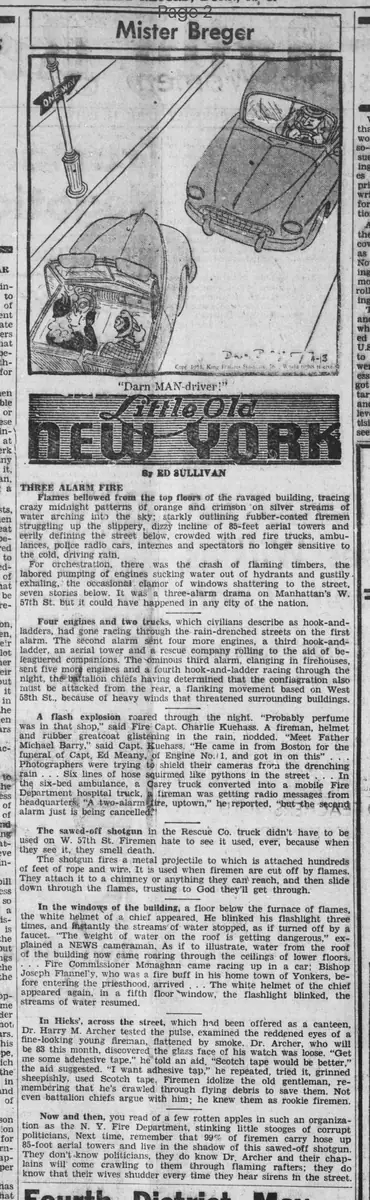
Mister Breger
"Darn man—driver!"
37 Ed Sullivan
THREE ALARM FIRE
Flames bellowed from the top floors of the ravaged building, tracing crazy midnight patterns of orange and crimson on silver streams of water arching into the sky; starkly outlining rubber-coated firemen struggling up the slippery, dizzy incline of 85-feet aerial towers and eerily defining the street below, crowded with red fire trucks, ambulances, police radio cars, internes and spectators no longer sensitive to the cold, driving rain.
For orchestration, there was the crash of flaming timbers, the labored pumping of engines sucking water out of hydrants and gustily exhaling; the occasional clamor of windows shattering to the street, seven stories below. It was a three-alarm drama on Manhattan's W. 57th St. but it could have happened in any city of the nation.
Four engines and two trucks, which civilians describe as hook-and-ladders, had gone racing through the rain-drenched streets on the first alarm. The second alarm sent four more engines, a third hook-and-ladder, an aerial tower and a rescue company rolling to the aid of beleaguered companions. The ominous third alarm, clanging in firehouses, sent five more engines and a fourth hook-and-ladder racing through the night, the battalion chiefs having determined that the conflagration also must be attacked from the rear, a flanking movement based on West 58th St., because of heavy winds that threatened surrounding buildings.
A flash explosion roared through the night. "Probably perfume was in that shop," said Fire Capt. Charlie Kuehass. A fireman, helmet and rubber greatcoat glistening in the rain, nodded. "Meet Father Michael Barry," said Capt. Kuehass. "He came in from Boston for the funeral of Capt. Ed Meany, of Engine No. 11, and got in on this" . . .
Photographers were trying to shield their cameras from the drenching rain . . . Six lines of hose squirmed like pythons in the street . . . In the six-bed ambulance, a Carey truck converted into a mobile Fire Department hospital truck, a fireman was getting radio messages from headquarters. "A two-alarm fire, uptown," he reported, "but the second alarm just is being cancelled."
The sawed-off shotgun in the Rescue Co. truck didn't have to be used on W. 57th St. Firemen hate to see it used, ever, because when they see it, they smell death.
The shotgun fires a metal projectile to which is attached hundreds of feet of rope and wire. It is used when firemen are cut off by flames. They attach it to a chimney or anything they can reach, and then slide down through the flames, trusting to God they'll get through.
In the windows of the building, a floor below the furnace of flames, the white helmet of a chief appeared. He blinked his flashlight three times, and instantly the streams of water stopped, as if turned off by a faucet. "The weight of water on the roof is getting dangerous," explained a NEWS cameraman. As if to illustrate, water from the roof of the building now came roaring through the ceilings of lower floors. . . . Fire Commissioner Monaghan came racing up in a car; Bishop Joseph Flannery, who was a fire buff in his home town of Yonkers, before entering the priesthood, arrived . . . The white helmet of the chief appeared again, in a fifth floor window, the flashlight blinked, the streams of water resumed.
In Hicks', across the street, which had been offered as a canteen, Dr. Harry M. Archer tested the pulse, examined the reddened eyes of a fine-looking young fireman, flattened by smoke. Dr. Archer, who will be 83 this month, discovered the glass face of his watch was loose. "Get me some adhesive tape," he told an aide. "Scotch tape would be better," the aide suggested. "I want adhesive tape," he repeated, tried it, grinned sheepishly, used Scotch tape. Firemen idolize the old gentleman, remembering that he's crawled through flying debris to save them. Not even battalion chiefs argue with him: he knew them as rookie firemen.
Now and then, you read of a few rotten apples in such an organization as the N. Y. Fire Department, stinking little stooges of corrupt politicians. Next time, remember that 99% of firemen carry hose up 85-foot aerial towers and live in the shadow of this sawed-off shotgun.
They don't know politicians, they do know Dr. Archer and their chaplains will come crawling to them through flaming rafters; they do know that their wives shudder every time they hear sirens in the street.
"Darn man—driver!"
37 Ed Sullivan
THREE ALARM FIRE
Flames bellowed from the top floors of the ravaged building, tracing crazy midnight patterns of orange and crimson on silver streams of water arching into the sky; starkly outlining rubber-coated firemen struggling up the slippery, dizzy incline of 85-feet aerial towers and eerily defining the street below, crowded with red fire trucks, ambulances, police radio cars, internes and spectators no longer sensitive to the cold, driving rain.
For orchestration, there was the crash of flaming timbers, the labored pumping of engines sucking water out of hydrants and gustily exhaling; the occasional clamor of windows shattering to the street, seven stories below. It was a three-alarm drama on Manhattan's W. 57th St. but it could have happened in any city of the nation.
Four engines and two trucks, which civilians describe as hook-and-ladders, had gone racing through the rain-drenched streets on the first alarm. The second alarm sent four more engines, a third hook-and-ladder, an aerial tower and a rescue company rolling to the aid of beleaguered companions. The ominous third alarm, clanging in firehouses, sent five more engines and a fourth hook-and-ladder racing through the night, the battalion chiefs having determined that the conflagration also must be attacked from the rear, a flanking movement based on West 58th St., because of heavy winds that threatened surrounding buildings.
A flash explosion roared through the night. "Probably perfume was in that shop," said Fire Capt. Charlie Kuehass. A fireman, helmet and rubber greatcoat glistening in the rain, nodded. "Meet Father Michael Barry," said Capt. Kuehass. "He came in from Boston for the funeral of Capt. Ed Meany, of Engine No. 11, and got in on this" . . .
Photographers were trying to shield their cameras from the drenching rain . . . Six lines of hose squirmed like pythons in the street . . . In the six-bed ambulance, a Carey truck converted into a mobile Fire Department hospital truck, a fireman was getting radio messages from headquarters. "A two-alarm fire, uptown," he reported, "but the second alarm just is being cancelled."
The sawed-off shotgun in the Rescue Co. truck didn't have to be used on W. 57th St. Firemen hate to see it used, ever, because when they see it, they smell death.
The shotgun fires a metal projectile to which is attached hundreds of feet of rope and wire. It is used when firemen are cut off by flames. They attach it to a chimney or anything they can reach, and then slide down through the flames, trusting to God they'll get through.
In the windows of the building, a floor below the furnace of flames, the white helmet of a chief appeared. He blinked his flashlight three times, and instantly the streams of water stopped, as if turned off by a faucet. "The weight of water on the roof is getting dangerous," explained a NEWS cameraman. As if to illustrate, water from the roof of the building now came roaring through the ceilings of lower floors. . . . Fire Commissioner Monaghan came racing up in a car; Bishop Joseph Flannery, who was a fire buff in his home town of Yonkers, before entering the priesthood, arrived . . . The white helmet of the chief appeared again, in a fifth floor window, the flashlight blinked, the streams of water resumed.
In Hicks', across the street, which had been offered as a canteen, Dr. Harry M. Archer tested the pulse, examined the reddened eyes of a fine-looking young fireman, flattened by smoke. Dr. Archer, who will be 83 this month, discovered the glass face of his watch was loose. "Get me some adhesive tape," he told an aide. "Scotch tape would be better," the aide suggested. "I want adhesive tape," he repeated, tried it, grinned sheepishly, used Scotch tape. Firemen idolize the old gentleman, remembering that he's crawled through flying debris to save them. Not even battalion chiefs argue with him: he knew them as rookie firemen.
Now and then, you read of a few rotten apples in such an organization as the N. Y. Fire Department, stinking little stooges of corrupt politicians. Next time, remember that 99% of firemen carry hose up 85-foot aerial towers and live in the shadow of this sawed-off shotgun.
They don't know politicians, they do know Dr. Archer and their chaplains will come crawling to them through flaming rafters; they do know that their wives shudder every time they hear sirens in the street.
What sub-type of article is it?
Disaster
Heroic Act
What themes does it cover?
Catastrophe
Bravery Heroism
What keywords are associated?
Three Alarm Fire
Manhattan Fire
Firefighters Bravery
Rainy Night Blaze
Rescue Operations
Fire Department Heroism
What entities or persons were involved?
Fire Capt. Charlie Kuehass
Father Michael Barry
Capt. Ed Meany
Fire Commissioner Monaghan
Bishop Joseph Flannery
Dr. Harry M. Archer
Where did it happen?
Manhattan's W. 57th St., West 58th St.
Story Details
Key Persons
Fire Capt. Charlie Kuehass
Father Michael Barry
Capt. Ed Meany
Fire Commissioner Monaghan
Bishop Joseph Flannery
Dr. Harry M. Archer
Location
Manhattan's W. 57th St., West 58th St.
Story Details
A three-alarm fire ravages a building on W. 57th St. in rain; firefighters use aerial towers, hoses, and rescue tools; explosion possibly from perfume shop; priest from Boston aids at scene; Dr. Archer treats smoke-injured fireman; highlights department's bravery and dedication.