Thank you for visiting SNEWPapers!
Sign up free
The Evening World
New York, New York County, New York
What is this article about?
The Evening World successfully advocates for opening Stuyvesant Square park in evenings, culminating in a Park Commissioners' resolution on August 21, 1888, supported by Corporation Counsel's opinion that the 1836 deed allows it without violation.
Merged-components note: These two components are a clear continuation of the same article on the opening of Stuyvesant Park, with the second picking up directly from the legal opinion in the first. Merging to form a single coherent story.
Clipping
OCR Quality
Full Text
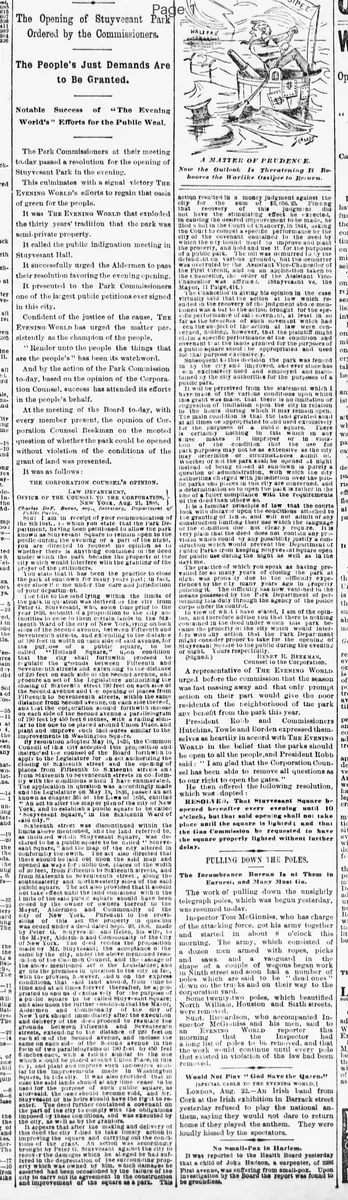
The People's Just Demands Are to Be Granted.
Notable Success of "The Evening World's" Efforts for the Public Weal.
The Park Commissioners at their meeting to-day passed a resolution for the opening of Stuyvesant Park in the evening.
This culminates with a signal victory The Evening World's efforts to regain that oasis of green for the people.
It was The Evening World that exploded the thirty years' tradition that the park was semi-private property.
It called the public indignation meeting in Stuyvesant Hall.
It successfully urged the Aldermen to pass their resolution favoring the evening opening.
It presented to the Park Commissioners one of the largest public petitions ever signed in this city.
Confident of the justice of the cause, The Evening World has urged the matter persistently as the champion of the people.
"Render unto the people the things that are the people's" has been its watchword.
And by the action of the Park Commission to-day, based on the opinion of the Corporation Counsel, success has attended its efforts in the people's behalf.
At the meeting of the Board to-day, with every member present, the opinion of Corporation Counsel Beekman on the mooted question of whether the park could be opened without violation of the conditions of the grant of land was presented.
It was as follows:
THE CORPORATION COUNSEL'S OPINION.
LAW DEPARTMENT,
OFFICE OF THE COUNSEL TO THE CORPORATION,
NEW YORK, Aug. 21, 1888.
Charles DeF. Burns, Esq., Secretary, Department of Public Parks.
Sir: I am in receipt of your communication of the 8th inst., in which you state that the Park Department, having been petitioned to allow the park known as Stuyvesant Square to remain open to the public during the evening or a part of the night, you are directed to request my opinion as to whether there is anything contained in the deed under which the park became the property of the city which would interfere with the granting of the prayer of the petitioners.
You state that it has been the practice to close the park at sundown for many years past; in fact, ever since it came under the care and jurisdiction of your department.
The title to the land lying within the limits of the park in question was derived by the city from Peter G. Stuyvesant, who, some time prior to the year 1836, submitted a proposition to the city authorities to cede to them certain lands in the Sixteenth Ward of the city of New York, lying on both sides of the Second avenue, between Fifteenth and Seventeenth streets, and extending to the distance of 100 feet in width on each side of said avenue, for the purpose of public square, to be called "Holland Square," upon condition that the city shall forthwith proceed to regulate the grounds between Fifteenth and Seventeenth streets and extending to the distance of 220 feet on each side of the Second avenue, and procure an act of the Legislature authorizing the closing of Sixteenth street 100 feet on each side of the Second avenue and the opening of places from Fifteenth to Seventeenth streets, within the same distance from Second avenue, on each side thereof, and that the corporation should forthwith inclose on each side of the Second avenue a parallelogram of 190 feet by 450 feet 6 inches, with a railing similar to the one to be placed around Union Place, and plant and improve such inclosures similar to the improvements in Washington Square.
By resolution adopted May 10, 1836, the Common Council of this city accepted this proposition and instructed the counsel of the Board forthwith to apply to the Legislature for an act authorizing the closing of Sixteenth street and the opening of places from Fifteenth to Sixteenth streets and from Sixteenth to Seventeenth streets in conformity with the Conditions which I have enumerated.
The application in question was accordingly made and the Legislature on May 18, 1836, passed an act known as chapter 361 of the Laws of 1836, entitled "An act to alter the map or plan of the city of New York, and to establish a public square to be called 'Stuyvesant Square,' in the Sixteenth Ward of said city."
Sixteenth street was discontinued within the limits above mentioned, and the land referred to, as included within Stuyvesant Square, was declared to be a public square to be called "Stuyvesant Square," and the map of the city altered in conformity therewith. The act also directed that there should be laid out upon the said map and opened as ways for public use, places of the width of 50 feet, from Fifteenth to Sixteenth streets, and from Sixteenth to Seventeenth street, along the southeasterly and northwesterly sides of the said public square. The act also provided that it should not take effect until the land contained within the limits of the said public square should have been ceded by the owner or owners thereof to the Mayor, Aldermen and Commonalty of the city of New York. Pursuant to the provisions of this act the property in question was ceded under a deed dated Sept. 20, 1836, made by Peter G. Stuyvesant and Helen, his wife, to the Mayor, Alderman and Commonalty of the City of New York. The deed recites the proposition made by Mr. Stuyvesant; the acceptance of the same by the city, under the above mentioned resolution of the Common Council, and the passage of the above mentioned act of the Legislature; and grants the premises in question to the city in fee, with the proviso, however, and upon the express conditions, that said land should, from time to time and at all times forever thereafter, be appropriated to and used exclusively for the purpose of a public square to be called Stuyvesant Square; and also upon the further condition that the Mayor, Aldermen and Commonalty of the city of New York should immediately after the execution and delivery of the deed proceed to regulate the grounds between Fifteenth and Seventeenth streets, extending to the distance of 220 feet on each side of the Second avenue, and inclose the same on each side of the Second avenue in the form of two parallelograms of 190 feet by 450 feet 6 inches each, with a railing similar to the one which should be placed around Union Place, in this city, and plant and improve such inclosures similar to the improvements made in Washington Square, in this city. It was also provided that in case the said lands should at any time cease to be used for the purpose of such public square, as aforesaid, the deed should become void, and Mr. Stuyvesant or his heirs should have the right to re-enter. The deed further contained a covenant on the part of the city to comply with the obligations imposed by these conditions, and was executed by the city, as well as by the grantors.
It appears that after the making and delivery of this deed the city failed to take timely action in improving the square and carrying out the conditions of the grant. An action was accordingly brought by Peter G. Stuyvesant against the city to recover the damages which he alleged he had suffered in the depreciation of the surrounding property which was owned by him, which damages he asserted had been occasioned by the failure of the city to carry out its agreement in the construction and improvement of the square as a park.
This action resulted in a money judgment against the city for the sum of $3,056.25.
Finding that recovery of this judgment did not have the stimulating effect be expected, in causing the desired improvement to be made, he filed a bill in the Court of Chancery, in 1844, asking the Court to compel a specific performance by the city of the covenant contained in the deed by which the city bound itself to improve and plant the property, and hold and use it for the purposes of a public park. The bill was demurred to by the defendant on various grounds, but the demurrer was overruled by the Assistant Vice-Chancellor of the First Circuit, and on an application taken to the Chancellor, the order of the Assistant Vice-Chancellor was affirmed.
(Stuyvesant vs. the Mayor, 11 Paige, 414.)
The Chancellor in giving his opinion in the case virtually held that the action at law which resulted in the recovery of the judgment above mentioned was a bar to the action brought for the specific performance of said covenant, at least in so far as the breaches of such covenant which had been the subject of the action at law were concerned, holding, however, that the plaintiff might claim a specific performance of the condition and covenant that the lands granted for the purposes of a public square should be appropriated and used for that purpose exclusively.
Subsequent to this decision the park was fenced in by the city and improved, and ever since has been exclusively used and employed and maintained by the city authorities for the purposes of a public park.
It will be perceived from the statement which I have made of the various conditions upon which this grant was made, that there is no limitation or suggestion of limitation upon the city in relation to the hours during which it may remain open.
The main condition is that the land granted shall at all times be appropriated to and used exclusively for the purposes of a public square.
There is certainly nothing in this which in any sense makes it improper or in violation of the condition that the use for park purposes may not be as extensive as the city may determine or circumstances admit of.
Whether or not the park shall be opened at night instead of being closed at sundown is purely a question of administration, with which the city authorities charged with jurisdiction over the public parks and places in this city are concerned, and a determination so to open the park is rather in the line of a fuller compliance with the requirements of the deed than otherwise.
It is a familiar principle of law that the courts look with disfavor upon the conditions attached to the granting of lands, and will not admit of any construction limiting their use which the language of the condition does not clearly require. It is very plain that the deed does not contain any provision which could by any possibility justify a construction which would prevent the Department of Public Parks from keeping Stuyvesant Square open for public use during the night as well as in the daytime.
The practice of which you speak as having prevailed for so many years of closing the park at night, was probably due to the difficulty experienced by the city many years ago in properly policing it. The difficulty has now vanished in the means possessed by the Park Department of performing this duty through the agency of the police corps under its control.
In view of what I have stated, I am of the opinion, and therefore advise you that there is nothing contained in the deed under which this park became the property of the city which would interfere with any action that the Park Department might consider proper to take for the opening of Stuyvesant Square to the public during the evening or night.
Yours respectfully,
(Signed.) HENRY R. BEEKMAN,
Counsel to the Corporation.
A representative of The Evening World urged before the commission that the season was fast passing away and that only prompt action on their part would give the poor residents of the neighborhood of the park any benefit from the park this year.
President Robb and Commissioners Hutchins, Towle and Borden expressed themselves as heartily in accord with The Evening World in the belief that the parks should be open to all the people, and President Robb said: "I am glad that the Corporation Counsel has been able to remove all questions as to our right to open the gates."
He then offered the following resolution, which was adopted:
RESOLVED, That Stuyvesant Square be opened hereafter every evening until 10 o'clock, but that said opening shall not take place until the square is lighted; and that the Gas Commission be requested to have the square properly lighted without further delay.
What sub-type of article is it?
What themes does it cover?
What keywords are associated?
What entities or persons were involved?
Where did it happen?
Story Details
Key Persons
Location
Stuyvesant Square, New York
Event Date
1888 08 21
Story Details
The Evening World campaigns for evening access to Stuyvesant Park, presents petition, and secures Park Commissioners' resolution to open until 10 PM, affirmed by Counsel Beekman's opinion on 1836 deed conditions.