Thank you for visiting SNEWPapers!
Sign up free
Editorial
July 16, 1838
Lynchburg Virginian
Lynchburg, Virginia
What is this article about?
Editorial defends Henry Clay against accusations of abolitionism from Calhoun supporters, recounting his Senate speech rejecting such charges and emphasizing union over sectionalism. It critiques Calhoun's ambitions, distinguishes gradual emancipation from radical abolition, and praises the Colonization Society as non-threatening to slavery.
Clipping
OCR Quality
98%
Excellent
Full Text
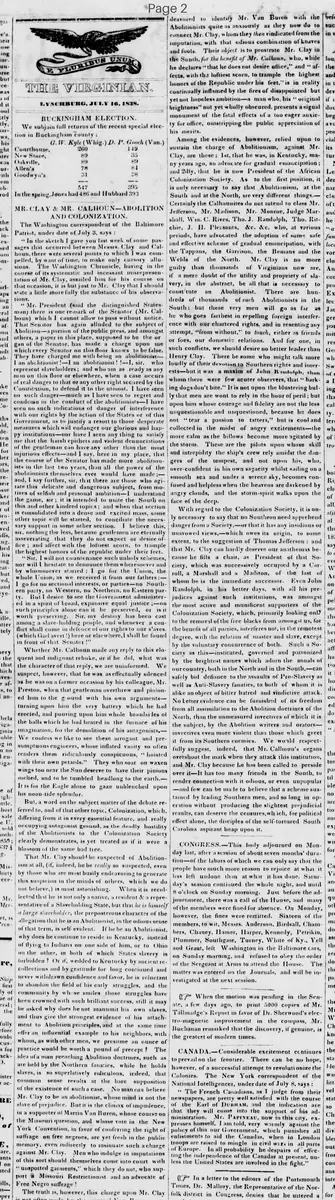
MR. CLAY & MR. CALHOUN—ABOLITION AND COLONIZATION.
The Washington correspondent of the Baltimore Patriot, under date of July 3, says:
'In the sketch I gave you last week of some passages that occurred between Messrs. Clay and Calhoun, there were several points to which I was compelled, by want of time, to make only cursory allusions. The Washington Chronicle, having in the course of its systematic and incessant misrepresentation of Mr. Clay, assailed him for his course on that occasion, it is but just to Mr. Clay that I should state a little more fully the substance of his observations.
'Mr. President (said the distinguished Statesman) there is one remark of the Senator (Mr. Calhoun) which I cannot allow to pass without notice. That Senator has again alluded to the subject of Abolition—a portion of the public press, and amongst others, a paper in this place, supposed to be the organ of the Senator, has made a charge upon me which every Senator on this floor knows to be false. They have charged me with being an abolitionist—I am abolitionist!—I am abolitionist!!—I, sir, who represent slaveholders; and who am as ready as any man on this floor or elsewhere, when a case occurs of real danger to that or any other right secured by the Constitution, to defend it to the utmost. I have seen no such danger—much as I have seen to regret and condemn in the conduct of the abolitionists—I have seen no such indications of danger of interference with our rights by the action of the States or of this Government, as to justify a resort to those desperate measures which will endanger our glorious and happy institutions—nor have I seen any thing to satisfy me that the harsh epithets and violent denunciations of the gentleman can have any other than the most injurious effects—and I say, here in my place, that the course of the Senator has made more abolitionists in the last two years, than all the power of the abolitionists themselves ever would have made;—and, I say further, sir, that there are those who agitate this delicate and dangerous subject, from motives of selfish and personal ambition—I understand the game, sir; it is intended to unite the South on this and other kindred topics; and when that section is consolidated into a dense and excited mass, some other topic will be started, to conciliate the necessary support in some other section. I believe this, sir, no less, because gentlemen are eternally asseverating that they do not expect or desire office; and affect with the loftiest scorn, to trample the highest honors of the republic under their feet.
'Sir, I will not countenance such unholy schemes, nor will I hesitate to denounce them wheresoever and by whomsoever started: I go for the Union, the whole Union, as we received it from our fathers:—I go for no sectional interests, or parties—no Southern party, no Western, no Northern, no Eastern party. But I desire to see the Government administered in a spirit of broad, expansive equal justice;—on such principles alone can it be preserved, or is it worth preserving. Sir, my destiny has been cast among a slave-holding people, and whenever a conflict shall come in defence of our rights to our slaves, (which God avert!) here or elsewhere, I shall be found in front of that Senator!'
Whether Mr. Calhoun made any reply to this eloquent and indignant rebuke, or if he did, what was the character of that reply, we are uninformed. We suspect, however, that he was as effectually silenced as he was on a former occasion by his colleague, Mr. Preston, when that gentleman overthrew and pinioned him to the ground with his own arguments—turning upon him the very battery which he had erected, and pouring upon him whole broadsides of the balls which he had heated in the furnace of his imagination, for the demolition of his antagonists.—We confess we like to see these arrogant and presumptuous engineers, whose inflated vanity so often renders them ridiculously conspicuous, "hoisted with their own petards." They who soar on waxen wings too near the Sun deserve to have their pinions melted, and to be tumbled headlong to the earth.—It is for the Eagle alone to gaze unblenched upon his noon-tide splendor.
But, a word on the subject matter of the debate referred to, and of that other topic, Colonization, which, differing from it in every essential feature, and really occupying antagonist ground, as the deadly hostility of the Abolitionists to the Colonization Society clearly demonstrates, is yet treated as if it were a blossom of the same bad tree.
That Mr. Clay should be suspected of Abolitionism at all, (if, indeed, he be really so suspected, even by those who are most busily endeavoring to generate this suspicion in the minds of others, which we do not believe,) is most astonishing. When it is recollected that he is not only a native, a resident & a representative of a Slaveholding State, but that he is himself a large slaveholder, the preposterous character of the allegation that he is an Abolitionist, in the odious sense of that term, is self-evident. If he be an Abolitionist, why does he continue to reside in Kentucky, instead of flying to Indiana on one side of him, or to Ohio on the other, in both of which States slavery is forbidden? Or if, wedded to Kentucky by ancient recollections and by gratitude for long continued and never withdrawn confidence and favor, he is reluctant to abandon the field of his early struggles, and the community by whose smiles those struggles have been crowned with such brilliant success, still it may be asked why does he not manumit his own slaves, and thus give the strongest evidence of his attachment to Abolition principles, and at the same time offer an influential example to his neighbors, with whom, as with other men, we presume an ounce of practice would be worth a pound of precept? The idea of a man preaching Abolition doctrines, such as are held by the Northern fanatics, while he holds slaves, is so superlatively ridiculous, indeed, that common sense revolts at the bare supposition of the existence of such a case. No man can believe Mr. Clay to be an abolitionist, whose mind is not the slave of prejudice. But it is the climax of impudence, in a supporter of Martin Van Buren, whose course on the Missouri question, and whose vote in the New York Convention, in favor of conferring the right of suffrage on free negroes, are yet fresh in the public memory, even indirectly to insinuate such a charge against Mr. Clay. Men who indulge in imputations of this sort should themselves come into court with "unspotted garments," which they do not, who support a Missouri Restrictionist and an advocate of Free Negro suffrage!
The truth is, however, this charge upon Mr. Clay is not often made by the original Van Buren men, but is, for the most part, confined to the new recruits, of the Calhoun school, who, twelve months ago, endeavored to identify Mr. Van Buren with the Abolitionists quite as anxiously as they now do to connect Mr. Clay, whom they then vindicated from the imputation, with that odious combination of knaves and fools. Their object is to prostrate Mr. Clay in the South, for the benefit of Mr. Calhoun, who, while he declares "that he does not desire office," and "affects, with the loftiest scorn, to trample the highest honors of the Republic under his feet," is in reality continually inflamed by the fires of disappointed but yet not hopeless ambition—a man who, his "original brightness" not yet wholly obscured, presents a signal monument of the fatal effects of a too eager anxiety for office, outstripping the public appreciation of his merits.
Among the evidences, however, relied upon to sustain the charge of Abolitionism, against Mr. Clay, are these: 1st, that he was, in Kentucky, many years ago, an advocate for gradual emancipation; and 2dly, that he is now President of the African Colonization Society. As to the first position, it is only necessary to say that Abolitionism, at the South and at the North, are very different things.—Certainly the Calhounites do not intend to class Mr. Jefferson, Mr. Madison, Mr. Monroe, Judge Marshall, Wm. C. Rives, Tho. J. Randolph, Tho. Ritchie, J. H. Pleasants, &c. &c. who, at various periods, have advocated the adoption of some safe and effective scheme of gradual emancipation, with the Tappans, the Garrisons, the Birneys and the Welds of the North. Mr. Clay is no more guilty than thousands of Virginians now are, if a mere doubt of the utility and propriety of slavery, in the abstract, be all that is necessary to constitute an Abolitionist. There are hundreds of thousands of such Abolitionists in the South: but these very men will go as far as he who goes farthest in repelling foreign interference with our chartered rights, and in resenting any attempt, "from without," to touch, either as friends or foes, our domestic relations. And for one, in such conflicts, we should desire no better leader than Henry Clay. There be some who might talk more loudly of their devotion to Southern rights and interests—but it was a maxim of John Randolph, than whom there were few acuter observers, that "barking dogs don't bite." It is not upon the blustering bully that men are wont to rely in the hour of peril; but upon him whose courage and fidelity are not the less unquestionable and unquestioned, because he does not "tear a passion to tatters," but is cool and collected in the midst of angry excitements—the more calm as the billows become more agitated by the storm. These are the pilots upon whose skill and intrepidity the ship's crew rely amidst the dangers of the tempest, and not upon his, who, over-confident in his own sagacity whilst sailing on a smooth sea and under a serene sky, becomes confused and helpless when the heavens are darkened by angry clouds, and the storm-spirit walks upon the face of the deep.
With regard to the Colonization Society, it is only necessary to say that no Southron need apprehend danger from a Society,—or that it has any insidious or unavowed views,—which owes its origin, to some extent, to the suggestion of Thomas Jefferson: and that Mr. Clay can hardly deserve our anathemas because he fills a chair, as President of that Society, which was successively occupied by a Carroll, a Marshall and a Madison, of the last of whom he is the immediate successor. Even John Randolph, in his better days, with all his prejudices against such institutions, was amongst the most active and munificent supporters of the Colonization Society, which, primarily looking only to the removal of the free blacks from amongst us, for the benefit of all parties, interferes not, in the remotest degree, with the relation of master and slave, except by the voluntary concurrence of both. Such a Society as this—instituted, governed and patronized by the brightest names which adorn the annals of our country, both in the North and in the South,—can safely bid defiance to the assaults of Pro-Slavery as well as Anti-Slavery fanatics, to both of whom it is alike an object of bitter hatred and vindictive attack. No better evidence can be furnished of its freedom from all assimilation to the Abolition doctrines of the North, than the unmeasured invectives of which it is the subject, by the Abolition writers and orators—invectives even more violent than those which greet it from its Southern enemies. We would respectfully suggest, indeed, that Mr. Calhoun's organs overshoot the mark when they attack this institution and Mr. Clay because he has been called to preside over it—It has too many friends in the South, to render connection with it odious, or even unpopular—and few can be made to believe that a scheme sustained by leading Southern men, and so long in operation without producing the slightest prejudicial results, can deserve the censures which, for political effect alone, the disciples of the self-tortured South Carolina aspirant heap upon it.
The Washington correspondent of the Baltimore Patriot, under date of July 3, says:
'In the sketch I gave you last week of some passages that occurred between Messrs. Clay and Calhoun, there were several points to which I was compelled, by want of time, to make only cursory allusions. The Washington Chronicle, having in the course of its systematic and incessant misrepresentation of Mr. Clay, assailed him for his course on that occasion, it is but just to Mr. Clay that I should state a little more fully the substance of his observations.
'Mr. President (said the distinguished Statesman) there is one remark of the Senator (Mr. Calhoun) which I cannot allow to pass without notice. That Senator has again alluded to the subject of Abolition—a portion of the public press, and amongst others, a paper in this place, supposed to be the organ of the Senator, has made a charge upon me which every Senator on this floor knows to be false. They have charged me with being an abolitionist—I am abolitionist!—I am abolitionist!!—I, sir, who represent slaveholders; and who am as ready as any man on this floor or elsewhere, when a case occurs of real danger to that or any other right secured by the Constitution, to defend it to the utmost. I have seen no such danger—much as I have seen to regret and condemn in the conduct of the abolitionists—I have seen no such indications of danger of interference with our rights by the action of the States or of this Government, as to justify a resort to those desperate measures which will endanger our glorious and happy institutions—nor have I seen any thing to satisfy me that the harsh epithets and violent denunciations of the gentleman can have any other than the most injurious effects—and I say, here in my place, that the course of the Senator has made more abolitionists in the last two years, than all the power of the abolitionists themselves ever would have made;—and, I say further, sir, that there are those who agitate this delicate and dangerous subject, from motives of selfish and personal ambition—I understand the game, sir; it is intended to unite the South on this and other kindred topics; and when that section is consolidated into a dense and excited mass, some other topic will be started, to conciliate the necessary support in some other section. I believe this, sir, no less, because gentlemen are eternally asseverating that they do not expect or desire office; and affect with the loftiest scorn, to trample the highest honors of the republic under their feet.
'Sir, I will not countenance such unholy schemes, nor will I hesitate to denounce them wheresoever and by whomsoever started: I go for the Union, the whole Union, as we received it from our fathers:—I go for no sectional interests, or parties—no Southern party, no Western, no Northern, no Eastern party. But I desire to see the Government administered in a spirit of broad, expansive equal justice;—on such principles alone can it be preserved, or is it worth preserving. Sir, my destiny has been cast among a slave-holding people, and whenever a conflict shall come in defence of our rights to our slaves, (which God avert!) here or elsewhere, I shall be found in front of that Senator!'
Whether Mr. Calhoun made any reply to this eloquent and indignant rebuke, or if he did, what was the character of that reply, we are uninformed. We suspect, however, that he was as effectually silenced as he was on a former occasion by his colleague, Mr. Preston, when that gentleman overthrew and pinioned him to the ground with his own arguments—turning upon him the very battery which he had erected, and pouring upon him whole broadsides of the balls which he had heated in the furnace of his imagination, for the demolition of his antagonists.—We confess we like to see these arrogant and presumptuous engineers, whose inflated vanity so often renders them ridiculously conspicuous, "hoisted with their own petards." They who soar on waxen wings too near the Sun deserve to have their pinions melted, and to be tumbled headlong to the earth.—It is for the Eagle alone to gaze unblenched upon his noon-tide splendor.
But, a word on the subject matter of the debate referred to, and of that other topic, Colonization, which, differing from it in every essential feature, and really occupying antagonist ground, as the deadly hostility of the Abolitionists to the Colonization Society clearly demonstrates, is yet treated as if it were a blossom of the same bad tree.
That Mr. Clay should be suspected of Abolitionism at all, (if, indeed, he be really so suspected, even by those who are most busily endeavoring to generate this suspicion in the minds of others, which we do not believe,) is most astonishing. When it is recollected that he is not only a native, a resident & a representative of a Slaveholding State, but that he is himself a large slaveholder, the preposterous character of the allegation that he is an Abolitionist, in the odious sense of that term, is self-evident. If he be an Abolitionist, why does he continue to reside in Kentucky, instead of flying to Indiana on one side of him, or to Ohio on the other, in both of which States slavery is forbidden? Or if, wedded to Kentucky by ancient recollections and by gratitude for long continued and never withdrawn confidence and favor, he is reluctant to abandon the field of his early struggles, and the community by whose smiles those struggles have been crowned with such brilliant success, still it may be asked why does he not manumit his own slaves, and thus give the strongest evidence of his attachment to Abolition principles, and at the same time offer an influential example to his neighbors, with whom, as with other men, we presume an ounce of practice would be worth a pound of precept? The idea of a man preaching Abolition doctrines, such as are held by the Northern fanatics, while he holds slaves, is so superlatively ridiculous, indeed, that common sense revolts at the bare supposition of the existence of such a case. No man can believe Mr. Clay to be an abolitionist, whose mind is not the slave of prejudice. But it is the climax of impudence, in a supporter of Martin Van Buren, whose course on the Missouri question, and whose vote in the New York Convention, in favor of conferring the right of suffrage on free negroes, are yet fresh in the public memory, even indirectly to insinuate such a charge against Mr. Clay. Men who indulge in imputations of this sort should themselves come into court with "unspotted garments," which they do not, who support a Missouri Restrictionist and an advocate of Free Negro suffrage!
The truth is, however, this charge upon Mr. Clay is not often made by the original Van Buren men, but is, for the most part, confined to the new recruits, of the Calhoun school, who, twelve months ago, endeavored to identify Mr. Van Buren with the Abolitionists quite as anxiously as they now do to connect Mr. Clay, whom they then vindicated from the imputation, with that odious combination of knaves and fools. Their object is to prostrate Mr. Clay in the South, for the benefit of Mr. Calhoun, who, while he declares "that he does not desire office," and "affects, with the loftiest scorn, to trample the highest honors of the Republic under his feet," is in reality continually inflamed by the fires of disappointed but yet not hopeless ambition—a man who, his "original brightness" not yet wholly obscured, presents a signal monument of the fatal effects of a too eager anxiety for office, outstripping the public appreciation of his merits.
Among the evidences, however, relied upon to sustain the charge of Abolitionism, against Mr. Clay, are these: 1st, that he was, in Kentucky, many years ago, an advocate for gradual emancipation; and 2dly, that he is now President of the African Colonization Society. As to the first position, it is only necessary to say that Abolitionism, at the South and at the North, are very different things.—Certainly the Calhounites do not intend to class Mr. Jefferson, Mr. Madison, Mr. Monroe, Judge Marshall, Wm. C. Rives, Tho. J. Randolph, Tho. Ritchie, J. H. Pleasants, &c. &c. who, at various periods, have advocated the adoption of some safe and effective scheme of gradual emancipation, with the Tappans, the Garrisons, the Birneys and the Welds of the North. Mr. Clay is no more guilty than thousands of Virginians now are, if a mere doubt of the utility and propriety of slavery, in the abstract, be all that is necessary to constitute an Abolitionist. There are hundreds of thousands of such Abolitionists in the South: but these very men will go as far as he who goes farthest in repelling foreign interference with our chartered rights, and in resenting any attempt, "from without," to touch, either as friends or foes, our domestic relations. And for one, in such conflicts, we should desire no better leader than Henry Clay. There be some who might talk more loudly of their devotion to Southern rights and interests—but it was a maxim of John Randolph, than whom there were few acuter observers, that "barking dogs don't bite." It is not upon the blustering bully that men are wont to rely in the hour of peril; but upon him whose courage and fidelity are not the less unquestionable and unquestioned, because he does not "tear a passion to tatters," but is cool and collected in the midst of angry excitements—the more calm as the billows become more agitated by the storm. These are the pilots upon whose skill and intrepidity the ship's crew rely amidst the dangers of the tempest, and not upon his, who, over-confident in his own sagacity whilst sailing on a smooth sea and under a serene sky, becomes confused and helpless when the heavens are darkened by angry clouds, and the storm-spirit walks upon the face of the deep.
With regard to the Colonization Society, it is only necessary to say that no Southron need apprehend danger from a Society,—or that it has any insidious or unavowed views,—which owes its origin, to some extent, to the suggestion of Thomas Jefferson: and that Mr. Clay can hardly deserve our anathemas because he fills a chair, as President of that Society, which was successively occupied by a Carroll, a Marshall and a Madison, of the last of whom he is the immediate successor. Even John Randolph, in his better days, with all his prejudices against such institutions, was amongst the most active and munificent supporters of the Colonization Society, which, primarily looking only to the removal of the free blacks from amongst us, for the benefit of all parties, interferes not, in the remotest degree, with the relation of master and slave, except by the voluntary concurrence of both. Such a Society as this—instituted, governed and patronized by the brightest names which adorn the annals of our country, both in the North and in the South,—can safely bid defiance to the assaults of Pro-Slavery as well as Anti-Slavery fanatics, to both of whom it is alike an object of bitter hatred and vindictive attack. No better evidence can be furnished of its freedom from all assimilation to the Abolition doctrines of the North, than the unmeasured invectives of which it is the subject, by the Abolition writers and orators—invectives even more violent than those which greet it from its Southern enemies. We would respectfully suggest, indeed, that Mr. Calhoun's organs overshoot the mark when they attack this institution and Mr. Clay because he has been called to preside over it—It has too many friends in the South, to render connection with it odious, or even unpopular—and few can be made to believe that a scheme sustained by leading Southern men, and so long in operation without producing the slightest prejudicial results, can deserve the censures which, for political effect alone, the disciples of the self-tortured South Carolina aspirant heap upon it.
What sub-type of article is it?
Slavery Abolition
Partisan Politics
Social Reform
What keywords are associated?
Henry Clay
John Calhoun
Abolitionism
Colonization Society
Slavery Rights
Partisan Intrigue
Gradual Emancipation
Union Preservation
What entities or persons were involved?
Henry Clay
John C. Calhoun
Martin Van Buren
Thomas Jefferson
James Madison
John Marshall
John Randolph
Editorial Details
Primary Topic
Defense Of Henry Clay Against Abolitionist Accusations In Debate With Calhoun
Stance / Tone
Strongly Pro Clay, Anti Calhoun Ambition, Supportive Of Colonization Over Radical Abolition
Key Figures
Henry Clay
John C. Calhoun
Martin Van Buren
Thomas Jefferson
James Madison
John Marshall
John Randolph
Key Arguments
Clay Rejects Abolitionist Label As False, Defends Slaveholders' Rights
Calhoun's Rhetoric Creates More Abolitionists Than It Prevents
Calhoun Agitates For Personal Ambition To Unite South
Clay Prioritizes Union Over Sectional Parties
Gradual Emancipation Differs From Northern Radical Abolition
Colonization Society Removes Free Blacks Without Interfering With Slavery
Society Supported By Southern Leaders Like Jefferson And Madison