Thank you for visiting SNEWPapers!
Sign up free
Editorial
August 28, 1801
The National Intelligencer And Washington Advertiser
Washington, District Of Columbia
What is this article about?
An essay from the Boston Telegraphe, written during John Adams' administration, argues against establishing a US naval force. It claims navies burden finances, provoke wars and colonialism, and are unnecessary for the resource-rich US, which should prioritize population growth, internal trade, and neutrality over European-style military ambitions.
Merged-components note: Sequential components on page 4 forming a single essay on naval establishments.
Clipping
OCR Quality
82%
Good
Full Text
From the Boston Telegraphe.
AN ESSAY:
ON NAVAL ESTABLISHMENTS
Particularly that of America.
In a letter to a friend, written during the administration of John Adams.
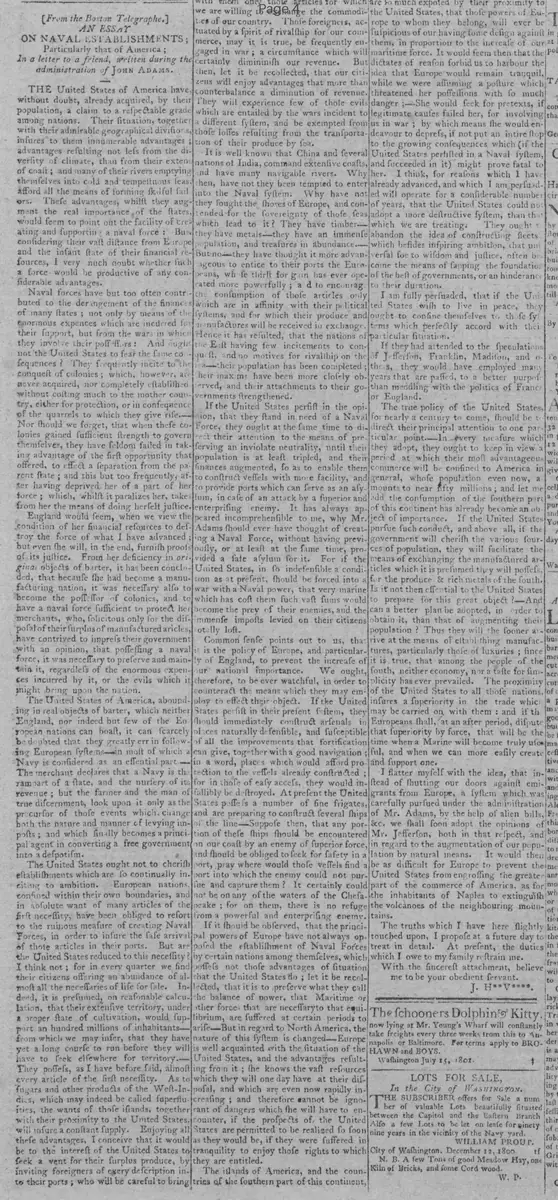
THE United States of America have, without doubt, already acquired, by their population, a claim to a respectable grade among nations. Their situation, together with their admirable geographical divisions, insures to them innumerable advantages; advantages resulting not less from the diversity of climate, than from their extent of coast; and many of their rivers emptying themselves into cold and tempestuous seas, afford all the means of forming skillful sailors. These advantages, whilst they augment the real importance of the states, would seem to point out the facility of creating and supporting a naval force: But considering their vast distance from Europe and the infant state of their financial resources, I very much doubt whether such a force would be productive of any considerable advantages.
Naval forces have but too often contributed to the derangement of the finances of many states; not only by means of the enormous expenses which are incurred for their support, but from the wars in which they involve their possessors: And ought not the United States to fear the same consequences? They frequently incite to the conquest of colonies; which, however, are never acquired, nor completely established without costing much to the mother country, either for protection, or in consequence of the quarrels to which they give rise.-- Nor should we forget, that when these colonies gained sufficient strength to govern themselves, they have seldom failed in taking advantage of the first opportunity that offered, to effect a separation from the parent state; and this but too frequently, after having deprived her of a part of her force; which, whilst it paralizes her, takes from her the means of doing herself justice.
England would seem, when we view the condition of her financial resources to destroy the force of what I have advanced; but even she will, in the end, furnish proofs of its justice. From her deficiency in original objects of barter, it has been concluded, that because she had become a manufacturing nation, it was necessary also to become the possessor of colonies, and to have a naval force sufficient to protect her merchants, who, solicitous only for the disposal of their surplus of manufactured articles, have contrived to impress their government with an opinion, that possessing a naval force, it was necessary to preserve and maintain it, regardless of the enormous expenses incurred by it, or the evils which it might bring upon the nation.
The United States of America, abounding in real objects of barter, which neither England, nor indeed but few of the European nations can boast, it can scarcely be doubted that they greatly err in following European systems--in most of which a Navy is considered as an essential part-- The merchant declares that a Navy is the rampart of a state, and the nursery of its revenue; but the farmer and the man of true discernment, look upon it only as the precursor of those events which change both the nature and manner of levying imposts; and which finally becomes a principal agent in converting a free government into a despotism.
The United States ought not to cherish establishments which are so continually inciting to ambition. European nations, confined within their own boundaries, and in absolute want of many articles of the first necessity, have been obliged to resort to the ruinous measure of creating Naval Forces, in order to insure the safe arrival of those articles in their ports. But are the United States reduced to this necessity? I think not; for in every quarter we find their citizens offering an abundance of almost all the necessaries of life for sale. Indeed, it is presumed, on reasonable calculation, that their extensive territory, under a proper state of cultivation, would support an hundred millions of inhabitants-- from which we may infer, that they have yet a long course to run before they will have to seek elsewhere for territory. They possess, as I have before said, almost every article of the first necessity. As to sugars and other products of the West-Indies, which may indeed be called superfluities, the wants of those islands, together with their proximity to the United States, will insure a constant supply. Enjoying all these advantages, I conceive that it would be to the interest of the United States to seek a vent for their surplus produce, by inviting foreigners of every description into their ports; who will be careful to bring situated by a spirit of rivalry to our commerce, may it is true, be frequently engaged in war; a circumstance which will certainly diminish our revenue. But then, let it be recollected, that our citizens will enjoy advantages that more than counterbalance a diminution of revenue. They will experience few of those evils which are entailed by the wars incident to a different system, and be exempted from those losses resulting from the transportation of their produce by sea.
It is well known that China and several nations of India, command extensive coasts, and have many navigable rivers. Why then, have not they been tempted to enter into the Naval system. Why have not they sought the shores of Europe, and contended for the sovereignty of those seas which lead to it? They have timber they have metals--they have an immense population, and treasures in abundance.-- But no--they have thought it more advantageous to entice to their ports the Europeans, whose thirst for gain has ever operated more powerfully; and to encourage the consumption of those articles only which are in affinity with their political systems, and for which their produce and manufactures will be received in exchange. Hence it has resulted, that the nations of the East having few incitements to conquest, and no motives for rivalry on the sea--their population has been completed; their laws have been more closely observed, and their attachments to their governments strengthened.
If the United States persist in the opinion, that they stand in need of a Naval Force, they ought at the same time to direct their attention to the means of preserving an inviolate neutrality, until their population is at least tripled, and their finances augmented, so as to enable them to construct vessels with more facility, and to provide ports which can serve as an asylum, in case of an attack by a superior and enterprising enemy. It has always appeared incomprehensible to me, why Mr. Adams should ever have thought of creating a Naval Force, without having previously, or at least at the same time, provided a safe asylum for it. For if the United States, in so indefensible a condition as at present, should be forced into a war with a Naval power, that very marine which has cost them such vast sums would become the prey of their enemies, and the immense imposts levied on their citizens totally lost.
Common sense points out to us, that it is the policy of Europe, and particularly of England, to prevent the increase of our national importance. We ought, therefore, to be ever watchful, in order to counteract the means which they may employ to effect their object. If the United States persist in their present system, they should immediately construct arsenals in places naturally defensible, and susceptible of all the improvements that fortification can give, together with a good navigation; in a word, places which would afford protection to the vessels already constructed; for in those of easy access, they would infallibly be destroyed. At present the United States possess a number of fine frigates, and are preparing to construct several Ships of the line--Suppose then, that any portion of these ships should be encountered on our coast by an enemy of superior force, and should be obliged to seek for safety in a port, pray where would those vessels find a port into which the enemy could not pursue and capture them? It certainly could not be on any of the waters of the Chesapeake; for on them, there is no refuge from a powerful and enterprising enemy.
If it should be observed, that the principal powers of Europe have not always opposed the establishment of Naval Forces by certain nations among themselves, which possess not those advantages of situation that the United States do; let it be recollected, that it is to preserve what they call the balance of power, that Maritime or other forces that are necessary to that equilibrium, are suffered at certain periods to arise--But in regard to North America, the nature of this system is changed--Europe is well acquainted with the situation of the United States, and the advantages resulting from it; he knows the vast resources which they will one day have at their disposal, and which are even now rapidly increasing; and therefore cannot be ignorant of dangers which he will have to encounter, if the prospects of, the United States are permitted to be realized so soon as they would be, if they were suffered in tranquility to enjoy those rights to which they are entitled.
The islands of America, and the countries of the southern part of this continent,
suspicious of our having some design against dictates of reason forbid us to harbour the idea that Europe would remain tranquil, while we were assuming a posture which threatened her possessions with so much danger--She would seek for pretexts, if legitimate causes failed her, for involving us in war; by which means she would endeavour to depress, if not put an entire stop to the growing consequences which (if the United States persisted in a Naval system, and succeeded in it) might prove fatal to her. I think, for reasons which I have already advanced, and which I am persuaded will operate for a considerable number of years, that the United States could not adopt a more destructive system, than that which we are treating: They ought abandon the idea of constructing fleets which besides inspiring ambition, that universal foe to wisdom and justice, often become the means of sapping the foundation, of the best of governments, or an hindrance to their duration.
I am fully persuaded, that if the United States wish to live in peace, they ought to confine themselves to. the systems which perfectly accord with their particular situation. If they had attended to the speculations of Jefferson, Franklin, Madison, and others, they would have employed many years that are passed, to a better purpose than meddling with the politics of France or England.
The true policy of the United States. for nearly a century to come, should be to direct their principal attention to one particular point. In every measure which they adopt, they ought to keep in view a period at which their most advantageous commerce will be confined to America in general, whose population even now, amounts to near fifty millions; and let me add the consumption of the southern part of this continent has already become an object of importance. If the United States pursue such conduct, and above all, if the government will cherish the various sources of population, they will facilitate the means of exchanging the manufactured articles which it is presumed they will possess. for the produce & rich metals of the south.
Is it not then essential to the United States to prepare for this great object? And can a better plan be adopted, in order to obtain it, than that of augmenting their population? Thus they will the sooner arrive at the means of establishing manufactures, particularly those of luxuries; since it is true, that among the people of the south, neither economy, nor a taste for simplicity has ever prevailed. The proximity of the United States to all those nations. insures a superiority in the trade which may be carried on with them: and if the Europeans shall, at an after period, dispute that superiority by force, that will be the time when a Marine will become truly useful, and when we can more easily create and support one.
I flatter myself with the idea, that instead of shutting our doors against emigrants from Europe, a system which was carefully pursued under the administration of Mr. Adams, by the help of alien bills, &c. we shall soon adopt the opinions of Mr. Jefferson, both in that respect, and in regard to the augmentation of our population by natural means. It would then be as difficult for Europe to prevent the United States from engrossing the greater part of the commerce of America, as for the inhabitants of Naples to extinguish the volcanoes of the neighbouring mountains.
The truths which I have here slightly touched upon, I propose at a future day to treat in detail. At present, the duties which I owe to my family restrain me.
With the sincerest attachment, believe me to be your obedient servant.
J. H**V****.
AN ESSAY:
ON NAVAL ESTABLISHMENTS
Particularly that of America.
In a letter to a friend, written during the administration of John Adams.
THE United States of America have, without doubt, already acquired, by their population, a claim to a respectable grade among nations. Their situation, together with their admirable geographical divisions, insures to them innumerable advantages; advantages resulting not less from the diversity of climate, than from their extent of coast; and many of their rivers emptying themselves into cold and tempestuous seas, afford all the means of forming skillful sailors. These advantages, whilst they augment the real importance of the states, would seem to point out the facility of creating and supporting a naval force: But considering their vast distance from Europe and the infant state of their financial resources, I very much doubt whether such a force would be productive of any considerable advantages.
Naval forces have but too often contributed to the derangement of the finances of many states; not only by means of the enormous expenses which are incurred for their support, but from the wars in which they involve their possessors: And ought not the United States to fear the same consequences? They frequently incite to the conquest of colonies; which, however, are never acquired, nor completely established without costing much to the mother country, either for protection, or in consequence of the quarrels to which they give rise.-- Nor should we forget, that when these colonies gained sufficient strength to govern themselves, they have seldom failed in taking advantage of the first opportunity that offered, to effect a separation from the parent state; and this but too frequently, after having deprived her of a part of her force; which, whilst it paralizes her, takes from her the means of doing herself justice.
England would seem, when we view the condition of her financial resources to destroy the force of what I have advanced; but even she will, in the end, furnish proofs of its justice. From her deficiency in original objects of barter, it has been concluded, that because she had become a manufacturing nation, it was necessary also to become the possessor of colonies, and to have a naval force sufficient to protect her merchants, who, solicitous only for the disposal of their surplus of manufactured articles, have contrived to impress their government with an opinion, that possessing a naval force, it was necessary to preserve and maintain it, regardless of the enormous expenses incurred by it, or the evils which it might bring upon the nation.
The United States of America, abounding in real objects of barter, which neither England, nor indeed but few of the European nations can boast, it can scarcely be doubted that they greatly err in following European systems--in most of which a Navy is considered as an essential part-- The merchant declares that a Navy is the rampart of a state, and the nursery of its revenue; but the farmer and the man of true discernment, look upon it only as the precursor of those events which change both the nature and manner of levying imposts; and which finally becomes a principal agent in converting a free government into a despotism.
The United States ought not to cherish establishments which are so continually inciting to ambition. European nations, confined within their own boundaries, and in absolute want of many articles of the first necessity, have been obliged to resort to the ruinous measure of creating Naval Forces, in order to insure the safe arrival of those articles in their ports. But are the United States reduced to this necessity? I think not; for in every quarter we find their citizens offering an abundance of almost all the necessaries of life for sale. Indeed, it is presumed, on reasonable calculation, that their extensive territory, under a proper state of cultivation, would support an hundred millions of inhabitants-- from which we may infer, that they have yet a long course to run before they will have to seek elsewhere for territory. They possess, as I have before said, almost every article of the first necessity. As to sugars and other products of the West-Indies, which may indeed be called superfluities, the wants of those islands, together with their proximity to the United States, will insure a constant supply. Enjoying all these advantages, I conceive that it would be to the interest of the United States to seek a vent for their surplus produce, by inviting foreigners of every description into their ports; who will be careful to bring situated by a spirit of rivalry to our commerce, may it is true, be frequently engaged in war; a circumstance which will certainly diminish our revenue. But then, let it be recollected, that our citizens will enjoy advantages that more than counterbalance a diminution of revenue. They will experience few of those evils which are entailed by the wars incident to a different system, and be exempted from those losses resulting from the transportation of their produce by sea.
It is well known that China and several nations of India, command extensive coasts, and have many navigable rivers. Why then, have not they been tempted to enter into the Naval system. Why have not they sought the shores of Europe, and contended for the sovereignty of those seas which lead to it? They have timber they have metals--they have an immense population, and treasures in abundance.-- But no--they have thought it more advantageous to entice to their ports the Europeans, whose thirst for gain has ever operated more powerfully; and to encourage the consumption of those articles only which are in affinity with their political systems, and for which their produce and manufactures will be received in exchange. Hence it has resulted, that the nations of the East having few incitements to conquest, and no motives for rivalry on the sea--their population has been completed; their laws have been more closely observed, and their attachments to their governments strengthened.
If the United States persist in the opinion, that they stand in need of a Naval Force, they ought at the same time to direct their attention to the means of preserving an inviolate neutrality, until their population is at least tripled, and their finances augmented, so as to enable them to construct vessels with more facility, and to provide ports which can serve as an asylum, in case of an attack by a superior and enterprising enemy. It has always appeared incomprehensible to me, why Mr. Adams should ever have thought of creating a Naval Force, without having previously, or at least at the same time, provided a safe asylum for it. For if the United States, in so indefensible a condition as at present, should be forced into a war with a Naval power, that very marine which has cost them such vast sums would become the prey of their enemies, and the immense imposts levied on their citizens totally lost.
Common sense points out to us, that it is the policy of Europe, and particularly of England, to prevent the increase of our national importance. We ought, therefore, to be ever watchful, in order to counteract the means which they may employ to effect their object. If the United States persist in their present system, they should immediately construct arsenals in places naturally defensible, and susceptible of all the improvements that fortification can give, together with a good navigation; in a word, places which would afford protection to the vessels already constructed; for in those of easy access, they would infallibly be destroyed. At present the United States possess a number of fine frigates, and are preparing to construct several Ships of the line--Suppose then, that any portion of these ships should be encountered on our coast by an enemy of superior force, and should be obliged to seek for safety in a port, pray where would those vessels find a port into which the enemy could not pursue and capture them? It certainly could not be on any of the waters of the Chesapeake; for on them, there is no refuge from a powerful and enterprising enemy.
If it should be observed, that the principal powers of Europe have not always opposed the establishment of Naval Forces by certain nations among themselves, which possess not those advantages of situation that the United States do; let it be recollected, that it is to preserve what they call the balance of power, that Maritime or other forces that are necessary to that equilibrium, are suffered at certain periods to arise--But in regard to North America, the nature of this system is changed--Europe is well acquainted with the situation of the United States, and the advantages resulting from it; he knows the vast resources which they will one day have at their disposal, and which are even now rapidly increasing; and therefore cannot be ignorant of dangers which he will have to encounter, if the prospects of, the United States are permitted to be realized so soon as they would be, if they were suffered in tranquility to enjoy those rights to which they are entitled.
The islands of America, and the countries of the southern part of this continent,
suspicious of our having some design against dictates of reason forbid us to harbour the idea that Europe would remain tranquil, while we were assuming a posture which threatened her possessions with so much danger--She would seek for pretexts, if legitimate causes failed her, for involving us in war; by which means she would endeavour to depress, if not put an entire stop to the growing consequences which (if the United States persisted in a Naval system, and succeeded in it) might prove fatal to her. I think, for reasons which I have already advanced, and which I am persuaded will operate for a considerable number of years, that the United States could not adopt a more destructive system, than that which we are treating: They ought abandon the idea of constructing fleets which besides inspiring ambition, that universal foe to wisdom and justice, often become the means of sapping the foundation, of the best of governments, or an hindrance to their duration.
I am fully persuaded, that if the United States wish to live in peace, they ought to confine themselves to. the systems which perfectly accord with their particular situation. If they had attended to the speculations of Jefferson, Franklin, Madison, and others, they would have employed many years that are passed, to a better purpose than meddling with the politics of France or England.
The true policy of the United States. for nearly a century to come, should be to direct their principal attention to one particular point. In every measure which they adopt, they ought to keep in view a period at which their most advantageous commerce will be confined to America in general, whose population even now, amounts to near fifty millions; and let me add the consumption of the southern part of this continent has already become an object of importance. If the United States pursue such conduct, and above all, if the government will cherish the various sources of population, they will facilitate the means of exchanging the manufactured articles which it is presumed they will possess. for the produce & rich metals of the south.
Is it not then essential to the United States to prepare for this great object? And can a better plan be adopted, in order to obtain it, than that of augmenting their population? Thus they will the sooner arrive at the means of establishing manufactures, particularly those of luxuries; since it is true, that among the people of the south, neither economy, nor a taste for simplicity has ever prevailed. The proximity of the United States to all those nations. insures a superiority in the trade which may be carried on with them: and if the Europeans shall, at an after period, dispute that superiority by force, that will be the time when a Marine will become truly useful, and when we can more easily create and support one.
I flatter myself with the idea, that instead of shutting our doors against emigrants from Europe, a system which was carefully pursued under the administration of Mr. Adams, by the help of alien bills, &c. we shall soon adopt the opinions of Mr. Jefferson, both in that respect, and in regard to the augmentation of our population by natural means. It would then be as difficult for Europe to prevent the United States from engrossing the greater part of the commerce of America, as for the inhabitants of Naples to extinguish the volcanoes of the neighbouring mountains.
The truths which I have here slightly touched upon, I propose at a future day to treat in detail. At present, the duties which I owe to my family restrain me.
With the sincerest attachment, believe me to be your obedient servant.
J. H**V****.
What sub-type of article is it?
Military Affairs
Economic Policy
Foreign Affairs
What keywords are associated?
Naval Establishments
Us Navy
John Adams Administration
Neutrality
Economic Policy
Foreign Trade
Population Growth
European Systems
What entities or persons were involved?
John Adams
Thomas Jefferson
Benjamin Franklin
James Madison
England
Europe
United States
Editorial Details
Primary Topic
Opposition To Us Naval Establishments
Stance / Tone
Critical Of Naval Forces, Advocating Neutrality And Internal Development
Key Figures
John Adams
Thomas Jefferson
Benjamin Franklin
James Madison
England
Europe
United States
Key Arguments
Naval Forces Derange Finances Through High Costs And Wars
Us Natural Resources And Geography Make Navy Unnecessary
Navies Incite Colonialism And Lead To Separation Of Colonies
England's Navy Will Ultimately Prove Burdensome
Us Should Invite Foreign Trade Rather Than Build Fleets
Focus On Population Growth And American Commerce
Neutrality Until Stronger, With Proper Defenses If Navy Pursued
Critique Of Adams' Naval Policy Without Safe Ports