Thank you for visiting SNEWPapers!
Sign up free
Literary Cadet And Rhode Island Statesman
Providence, Providence County, Rhode Island
What is this article about?
Biographical sketch of French actress Mademoiselle Clarion (1722-1803), her rise from humble beginnings to Parisian stardom, acclaimed acting style, theater dispute causing retirement, and virtuous life admired by Voltaire and Garrick.
Merged-components note: Continuation of the story about the French actress Clarion across adjacent columns on page 1.
Clipping
OCR Quality
Full Text
The annexed communication, which is from the pen of an unknown female correspondent, contains much that will agreeably entertain all who may read it. The writer, has laid no small tax upon us, by requesting us to afford her some "information dramatique," connected with the French Stage; but as we are very much disposed to appear to be as intelligent as she supposes us, we will, as soon as we have copied her article, endeavour to gratify her wishes. And where, in the four quarters of the world, can there be found a man, who will not rejoice, in having an opportunity to labor for "Heaven's first best gift, woman-lovely woman?" But lest we become too gallant, and say too many civil things, we lay before our readers the communication of our fair correspondent.
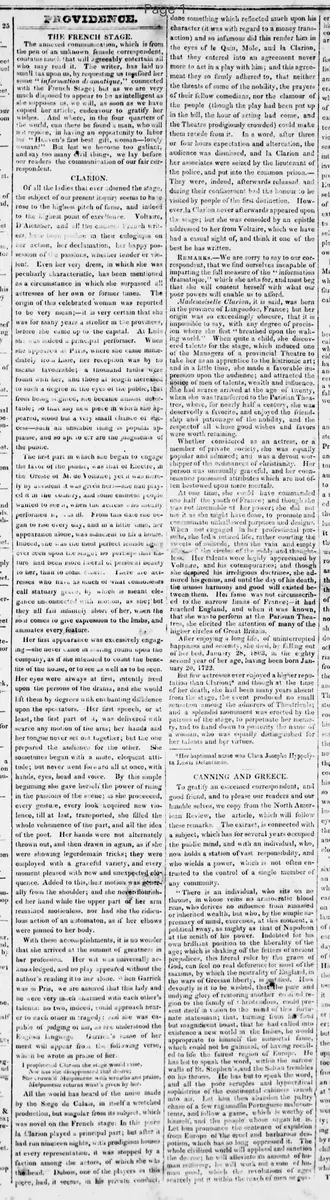
CLARION.
Of all the ladies that ever adorned the stage, the subject of our present inquiry seems to have rose to the highest pitch of fame, and indeed to the highest point of excellence. Voltaire, D'Alembert, and all the eminent French writers, have been profuse in their eulogiums on her action, her declamation, her happy possession of the passions, whether tender or violent. Even her very dress, in which she was peculiarly characteristic, has been mentioned as a circumstance in which she surpassed all actresses of her own or former times.
The origin of this celebrated woman was reported to be very mean;-it is very certain that she was for many years a stroller in the provinces, before she came up to the capital. At Lisle she was indeed a principal performer. When she appeared at Paris, where she came immediately from Lisle, her reception was by no means favourable; a thousand faults were found with her, and those at length increased to such a degree in the eyes of the public, that from being slighted, she became almost detestable; so that any new piece in which she appeared, stood but a very small chance of success--such an unstable thing is popular applause, and so apt to err are the judgments of the public.
The first part in which she began to engage the favor of the public, was that of Electra, in the Orestes of M. de Voltaire; yet it was merely by accident it was given her:-she had played it in the country, and some eminent people wanted to see it, when the actress who usually performed it, was ill. From this date she began to rise every day, and in a little time, her appearance alone, was sufficient to fill a house. Indeed, she was the most perfect female figure ever seen upon the stage; no perhaps that nature had been more liberal in personal beauty to her, than to some others. There are actresses who have as much of what connoisseurs call statuary grace, by which is meant elegance unconnected with motion, as she; but they all fail entirely short of her, when the soul comes to give expression to the limbs, and animates every feature.
Her first appearance was excessively engaging-she never came in standing round upon the company, as if she intended to count the benches of the house, or to see as well as to be seen. Her eyes were always at first, intently fixed upon the persons of the drama, and she would lift them by degrees with enchanting diffidence upon the spectators. -Her first speech, or at least, the first part of it, was delivered with scarce any motion of the arm; her hands and her tongue never set out together; but the one prepared the audience for the other. She sometimes began with a mute, eloquent attitude; but never went forward all at once, with hands, eyes, head and voice. By this simple beginning she gave herself the power of rising in the passions of the scene; as she proceeded, every gesture, every look acquired new violence, till at last, transported, she filled the whole vehemence of the part, and all the idea of the poet. Her hands were not alternately thrown out, and then drawn in again, as if she were showing legerdemain tricks; they were employed with a graceful variety, and every moment pleased with new and unexpected eloquence. Added to this, her motion was generally from the shoulder; and she never flourished her hand while the upper part of her arm remained motionless, nor had she the ridiculous action of an automaton, as if her elbows were pinned to her body.
With these accomplishments, it is no wonder that she arrived at the summit of greatness in her profession. Her wit was universally acknowledged, and no play appeared without the author's reading it to her alone. When Garrick was in Paris, we are assured that this lady and he were very much charmed with each other's talents: no two, indeed, could approach nearer to each other in tragedy: and she was capable of judging of this, as she understood the English language
Garrick's sense of her merit will appear from the following verse, which he wrote in praise of her.
I prophesied Clarion the stage would raise,
Nor has she disappointed that desire;
She crown'd Melpomene with wreaths and praise,
Melpomene returns what's given by her.
All the world has heard of the noise made by the Siege de Calais, in itself a wretched production, but singular from its subject, which was novel on the French stage: In this piece la Clarion played a principal part; but after it had run nineteen nights, with prodigious houses at every representation, it was stopped by a faction among the actors, of which she was the head. Dubois, one of the players in this piece, had, it seems, in his private conduct,
done something which reflected much upon his character (it was with regard to a money transaction) and so infamous did this render him in the eyes of le Quin, Mole, and la Clarion, that they entered into an agreement never more to act in a play with him; and this agreement they so firmly adhered to, that neither the threats of some of the nobility, the prayers of their fellow comedians, nor the clamour of the people (though the play had been put up in the bill, the hour of acting had come, and the Theatre prodigiously crowded) could make them recede from it. In a word, after three or four hours expectation and altercation, the audience was dismissed. and la Clarion and her associates were seized by the lieutenant of the police, and put into the common prison.- They were, indeed, afterwards released and during their confinement had the honour to be visited by people of the first distinction. However, la Clarion never afterwards appeared upon the stage; but she was consoled by an epistle addressed to her from Voltaire, which we have had a casual sight of, and think it one of the best he has written.
Remarks.-We are sorry to say to our correspondent, that we find ourselves incapable of imparting the full measure of the "information dramatique," which she asks for, and must beg that she will content herself with what our poor powers will enable us to afford.
Mademoiselle Clarion, it is said, was born in the province of Languedoc, France; but her origin was so exceedingly obscure, that it is impossible to say, with any degree of precision where she first "breathed upon the waking world." When quite a child, she discovered talents for the stage, which induced one of the Managers of a provincial Theatre to take her as an apprentice to the histrionic art: and in a little time, she made a favorable impression upon the audience; and attracted the notice of men of talents, wealth and influence. She had scarce arrived at the age of twenty, when she was transferred to the Parisian Theatres, where, for nearly half a century, she was deservedly a favorite, and enjoyed the friendship and patronage of the nobility, and the respect of all whose good wishes and favors were worth retaining.
Whether considered as an actress, or a member of private society, she was equally popular and admired; and was a devout worshiper of the ordinances of christianity. Her person was unusually graceful, and her countenance possessed attributes which are not often bestowed upon mere mortals.
At one time, she could have commanded one half the youth of France; and though she was not insensible of her power; she did not use it as she might have done, to promote and consummate unhallowed purposes and designs.
When not engaged in her professional pursuits, she led a retired life, rather courting the sweets of solitude, than the vain and empty pleasures of the circles of the giddy and thoughtless. Her talents were highly appreciated by Voltaire, and his cotemporaries; and though she despised his irreligious doctrines, she admired his genius, and until the day of his death, the utmost harmony and good will existed between them. Her fame was not circumscribed to the narrow limits of France;-it had reached England, and when it was known, that she was to perform at the Parisian Theatres, she elicited the attention of many of the higher circles of Great Britain.
After enjoying a long life, of uninterrupted happiness and serenity, she died, by falling out of her bed, January 28, 1803, in the eighty second year of her age, having been born January 20, 1722.
But few actresses ever enjoyed a higher reputation than Clarion;* and though at the time of her death, she had been many years absent from the stage, the event produced no small sensation among the admirers of Theatricals: and a splendid monument was erected by the patrons of the stage, to perpetuate her memory, and to hand down to posterity the name of a woman, who was equally distinguished for her talents and her virtues.
*Her baptismal name was Clara Josephe Hippolyte Léris de la Tude.
What sub-type of article is it?
What themes does it cover?
What keywords are associated?
What entities or persons were involved?
Where did it happen?
Story Details
Key Persons
Location
Paris, France; Lisle; Languedoc, France
Event Date
Born January 20, 1722; Died January 28, 1803
Story Details
Mademoiselle Clarion rose from obscure origins in Languedoc to provincial acting in Lisle, faced initial rejection in Paris but gained fame through her role as Electra in Voltaire's Orestes, praised for her natural acting, beauty, and grace; involved in a theater faction dispute over the Siege de Calais leading to her imprisonment and retirement; lived virtuously, admired by Voltaire and Garrick, died at age 82.