Thank you for visiting SNEWPapers!
Sign up free
The Enquirer
Richmond, Henrico County, Virginia
What is this article about?
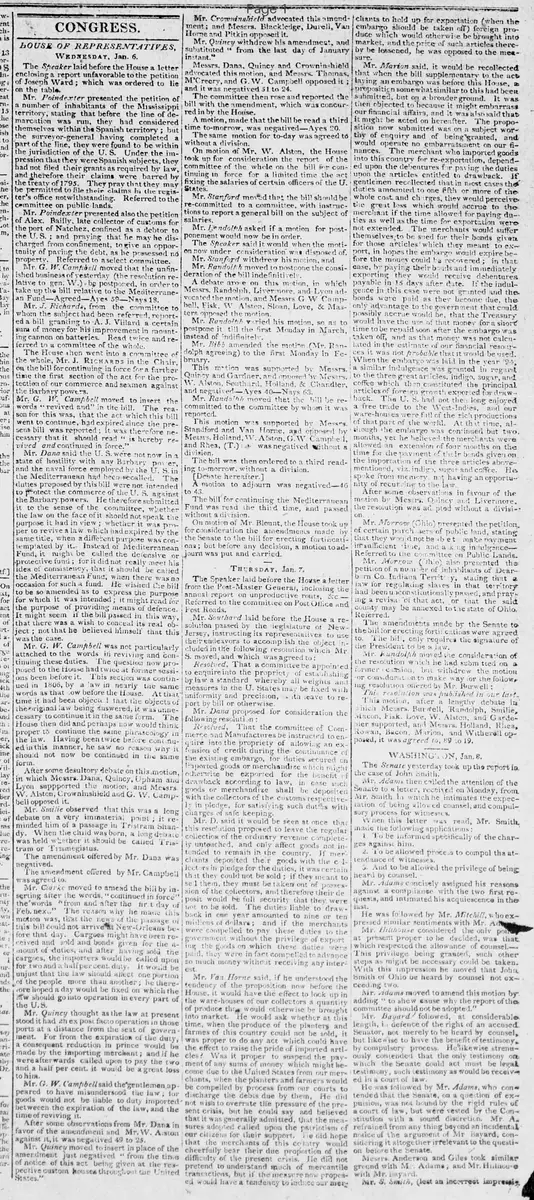
Detailed report of U.S. House of Representatives proceedings on January 6 and 7, 1808, covering petitions from Mississippi territory and Natchez, debates on reviving the Mediterranean Fund duties, salaries bill, and resolutions on weights/measures and embargo duties; Senate proceedings on January 8 regarding John Smith's expulsion case, granting him counsel.
Merged-components note: These components form a continuous report on congressional proceedings, spanning multiple columns on page 1 and continuing to page 2.
Clippings
1 of 2
OCR Quality
Full Text
HOUSE OF REPRESENTATIVES,
Wednesday, Jan. 6.
The Speaker laid before the House a letter enclosing a report unfavorable to the petition of Joseph Ward; which was ordered to lie on the table.
Mr. Poindexter presented the petition of a number of inhabitants of the Mississippi territory, stating that before the line of demarcation was run, they had considered themselves within the Spanish territory; but the surveyor-general having completed a part of the line, they were found to be within the jurisdiction of the U. S. Under the impression that they were Spanish subjects, they had not filed their grants as required by law, and therefore their claims were barred by the treaty of 1795. They pray that they may be permitted to file their claims in the register's office notwithstanding.
Referred to the committee on public lands.
Mr. Poindexter presented also the petition of Alex. Bailly, late collector of customs for the port of Natchez, confined as a debtor to the U.S.: and praying that he may be discharged from confinement, to give an opportunity of paying the debt, as he possessed no property. Referred to a select committee.
Mr. G. W. Campbell moved that the unfinished business of yesterday (the resolution relative to gen. W.) be postponed, in order to take up the bill relative to the Mediterranean Fund—Agreed—Ayes 59—Nays 18.
Mr. J. Richards, from the committee to whom the subject had been referred, reported a bill granting to A.J. Villard a certain sum of money for his improvement in mounting cannon on batteries. Read twice and referred to a committee of the whole.
The House then went into a committee of the whole, Mr. J. Richards in the Chair, on the bill for continuing in force for a further time the first section of the act for the protection of our commerce and seamen against the Barbary powers.
Mr. G. W. Campbell moved to insert the words "revived and" in the bill. The reason for this was, that the act which this bill went to continue, had expired since the present bill was reported; it was therefore necessary that it should read "is hereby revived and continued in force."
Mr. Dana said the U. S. were not now in a state of hostility with any Barbary power, and the naval force employed by the U. S. in the Mediterranean had been recalled. The duties proposed by this bill were not intended to protect the commerce of the U. S. against the Barbary powers. He therefore submitted it to the sense of the committee, whether the law on the face of it should not speak the purpose it had in view; whether it was proper to revive a law which had expired by the same title, when a different purpose was contemplated by it.—Instead of Mediterranean Fund, it might be called the defensive or protective fund; for it did not really meet his idea of consistency, that it should be called the Mediterranean Fund, when there was no occasion for such a fund. He wished the bill to be so amended as to express the purpose for which it was intended; it might read for the purpose of providing means of defence.
It might seem if the bill passed in this way, that there was a wish to conceal its real object; not that he believed himself that this was the case.
Mr. G. W. Campbell was not particularly attached to the words in reviving and continuing these duties. The question now proposed to the House had twice at former sessions been before it. This section was continued in 1806, by a law in nearly the same words as that now before the House. At that time it had been objected that the objects of the original law being answered, it was unnecessary to continue it in the same form. The House then did and perhaps now would think proper to continue the same phraseology in the law. Having been twice before continued in this manner, he saw no reason why it should not now be continued in the same form.
After some desultory debate on this motion, in which Messrs. Dana, Quincy, Upham and Lyon supported the motion, and Messrs. W. Alston, Crowninshield and G. W. Campbell opposed it.
Mr. Smilie observed that this was a long debate on a very immaterial point; it reminded him of a passage in Tristram Shandy. When the child was born, a long debate was held whether it should be called Tristram or Trismegistus.
The amendment offered by Mr. Dana was negatived.
The amendment offered by Mr. Campbell was agreed to.
Mr. Clarke moved to amend the bill by inserting after the words, "continued in force" the words "from and after the first day of Feb. next."
The reason why he made this motion was, that the news of the passage of this bill could not arrive at New-Orleans before that day. Cargoes might have been received and sold and bonds given for the amount of duties, and after having sold the cargoes, the importers would be called upon for two and a half per cent. duty. It would be unjust that the law should affect one portion of the people more than another; he therefore hoped a day would be fixed on which the law should go into operation in every part of the U.S.
Mr. Quincy thought as the law at present stood it had an ex post facto operation in those ports at a distance from the seat of government. For from the expiration of the duty, a consequent reduction in price would be made by the importing merchant; and if he were afterwards called upon to pay the two and a half per cent. it would be a great loss to him.
Mr. G. W. Campbell said the gentlemen appeared to have misunderstood the law; for goods would not be liable to duty imported between the expiration of the law, and the time of reviving it.
After some observations from Mr. Dana in favor of the amendment and Mr. W. Alston against it, it was negatived 49 to 25.
Mr. Quincy moved to insert in place of the amendment just negatived "from the time of notice of this act being given at the respective custom houses throughout the United States."
Mr. Crowninshield advocated this amendment; and Messrs. Blackledge, Durell, Van Horne and Pitkin opposed it.
Mr. Quincy withdrew his amendment, and substituted "from the last day of January instant."
Messrs. Dana, Quincy and Crowninshield advocated this motion, and Messrs. Thomas, M'Creery, and G. W. Campbell opposed it; and it was negatived 51 to 24.
The committee then rose and reported the bill with the amendment, which was concurred in by the House.
A motion, made that the bill be read a third time to-morrow, was negatived—Ayes 20.
The same motion for to-day was agreed to without a division.
On motion of Mr. W. Alston, the House took up for consideration the report of the committee of the whole on the bill for continuing in force for a limited time the act fixing the salaries of certain officers of the U. States.
Mr. Stanford moved that the bill should be re-committed to a committee, with instructions to report a general bill on the subject of salaries.
Mr. Randolph asked if a motion for postponement would now be in order.
The Speaker said it would when the motion now under consideration was disposed of.
Mr. Stanford withdrew his motion, and Mr. Randolph moved to postpone the consideration of the bill indefinitely.
A debate arose on this motion, in which Messrs. Randolph, Livermore, and Lyon advocated the motion, and Messrs. G. W. Campbell, Fisk, W. Alston, Sloan, Love, & Masters opposed the motion.
Mr. Randolph varied his motion, so as to postpone it till the first Monday in March, instead of indefinitely.
Mr. Bibb amended the motion (Mr. Randolph agreeing) to the first Monday in February.
This motion was supported by Messrs. Quincy and Gardner, and opposed by Messrs. W. Alston, Southard, Holland, & Chandler, and negatived—Ayes 40—Nays 63.
Mr. Randolph moved that the bill be re-committed to the committee by whom it was reported.
This motion was supported by Messrs. Stanford and Van Horne, and opposed by Messrs. Holland, W. Alston, G. W. Campbell, and Rhea, it was negatived without a division.
The bill was then ordered to a third reading to-morrow, without a division.
[Debate hereafter.]
A motion to adjourn was negatived—46 to 43.
The bill for continuing the Mediterranean Fund was read the third time, and passed without a division.
On motion of Mr. Blount, the House took up for consideration the amendments made by the Senate to the bill for erecting fortifications; but before any decision, a motion to adjourn was put and carried.
Thursday, Jan. 7.
The Speaker laid before the House a letter from the Post-Master General, enclosing the annual report on unproductive routes, &c.—Referred to the committee on Post Office and Post Roads.
Mr. Southard laid before the House a resolution passed by the legislature of New-Jersey, instructing its representatives to use their endeavors to accomplish the object included in the following resolution which Mr. S. moved, and which was agreed to:
Resolved, That a committee be appointed to enquire into the propriety of establishing by law a standard whereby all weights and measures in the U. States may be fixed with uniformity and precision, with leave to report by bill or otherwise.
Mr. Dana proposed for consideration the following resolution:
Resolved, That the committee of Commerce and Manufactures be instructed to enquire into the propriety of allowing an extension of credit during the continuance of the existing embargo, for duties secured on imported goods or merchandize which might otherwise be exported for the benefit of drawback according to law, in case such goods or merchandize shall be deposited with the collectors of the customs respectively in pledge, for satisfying such duties with charges of safe keeping.
Mr. D. said it would be seen at once that this resolution proposed to leave the regular collection of the ordinary revenue completely untouched, and only affect goods not intended to remain in the country. If merchants deposited their goods with the collectors in pledge for the duties, it was certain that they could not be sold; if they meant to sell them, they must be taken out of possession of the collectors, and therefore their deposit would be full security that they were not to be sold. The duties liable to drawback in one year amounted to nine or ten millions of dollars; and if the merchants were compelled to pay these duties to the government without the privilege of exporting the goods on which these duties were paid, they were in fact compelled to advance so much money without receiving any interest.
Mr. Van Horne said, if he understood the tendency of the proposition now before the House, it would have the effect to lock up in the ware-houses of our collectors a quantity of produce that would otherwise be brought into market. He would ask whether at this time, when the produce of the planters and farmers of this country could not be sold, it was proper to do any act which could have the effect to raise the price of imported articles? Was it proper to suspend the payment of any sums of money which might become due to the United States from our merchants, when the planters and farmers would be compelled by process from our courts to discharge the debts due by them? He did not wish to overrate the pressure of the present crisis, but he could say and believed that it was generally admitted, that the measures adopted called upon the patriotism of our citizens for their support. He did hope that the merchants of this country would cheerfully bear their due proportion of the difficulty of the present crisis. He did not pretend to understand much of mercantile transactions, but if the measure now proposed would have a tendency to induce our merchants to hold up for exportation (when the embargo should be taken off) foreign produce which would otherwise be brought into market, and the price of such articles thereby be lessened, he was opposed to the measure.
Mr. Marion said, it would be recollected that when the bill supplementary to the act laying an embargo was before this House, a proposition somewhat similar to this had been submitted, but on a broader ground. It was then objected to because it might embarrass our financial affairs, and it was also said that it might be acted on hereafter. The proposition now submitted was on a subject worthy of enquiry and of being granted, and would operate no embarrassment on our finances. The merchant who imported goods into this country for re-exportation, depended upon the debentures for paying the duties upon the articles entitled to drawback. If gentlemen recollected that in most cases the duties amounted to one fifth or more of the whole cost and charges, they would perceive the great loss which would accrue to the merchant if the time allowed for paying duties as well as the time for exportation were not extended. The merchants would suffer themselves to be sued for their bonds given for those articles which they meant to export, in hopes the embargo would expire before the money could be recovered; in that case, by paying their bonds and immediately exporting they would receive debentures payable in 15 days after date. If the indulgence in this case were not granted and the bonds were paid as they become due, the only advantage to the government that could possibly accrue would be, that the Treasury would have the use of that money for a short time to be repaid soon after the embargo was taken off, and as that money was not calculated in the estimate of our financial resources it was not probable that it would be used.
When the embargo was laid in the year 98, a similar indulgence was granted in regard to the three great articles, indigo, sugar, and coffee which then constituted the principal articles of foreign growth exported for drawback. The U. S. had not then long enjoyed a free trade to the West-Indies, and our ware-houses were full of the rich productions of that part of the world. At that time, although the embargo was continued but two months, yet he believed the merchants were allowed an extension of four months on the time for the payment of their bonds given on the importation of the three articles above mentioned, viz. indigo, sugar and coffee. He spoke from memory not having an opportunity of recurring to the law.
After some observations in favour of the motion by Messrs. Quincy and Livermore, the resolution was adopted without a division.
Mr. Morrow (Ohio) presented the petition, of certain purchasers of public land, stating that they would not be able to make payment in sufficient time, and asking indulgence—Referred to the committee on Public Lands.
Mr. Morrow (Ohio) also presented the petition of a number of inhabitants of Dearborn Co. Indiana Territory, stating that a law for regulating slaves in that territory had been unconstitutionally passed, and praying a revisal of that act, or that the said county may be annexed to the state of Ohio.
Referred.
The amendments made by the Senate to the bill for erecting fortifications were agreed to. The bill only requires the signature of the President to be a law.
Mr. Randolph moved the consideration of the resolution which he had submitted on a former occasion, but withdrew the motion for consideration to make way for the following resolution offered by Mr. Burwell:
This resolution was published in our last—
This motion, after a lengthy debate in which Messrs. Burwell, Randolph, Smilie, Macon, Fisk, Love, W. Alston, and Gardnier supported, and Messrs. Holland, Rhea, Rowan, Bacon, Marion, and Witherell opposed, it was agreed to, 89 to 19.
WASHINGTON, Jan. 8.
The Senate yesterday took up the report in the case of John Smith.
Mr. Adams then called the attention of the Senate to a letter, received on Monday, from Mr. Smith in which he intimates the expectation of being allowed counsel, and compulsory process for witnesses.
When this letter was read, Mr. Smith made the following applications:
1. To be informed specifically of the charges against him.
2. To be allowed process to compel the attendance of witnesses.
3. And to be allowed the privilege of being heard by counsel.
Mr. Adams concisely assigned his reasons against a compliance with the two first requests, and intimated his acquiescence in the last.
He was followed by Mr. Mitchill, who expressed similar sentiments with Mr. Adams.
Mr. Althouse considered the only point at present proper to be decided, was that which respected the allowance of counsel. This privilege being granted, such other steps as might be necessary could be taken.
With this impression he moved that John Smith of Ohio be heard by counsel not exceeding two.
Mr. Adams moved to amend this motion by adding "to shew cause why the report of the committee should not be adopted."
Mr. Bayard followed, at considerable length, in defence of the right of an accused Senator, not merely to be heard by counsel, but likewise to have the benefit of testimony by compulsory process. He likewise strenuously contended that the only testimony of which the Senate could act must be legal testimony, such testimony as would be received in a Court of law.
He was followed by Mr. Adams, who contended that the Senate, on a question of expulsion, was not bound by the rigid rules of a court of law, but were vested by the Constitution with a sound discretion. Mr. A. refrained from any thing beyond an incidental notice of the argument of Mr. Bayard, considering it altogether irrelevant to the question before the Senate.
Messrs. Anderson and Giles took similar ground with Mr. Adams, and Mr. Hulchouse with Mr. Bayard.
Mr. S. Smith, lest an incorrect impression
on might be made on the public mind) called for the yeas and nays, to shew that, notwithstanding the long speech of the gentleman from Delaware, there was no diversity of opinion in the Senate on the question before them.
Mr. Bayard spoke again at some length in vindication of the remarks previously made by him.
When the Vice-President called the attention of the Senate to the real question under consideration, and intimated his expectation that gentlemen would confine themselves to it.
Mr. Giles presumed that, after this admonition from the Chair, it would be out of order to reply to the remarks of Mr. Bayard, which he should otherwise have noticed.
The question was then taken on the resolution offered by Mr. Hillhouse, and amended, at the instance of Mr. Adams (in which amendment Mr. H. acquiesced) and carried, by a unanimous vote.
When Wednesday was assigned for hearing Mr. Smith by counsel.
What sub-type of article is it?
What keywords are associated?
What entities or persons were involved?
Where did it happen?
Domestic News Details
Primary Location
Washington
Event Date
Wednesday, Jan. 6 To Thursday, Jan. 7, And Jan. 8
Key Persons
Outcome
bills passed on mediterranean fund and salaries; resolutions adopted on weights/measures and embargo duties; senate grants counsel to john smith unanimously.
Event Details
Proceedings in the House of Representatives included handling petitions from Mississippi territory inhabitants and Alex. Bailly, debates and passage of bill reviving Mediterranean Fund duties, consideration of salaries bill, adoption of resolutions for standard weights/measures and extension of credit on embargo duties, and agreement to Senate amendments on fortifications bill. Senate debated and unanimously allowed counsel for John Smith in his expulsion case.