Thank you for visiting SNEWPapers!
Sign up free
The Nome Nugget
Nome, Nome County, Alaska
What is this article about?
In Washington, Congress adjourned its frustrating 1959 session early Tuesday, five hours before Soviet Premier Khrushchev's arrival. The longest since 1951 ended with foreign aid appropriations, Civil Rights Commission extension, but left major bills like civil rights and education aid for 1960. Eisenhower's labor bill was a key victory.
Clipping
OCR Quality
Full Text
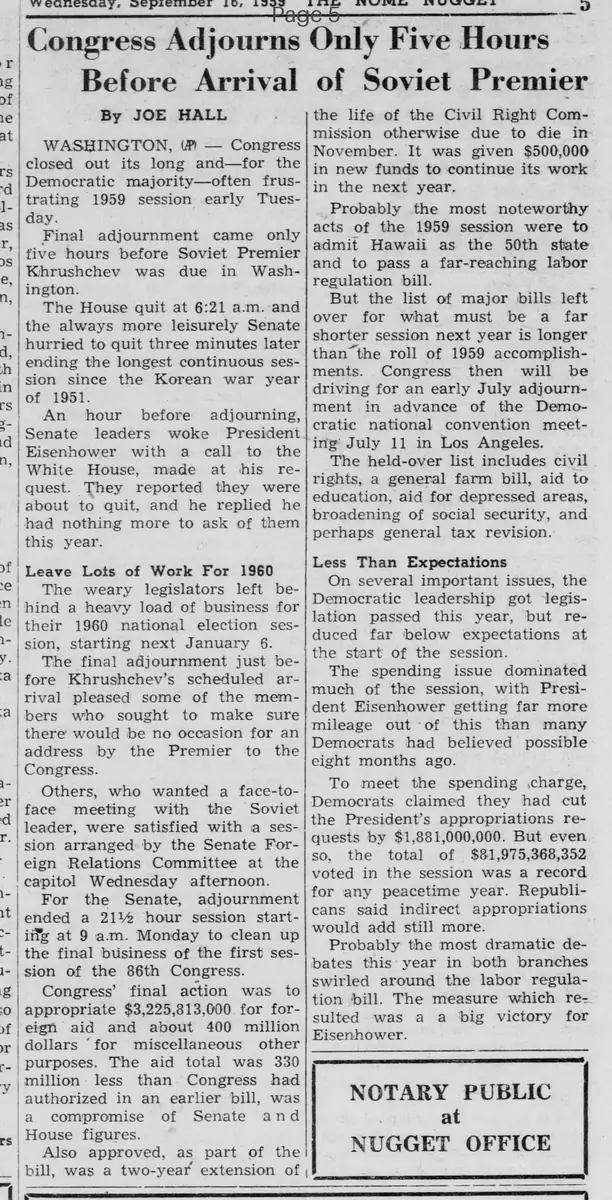
Before Arrival of Soviet Premier
By JOE HALL
WASHINGTON, (AP) - Congress closed out its long and--for the Democratic majority--often frustrating 1959 session early Tuesday.
Final adjournment came only five hours before Soviet Premier Khrushchev was due in Washington.
The House quit at 6:21 a.m. and the always more leisurely Senate hurried to quit three minutes later ending the longest continuous session since the Korean war year of 1951.
An hour before adjourning, Senate leaders woke President Eisenhower with a call to the White House, made at his request.
They reported they were about to quit, and he replied he had nothing more to ask of them this year.
Leave Lots of Work For 1960
The weary legislators left behind a heavy load of business for their 1960 national election session, starting next January 6.
The final adjournment just before Khrushchev's scheduled arrival pleased some of the members who sought to make sure there would be no occasion for an address by the Premier to the Congress.
Others, who wanted a face-to-face meeting with the Soviet leader, were satisfied with a session arranged by the Senate Foreign Relations Committee at the capitol Wednesday afternoon.
For the Senate, adjournment ended a 21 1/2 hour session starting at 9 a.m. Monday to clean up the final business of the first session of the 86th Congress.
Congress' final action was to appropriate $3,225,813,000 for foreign aid and about 400 million dollars for miscellaneous other purposes. The aid total was 330 million less than Congress had authorized in an earlier bill, was a compromise of Senate and House figures.
Also approved, as part of the bill, was a two-year extension of the life of the Civil Rights Commission otherwise due to die in November. It was given $500,000 in new funds to continue its work in the next year.
Probably the most noteworthy acts of the 1959 session were to admit Hawaii as the 50th state and to pass a far-reaching labor regulation bill.
But the list of major bills left over for what must be a far shorter session next year is longer than the roll of 1959 accomplishments.
Congress then will be driving for an early July adjournment in advance of the Democratic national convention meeting July 11 in Los Angeles.
The held-over list includes civil rights, a general farm bill, aid to education, aid for depressed areas, broadening of social security, and perhaps general tax revision.
Less Than Expectations
On several important issues, the Democratic leadership got legislation passed this year, but reduced far below expectations at the start of the session.
The spending issue dominated much of the session, with President Eisenhower getting far more mileage out of this than many Democrats had believed possible eight months ago.
To meet the spending charge, Democrats claimed they had cut the President's appropriations requests by $1,881,000,000. But even so, the total of $81,975,368,352 voted in the session was a record for any peacetime year. Republicans said indirect appropriations would add still more.
Probably the most dramatic debates this year in both branches swirled around the labor regulation bill. The measure which resulted was a big victory for Eisenhower.
What sub-type of article is it?
What themes does it cover?
What keywords are associated?
What entities or persons were involved?
Where did it happen?
Story Details
Key Persons
Location
Washington
Event Date
1959
Story Details
Congress adjourned its 1959 session early Tuesday, five hours before Khrushchev's arrival, after a long session passing foreign aid, Civil Rights extension, Hawaii statehood, and labor bill, but leaving many issues for 1960 amid Democratic frustrations and Eisenhower's victories.