Thank you for visiting SNEWPapers!
Sign up free
Fowle's New Hampshire Gazette And General Advertiser
Portsmouth, Rockingham County, New Hampshire
What is this article about?
A recent arrival from the West Indies reports severe British enforcement against suspected American vessels, including chases, seizures, and destruction of cargo. A new English act prohibits British ownership of post-1776 American-built ships, rendering many vessels useless and distressing planters and merchants, amid calls for a US-British commercial treaty.
Clipping
OCR Quality
Full Text
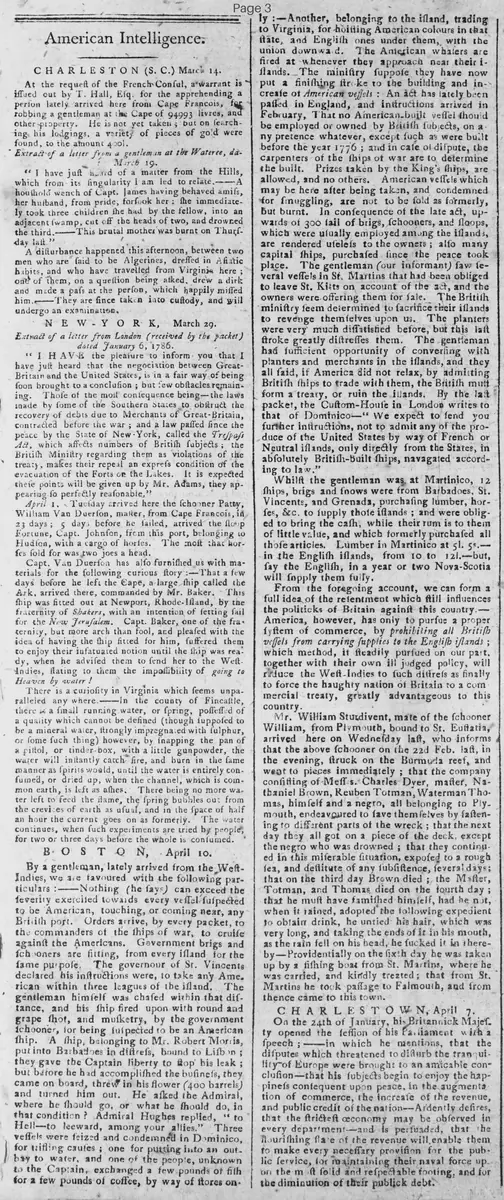
By a gentleman, lately arrived from the West-Indies, we are favoured with the following particulars :--Nothing (he says) can exceed the severity exercised towards every vessel suspected to be American, touching, or coming near, any British port. Orders arrive, by every packet, to the commanders of the ships of war, to cruize against the Americans. Government brigs and schooners are fitting, from every island for the same purpose. The governour of St. Vincents declared his instructions were, to take any American within three leagues of the island. The gentleman himself was chased within that distance, and his ship fired upon with round and grape shot, and musketry, by the government schooner, for being suspected to be an American ship. A ship, belonging to Mr. Robert Morris, put into Barbadoes in distress, bound to Lisbon; they gave the Captain liberty to stop his leak; but before he had accomplished the business, they came on board, threw overboard his flour (400 barrels) and turned him out. He asked the Admiral, where he should go, or what he should do, in that condition? Admiral Hughes replied, "to Hell-to leeward, among your allies." Three vessels were seized and condemned in Dominico, for trifling causes; one for putting into an out bay to water, and one of the people, unknown to the Captain, exchanged a few pounds of fish for a few pounds of coffee, by way of stores on-ly :-Another, belonging to the island, trading to Virginia, for hoisting American colours in that state, and English ones under them, with the union downward. The American whalers are fired at -whenever they approach near their islands. The ministry suppose they have now put a finishing stroke to the building and increase of American vessels : An act has lately been passed in England, and instructions arrived in February, That no American-built vessel should be employed or owned by British subjects, on any pretence whatever, except such as were built before the year 1776; and in case of dispute, the carpenters of the ships of war are to determine the built. Prizes taken by the King's ships, are allowed, and no others. American vessels which may be here after being taken, and condemned for smuggling, are not to be sold as formerly, but burnt. In consequence of the late act, upwards of 300 sail of brigs, schooners, and sloops, which were usually employed among the islands, are rendered useless to the owners; also many capital ships, purchased since the peace took place. The gentleman (our informant) saw several vessels in St. Martins that had been obliged to leave St. Kitts on account of the act, and the owners were offering them for sale. The British ministry seem determined to sacrifice their islands to revenge themselves upon us. The planters were very much dissatisfied before, but this last stroke greatly distresses them. The gentleman had sufficient opportunity of conversing with planters and merchants in the islands, and they all said, if America did not relax, by admitting British ships to trade with them, the British must form a treaty, Or ruin the islands. By the last packet, the Custom-House in London writes to that of Dominico-" We expect to send you further instructions, not to admit any of the produce of the United States by way of French or Neutral islands, only directly from the States, in absolutely British-built ships, navigated according-ing to law." Whilst the gentleman was at Martinico, 12 ships, brigs and snows were from Barbadoes, St. Vincents, and Grenada, purchasing lumber, horses, &c. to supply those islands; and were obliged to bring the cash, while their rum is to them of little value, and which formerly purchased all those articles. Lumber in Martinico at 5l. 5s.- in the English islands, from 10 to 12l.-but, say the English, in a year or two Nova-Scotia will supply them fully.
From the foregoing account, we can form a full idea of the resentment which still influences the politicks of Britain against this country.-- America, however, has only to pursue a proper system of commerce, by prohibiting all British vessels from carrying supplies to the English islands; which method, if steadily pursued on our part, together with their own ill judged policy, will reduce the West-Indies to such distress as finally to force the haughty nation of Britain to a commercial treaty, greatly advantageous to this country.
What sub-type of article is it?
What keywords are associated?
What entities or persons were involved?
Where did it happen?
Foreign News Details
Primary Location
West Indies
Event Date
Lately Arrived From The West Indies; Instructions Arrived In February
Key Persons
Outcome
vessels chased, fired upon, seized, and condemned for minor reasons; 400 barrels of flour destroyed; over 300 small vessels rendered useless; american-built ships post-1776 banned for british ownership; condemned smuggling vessels to be burnt; economic distress to planters and merchants; calls for commercial treaty.
Event Details
British authorities in the West Indies severely target suspected American vessels with cruises, seizures, and destruction. A new English act prohibits British subjects from owning or employing American-built vessels after 1776. Informant witnessed chases, cargo dumping, and vessel condemnations in islands like St. Vincents, Barbadoes, and Dominico. Planters and merchants express dissatisfaction and predict ruin without a US-British trade treaty. Supplies now purchased via cash from Martinico due to trade restrictions.