Thank you for visiting SNEWPapers!
Sign up free
Story
January 15, 1790
Gazette Of The United States
New York, New York County, New York
What is this article about?
Alexander Hamilton's 1790 Treasury report argues for a national bank to support public credit, critiquing existing state banks like the Bank of North America for insufficient capital and scope, emphasizing public utility over private profit.
Clipping
OCR Quality
98%
Excellent
Full Text
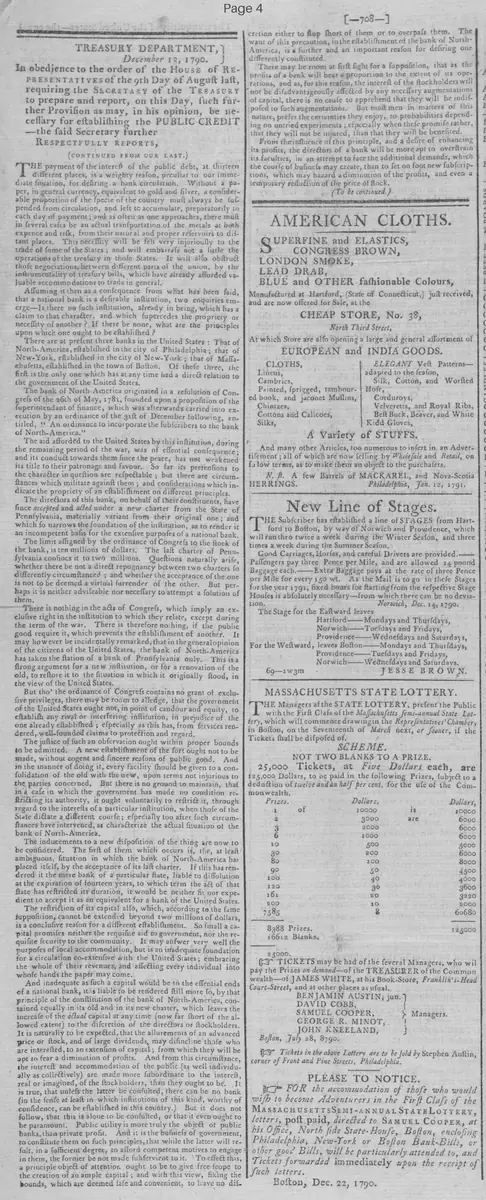
TREASURY DEPARTMENT,
December 13, 1790.
In obedience to the order of the House of Representatives of the 9th Day of August last, requiring the Secretary of the Treasury to prepare and report, on this day, such further provision as may, in his opinion, be necessary for establishing the public credit—the said Secretary further respectfully reports:
(CONTINUED FROM OUR LAST.)
The payment of the interest of the public debt, at thirteen different places, is a weighty reason, peculiar to our immediate situation, for desiring a bank circulation. Without a paper, in general currency, equivalent to gold and silver, a considerable proportion of the specie of the country must always be suspended from circulation, and left to accumulate, preparatorily to each day of payment; and as often as one approaches, there must in several cases be an actual transportation of the metals at both expense and risk, from their natural and proper reservoirs to distant places. This necessity will be felt very injuriously to the trade of some of the States; and will embarrass not a little the operations of the treasury in those States. It will also obstruct those negotiations, between different parts of the union, by the instrumentality of treasury bills, which have already afforded valuable accommodations to trade in general.
Assuming it then as a consequence from what has been said, that a national bank is a desirable institution, two enquiries emerge—Is there no such institution, already in being, which has a claim to that character, and which supersedes the propriety or necessity of another? If there be none, what are the principles upon which one ought to be established?
There are at present three banks in the United States: That of North-America, established in the city of Philadelphia; that of New-York, established in the city of New-York; that of Massachusetts, established in the town of Boston. Of these three, the first is the only one which has at any time had a direct relation to the government of the United States.
The bank of North America originated in a resolution of Congress of the 26th of May, 1781, founded upon a proposition of the superintendent of finance, which was afterwards carried into execution by an ordinance of the said of December following, entitled, "An ordinance to incorporate the subscribers to the bank of North-America."
The aid afforded to the United States by this institution, during the remaining period of the war, was of essential consequence; and its conduct towards them since the peace, has not weakened its title to their patronage and favour. So far its pretensions to the character in question are respectable; but there are circumstances which militate against them; and considerations which indicate the propriety of an establishment on different principles.
The directors of this bank, on behalf of their constituents, have since accepted and acted under a new charter from the State of Pennsylvania, materially variant from their original one; and which so narrows the foundation of the institution, as to render it an incompetent basis for the extensive purposes of a national bank.
The limit assigned by the ordinance of Congress to the stock of the bank, is ten millions of dollars. The last charter of Pennsylvania confines it to two millions. Questions naturally arise, whether there be not a direct repugnancy between two charters so differently circumstanced; and whether the acceptance of the one is not to be deemed a virtual surrender of the other. But perhaps it is neither advisable nor necessary to attempt a solution of them.
There is nothing in the acts of Congress, which imply an exclusive right in the institution to which they relate, except during the term of the war. There is therefore nothing, if the public good require it, which prevents the establishment of another. It may however be incidentally remarked, that in the general opinion of the citizens of the United States, the bank of North-America has taken the station of a bank of Pennsylvania only. This is a strong argument for a new institution, or for a renovation of the old, to restore it to the situation in which it originally stood, in the view of the United States.
But tho' the ordinance of Congress contains no grant of exclusive privileges, there may be room to allege, that the government of the United States ought not, in point of candour and equity, to establish any rival or interfering institution, in prejudice of the one already established; especially as this has, from services rendered, well-founded claims to protection and regard.
The justice of such an observation ought within proper bounds to be admitted. A new establishment of the sort ought not to be made, without cogent and sincere reasons of public good. And in the manner of doing it, every facility should be given to a consolidation of the old with the new, upon terms not injurious to the parties concerned. But there is no ground to maintain, that in a case in which the government has made no condition restricting its authority, it ought voluntarily to restrict it, through regard to the interests of a particular institution, when those of the State dictate a different course; especially too after such circumstances have intervened, as characterize the actual situation of the bank of North-America.
The inducements to a new disposition of the thing are now to be considered. The first of them which occurs is, the, at least ambiguous, situation in which the bank of North-America has placed itself, by the acceptance of its last charter. If this has rendered it the mere bank of a particular state, liable to dissolution at the expiration of fourteen years, to which term the act of that state has restricted its duration, it would be neither fit nor expedient to accept it as an equivalent for a bank of the United States.
The restriction of its capital also, which, according to the same supposition, cannot be extended beyond two millions of dollars, is a conclusive reason for a different establishment. So small a capital promises neither the requisite aid to government, nor the requisite security to the community. It may answer very well the purposes of local accommodation, but is an inadequate foundation for a circulation co-extensive with the United States; embracing the whole of their revenues, and affecting every individual into whose hands the paper may come.
And inadequate as such a capital would be to the essential ends of a national bank, it is liable to be rendered still more so, by that principle of the constitution of the bank of North-America, contained equally in its old and in its new charter, which leaves the increase of the actual capital at any time (now far short of the allowed extent) to the discretion of the directors or stockholders.
It is naturally to be expected, that the allurements of an advanced price of stock, and of large dividends, may disincline those who are interested, to an extension of capital; from which they will be apt to fear a diminution of profits. And from this circumstance, the interest and accommodation of the public (as well individually as collectively) are made more subordinate to the interest, real or imagined, of the stockholders, than they ought to be. It is true, that unless the latter be consulted, there can be no bank (in the sense at least in which institutions of this kind, worthy of confidence, can be established in this country.) But it does not follow, that this is alone to be consulted, or that it even ought to be paramount. Public utility is more truly the object of public banks, than private profit. And it is the business of government to constitute them on such principles, that while the latter will result, in a sufficient degree, to afford competent motives to engage in them, the former be not made subservient to it. To effect this, a principal object of attention, ought to be to give free scope to the creation of an ample capital; and with this view, fixing the bounds, which are deemed safe and convenient, to leave no discretion either to lop short of them or to overpass them.
The want of this precaution, in the establishment of the bank of North-America, is a further and an important reason for desiring one differently constituted.
There may be room at first sight for a supposition, that as the profits of a bank will bear a proportion to the extent of its operations, and as, for this reason, the interest of the stockholders will not be disadvantageously affected by any necessary augmentations of capital, there is no cause to apprehend that they will be indisposed to such augmentations. But most men in matters of this nature, prefer the certainties they enjoy, to probabilities depending on untried experiments; especially when these promise rather, that they will not be injured, than that they will be benefited.
From the influence of this principle, and a desire of enhancing its profits, the directors of a bank will be more apt to overstrain its faculties, in an attempt to face the additional demands, which the course of business may create, than to set on foot new subscriptions, which may hazard a diminution of the profits, and even a temporary reduction of the price of stock.
(To be continued.)
December 13, 1790.
In obedience to the order of the House of Representatives of the 9th Day of August last, requiring the Secretary of the Treasury to prepare and report, on this day, such further provision as may, in his opinion, be necessary for establishing the public credit—the said Secretary further respectfully reports:
(CONTINUED FROM OUR LAST.)
The payment of the interest of the public debt, at thirteen different places, is a weighty reason, peculiar to our immediate situation, for desiring a bank circulation. Without a paper, in general currency, equivalent to gold and silver, a considerable proportion of the specie of the country must always be suspended from circulation, and left to accumulate, preparatorily to each day of payment; and as often as one approaches, there must in several cases be an actual transportation of the metals at both expense and risk, from their natural and proper reservoirs to distant places. This necessity will be felt very injuriously to the trade of some of the States; and will embarrass not a little the operations of the treasury in those States. It will also obstruct those negotiations, between different parts of the union, by the instrumentality of treasury bills, which have already afforded valuable accommodations to trade in general.
Assuming it then as a consequence from what has been said, that a national bank is a desirable institution, two enquiries emerge—Is there no such institution, already in being, which has a claim to that character, and which supersedes the propriety or necessity of another? If there be none, what are the principles upon which one ought to be established?
There are at present three banks in the United States: That of North-America, established in the city of Philadelphia; that of New-York, established in the city of New-York; that of Massachusetts, established in the town of Boston. Of these three, the first is the only one which has at any time had a direct relation to the government of the United States.
The bank of North America originated in a resolution of Congress of the 26th of May, 1781, founded upon a proposition of the superintendent of finance, which was afterwards carried into execution by an ordinance of the said of December following, entitled, "An ordinance to incorporate the subscribers to the bank of North-America."
The aid afforded to the United States by this institution, during the remaining period of the war, was of essential consequence; and its conduct towards them since the peace, has not weakened its title to their patronage and favour. So far its pretensions to the character in question are respectable; but there are circumstances which militate against them; and considerations which indicate the propriety of an establishment on different principles.
The directors of this bank, on behalf of their constituents, have since accepted and acted under a new charter from the State of Pennsylvania, materially variant from their original one; and which so narrows the foundation of the institution, as to render it an incompetent basis for the extensive purposes of a national bank.
The limit assigned by the ordinance of Congress to the stock of the bank, is ten millions of dollars. The last charter of Pennsylvania confines it to two millions. Questions naturally arise, whether there be not a direct repugnancy between two charters so differently circumstanced; and whether the acceptance of the one is not to be deemed a virtual surrender of the other. But perhaps it is neither advisable nor necessary to attempt a solution of them.
There is nothing in the acts of Congress, which imply an exclusive right in the institution to which they relate, except during the term of the war. There is therefore nothing, if the public good require it, which prevents the establishment of another. It may however be incidentally remarked, that in the general opinion of the citizens of the United States, the bank of North-America has taken the station of a bank of Pennsylvania only. This is a strong argument for a new institution, or for a renovation of the old, to restore it to the situation in which it originally stood, in the view of the United States.
But tho' the ordinance of Congress contains no grant of exclusive privileges, there may be room to allege, that the government of the United States ought not, in point of candour and equity, to establish any rival or interfering institution, in prejudice of the one already established; especially as this has, from services rendered, well-founded claims to protection and regard.
The justice of such an observation ought within proper bounds to be admitted. A new establishment of the sort ought not to be made, without cogent and sincere reasons of public good. And in the manner of doing it, every facility should be given to a consolidation of the old with the new, upon terms not injurious to the parties concerned. But there is no ground to maintain, that in a case in which the government has made no condition restricting its authority, it ought voluntarily to restrict it, through regard to the interests of a particular institution, when those of the State dictate a different course; especially too after such circumstances have intervened, as characterize the actual situation of the bank of North-America.
The inducements to a new disposition of the thing are now to be considered. The first of them which occurs is, the, at least ambiguous, situation in which the bank of North-America has placed itself, by the acceptance of its last charter. If this has rendered it the mere bank of a particular state, liable to dissolution at the expiration of fourteen years, to which term the act of that state has restricted its duration, it would be neither fit nor expedient to accept it as an equivalent for a bank of the United States.
The restriction of its capital also, which, according to the same supposition, cannot be extended beyond two millions of dollars, is a conclusive reason for a different establishment. So small a capital promises neither the requisite aid to government, nor the requisite security to the community. It may answer very well the purposes of local accommodation, but is an inadequate foundation for a circulation co-extensive with the United States; embracing the whole of their revenues, and affecting every individual into whose hands the paper may come.
And inadequate as such a capital would be to the essential ends of a national bank, it is liable to be rendered still more so, by that principle of the constitution of the bank of North-America, contained equally in its old and in its new charter, which leaves the increase of the actual capital at any time (now far short of the allowed extent) to the discretion of the directors or stockholders.
It is naturally to be expected, that the allurements of an advanced price of stock, and of large dividends, may disincline those who are interested, to an extension of capital; from which they will be apt to fear a diminution of profits. And from this circumstance, the interest and accommodation of the public (as well individually as collectively) are made more subordinate to the interest, real or imagined, of the stockholders, than they ought to be. It is true, that unless the latter be consulted, there can be no bank (in the sense at least in which institutions of this kind, worthy of confidence, can be established in this country.) But it does not follow, that this is alone to be consulted, or that it even ought to be paramount. Public utility is more truly the object of public banks, than private profit. And it is the business of government to constitute them on such principles, that while the latter will result, in a sufficient degree, to afford competent motives to engage in them, the former be not made subservient to it. To effect this, a principal object of attention, ought to be to give free scope to the creation of an ample capital; and with this view, fixing the bounds, which are deemed safe and convenient, to leave no discretion either to lop short of them or to overpass them.
The want of this precaution, in the establishment of the bank of North-America, is a further and an important reason for desiring one differently constituted.
There may be room at first sight for a supposition, that as the profits of a bank will bear a proportion to the extent of its operations, and as, for this reason, the interest of the stockholders will not be disadvantageously affected by any necessary augmentations of capital, there is no cause to apprehend that they will be indisposed to such augmentations. But most men in matters of this nature, prefer the certainties they enjoy, to probabilities depending on untried experiments; especially when these promise rather, that they will not be injured, than that they will be benefited.
From the influence of this principle, and a desire of enhancing its profits, the directors of a bank will be more apt to overstrain its faculties, in an attempt to face the additional demands, which the course of business may create, than to set on foot new subscriptions, which may hazard a diminution of the profits, and even a temporary reduction of the price of stock.
(To be continued.)
What sub-type of article is it?
Historical Event
What themes does it cover?
Moral Virtue
Justice
What keywords are associated?
National Bank
Public Credit
Bank Of North America
Treasury Report
Public Debt
What entities or persons were involved?
Secretary Of The Treasury
Where did it happen?
United States
Story Details
Key Persons
Secretary Of The Treasury
Location
United States
Event Date
1790 12 13
Story Details
The Secretary reports on the need for a national bank to facilitate public debt payments and trade, critiquing the Bank of North America's limited capital and state charter as insufficient for national purposes, advocating for a new institution prioritizing public utility over private profit.