Thank you for visiting SNEWPapers!
Sign up free
Staunton Spectator
Staunton, Virginia
What is this article about?
Proceedings of the Virginia House of Delegates from January 7-13, covering passage of bills on lotteries, roads, and companies; resolutions on military elections and internal improvements via state loan; and extended debate on discharging committee from abolition petitions post-Southampton massacre, with proposals for gradual emancipation and deportation.
Clipping
OCR Quality
Full Text
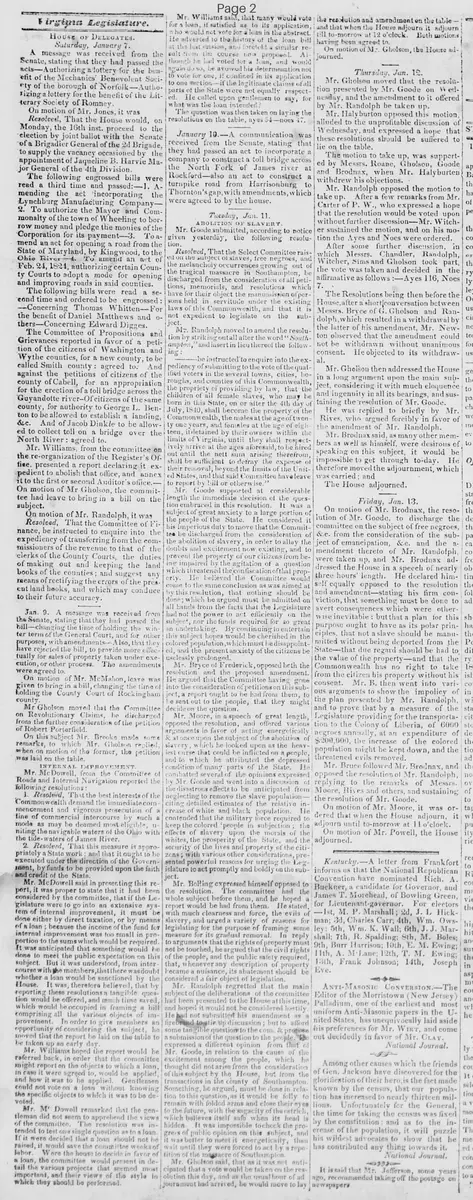
House of Delegates.
Saturday, January 7.
A message was received from the Senate, stating that they had passed the acts—Authorizing a lottery for the benefit of the Mechanics' Benevolent Society of the borough of Norfolk—Authorizing a lottery for the benefit of the Literary Society of Romney.
On motion of Mr. Jones, it was Resolved, That the House would, on Monday, the 16th inst. proceed to the election by joint ballot with the Senate of a Brigadier General of the 2d Brigade, to supply the vacancy occasioned by the appointment of Jacqueline B. Harvie Major General of the 4th Division.
The following engrossed bills were read a third time and passed:—1. Amending the act incorporating the Lynchburg Manufacturing Company—2. To authorize the Mayor and Commonalty of the town of Wheeling to borrow money and pledge the monies of the Corporation for its payment—3. To amend an act for opening a road from the State of Maryland, by Kingwood, to the Ohio River—4. To amend an act of Feb. 24, 1824, authorizing certain County Courts to adopt a mode for opening and improving roads in said counties.
The following bills were read a second time and ordered to be engrossed:—Concerning Thomas Whitten—For the benefit of Daniel Matthews and others—Concerning Edward Digges.
The Committee of Propositions and Grievances reported in favor of a petition of the citizens of Washington and Wythe counties, for a new county, to be called Smith county: agreed to. And against the petitions of citizens of the county of Cabell, for an appropriation for the erection of a toll bridge across the Guyandotte river—Of citizens of the same county, for authority to George L. Benton to be allowed to establish a landing, &c. And of Jacob Dinkle to be allowed to collect toll on a bridge over the North River: agreed to.
Mr. Williams, from the committee on the re-organization of the Register's Office, presented a report declaring it expedient to abolish that office, and annex it to the first or second Auditor's office.—On motion of Mr. Gholson, the committee had leave to bring in a bill on the subject.
On motion of Mr. Randolph, it was Resolved, That the Committee of Finance, be instructed to enquire into the expediency of transferring from the commissioners of the revenue to that of the clerks of the County Courts, the duties of making out and keeping the land books of the counties; and suggest any means of rectifying the errors of the present land books, and which may conduce to their future accuracy.
Jan. 9. A message was received from the Senate, stating that they had passed the bill changing the time of holding the winter term of the General Court, and for other purposes, with amendments—Also, that they have rejected the bill, to provide more effectually for sales of property taken under execution, or other process. The amendments were agreed to.
On motion of Mr. McMahon, leave was given to bring in a bill, changing the time of holding the County Court of Rockingham county.
Mr. Gholson moved that the Committee on Revolutionary Claims, be discharged from the further consideration of the petition of Robert Porterfield.
On this subject Mr. Brooke made some remarks, to which Mr. Gholson replied, when on motion of the former, the petition was laid on the table.
INTERNAL IMPROVEMENT.
Mr. McDowell, from the Committee of Roads and Internal Navigation reported the following resolutions:
1. Resolved, That the best interests of the Commonwealth demand the immediate commencement and vigorous prosecution of a line of commercial intercourse by such a mode as may be deemed most eligible, uniting the navigable waters of the Ohio with the tide-waters of James River.
2. Resolved, That this measure is appropriately a State work; and that it ought to be executed under the direction of the Government, by funds to be provided upon the faith and credit of the State.
Mr. McDowell said in presenting this report, it was proper to state that it had been considered by the committee, that if the Legislature were to go into an extensive system of internal improvement, it must be done either by direct taxation, or by means of a loan: because the income of the fund for internal improvement was too small in proportion to the sums which would be required.
It was anticipated that something would be done to meet the public expectation on this subject. But it was understood, from intercourse with the members, that there was doubt whether a loan would be sanctioned by the House. It was, therefore believed, that by reporting these resolutions a tangible question would be offered, and much time saved which would be occupied in framing a bill comprising all the various objects of improvement. In order to give members an opportunity of considering the subject, he moved that the report be laid on the table to be taken up an early day.
Mr. Williams hoped the report would be referred back, in order that the committee might report on the objects to which a loan, in case it were agreed to, would be applied, and how it was to be applied. Gentlemen could not vote on a loan without knowing the specific objects to which it was to be devoted.
Mr. McDowell remarked that the gentleman did not seem to apprehend the views of the committee. The resolution was intended to test one single question as to a loan. If it were decided that a loan should not be raised, it would save the committee weeks of labor. Were the house to decide in favor of a loan, the committee would present in detail the various projects that seemed most important, and their views of the style in which they should be performed.
Mr. Williams said, that many would vote for a loan, if satisfied as to its application, as he would not vote for a loan in the abstract. He adverted to the history of the loan bill at the last session, and foretold a similar result from the course now proposed. Although he had voted for a loan, and would again do so, he avowed his determination not to vote for one, if confined in its application to one section—if the legitimate claims of all parts of the State were not equally respected. He called upon gentlemen to say, for what was the loan intended?
The question was then taken on laying the resolutions on the table, ayes 54—noes 47.
January 10.—A communication was received from the Senate, stating that they had passed an act to incorporate a company to construct a toll bridge across the North Fork of James river at Rockford—also an act to construct a turnpike road from Harrisonburg to Thornton's gap, with amendments, which were agreed to by the house.
Tuesday, Jan. 11.
ABOLITION OF SLAVERY.
Mr. Goode submitted, according to notice given yesterday, the following resolution.
Resolved, That the Select Committee raised on the subject of slaves, free negroes, and the melancholy occurrences growing out of the tragical massacre in Southampton, be discharged from the consideration of all petitions, memorials, and resolutions which have for their object the manumission of persons held in servitude under the existing laws of this Commonwealth, and that it is not expedient to legislate on the subject.
Mr. Randolph moved to amend the resolution by striking out all after the word "Southampton," and inserting in lieu thereof the following:—
be instructed to enquire into the expediency of submitting to the vote of the qualified voters in the several towns, cities, boroughs, and counties of this Commonwealth, the propriety of providing by law, that the children of all female slaves, who may be born in this State, on or after the 4th day of July, 1840, shall become the property of the Commonwealth, the males at the age of twenty one years, and females at the age of eighteen, if retained by their owners within the limits of Virginia, until they shall respectively arrive at the ages aforesaid, to be hired out until the net sum arising therefrom, shall be sufficient to defray the expense of their removal, beyond the limits of the United States, and that said Committee have leave to report by bill or otherwise."
Mr. Goode supported at considerable length the immediate decision of the question embraced in this resolution. It was a subject of great anxiety to a large portion of the people of the State. He considered it his imperious duty to move that the Committee be discharged from the consideration of the abolition of slavery, in order to allay the doubts and excitement now existing, and to prevent the property of our citizens from being impaired by the agitation of a question which threatened the confiscation of that property. He believed the Committee would come to the same conclusion as was aimed at by this resolution, that nothing should be done; which he argued must be admitted on all hands from the facts that the Legislature had not the power to act efficiently on the subject, nor the funds required for so great an undertaking. By continuing to entertain this subject hopes would be cherished in the colored population, which must be disappointed, and the present anxiety of the citizens be uselessly prolonged.
Mr. Bryce of Frederick, opposed both the resolution and the proposed amendment. He argued that the Committee having gone into the consideration of petitions on this subject, a report ought to be had from them, to be sent out to the people, that they might decide on the question.
Mr. Moore, in a speech of great length, opposed the resolution, and offered various arguments in favor of acting energetically & at once upon the subject of the abolition of slavery, which he looked upon as the heaviest curse that could be inflicted on a people, and to which he attributed the depressed condition of many parts of the State. He combatted several of the opinions expressed by Mr. Goode and went into a discussion of the disastrous effects to be anticipated from neglecting to remove the slave population—citing detailed estimates of the relative increase of white and black population. He contended that the military force required to keep the colored people in subjection; the effects of slavery upon the morals of the whites, the prosperity of the State, and the security of the lives and property of the citizens; with various other considerations, presented powerful reasons for urging the Legislature to act promptly and boldly on the subject.
Mr. Bolling expressed himself opposed to the resolution. The committee had the whole subject before them, and he hoped a report would be had from them. He stated, with much clearness and force, the evils of slavery, and urged a variety of reasons for legislating for the purpose of framing some measure for its gradual removal. In reply to arguments that the rights of property must not be touched, he argued that the civil rights of the people, and the public safety required, that, whenever any description of property became a nuisance, its abatement should be considered a fair object of legislation.
Mr. Randolph regretted that the main subject of the deliberations of the committee had been presented to the House at this time, and hoped it would not be considered hastily. He had not submitted his amendment as a firebrand to stir up discussion; but to afford some tangible question to the com. & propose a submission of the question to the people. He expressed a different opinion from that of Mr. Goode, in relation to the cause of the excitement among the people, which he thought did not arise from the consideration of this subject by the House, but from the transactions in the county of Southampton. Something, he argued, must be done in relation to this question, as it would be folly to remain with folded arms and close their eyes to the future, with the sagacity of the ostrich, which believes itself safe when its head is hidden. It was impossible to check the progress of public opinion on this subject, and it was better to meet it energetically, than wait until they were forced to act by a repetition of the massacre of Southampton.
Mr. Gholson said, that as it was not anticipated that a vote would be taken on the resolution this day, and as the usual hour of adjournment had arrived, he would move to lay the resolution and amendment on the table—and that when the House adjourn it adjourn till to-morrow at 12 o'clock. Both motions having been agreed to.
On motion of Mr. Gholson, the House adjourned.
Thursday, Jan. 12.
Mr. Gholson moved that the resolution presented by Mr. Goode on Wednesday, and the amendment to it offered by Mr. Randolph be taken up.
Mr. Halyburton opposed this motion, alluded to the unprofitable discussion of Wednesday, and expressed a hope that these resolutions should be suffered to lie on the table.
The motion to take up, was supported by Messrs. Roane, Gholson, Goode and Brodnax, when Mr. Halyburton withdrew his objections.
Mr. Randolph opposed the motion to take up. After a few remarks from Mr. Carter of P. W., who expressed a hope that the resolution would be voted upon without further discussion—Mr. Witcher sustained the motion, and on his motion the Ayes and Noes were ordered.
After some further discussion, in which Messrs. Chandler, Randolph, Witcher, Sims and Gholson took part, the vote was taken and decided in the affirmative as follows:—Ayes 116, Noes 7.
The Resolutions being then before the House, after a short conversation between Messrs. Bryce of G. Gholson and Randolph, which resulted in a withdrawal by the latter of his amendment. Mr. Newton observed that the amendment could not be withdrawn without unanimous consent. He objected to its withdrawal.
Mr. Gholson then addressed the House in a long argument upon the main subject, considering it with much eloquence and ingenuity in all its bearings, and sustaining the resolution of Mr. Goode.
He was replied to briefly by Mr. Rives, who argued forcibly in favor of the amendment of Mr. Randolph.
Mr. Brodnax said, as many other members as well as himself, were desirous of speaking on this subject, it would be impossible to get through to-day. He therefore moved the adjournment, which was carried: and The House adjourned.
Friday, Jan. 13.
On motion of Mr. Brodnax, the resolution of Mr. Goode, to discharge the committee on the subject of free negroes, &c. from the consideration of the subject of emancipation, &c. and the amendment thereto of Mr. Randolph, were taken up. and Mr. Brodnax addressed the House in a speech of nearly three hours' length. He declared himself equally opposed to the resolution and amendment—stating his firm conviction, that something must be done to avert consequences which were otherwise inevitable: but that a plan for this purpose ought to have as its polar principles, that not a slave should be manumitted without being deported from the State—that due regard should be had to the value of the property—and that the Commonwealth has no right to take from the citizen his property without his consent. Mr. B. then went into various arguments to show the impolicy of the plan presented by Mr. Randolph, and to prove that by a measure of the Legislature providing for the transportation to the Colony of Liberia, of 6000 negroes annually, at an expenditure of $200,000, the increase of the colored population might be kept down, and the threatened evils removed.
Mr. Bruce followed Mr. Brodnax, and opposed the resolution of Mr. Randolph, replying to the remarks of Messrs. Moore, Rives and others, and sustaining the resolution of Mr. Goode.
On motion of Mr. Moore, it was ordered that when the House adjourn, it adjourn until to-morrow at 11 o'clock.
On motion of Mr. Powell, the House adjourned.
What sub-type of article is it?
What themes does it cover?
What keywords are associated?
What entities or persons were involved?
Where did it happen?
Story Details
Key Persons
Location
Virginia House Of Delegates
Event Date
January 7 To 13
Story Details
The Virginia House of Delegates passed bills on lotteries, manufacturing, roads, and county matters; resolved on military elections and land book management; debated internal improvements via state loan for Ohio-James River connection; and engaged in multi-day debate on discharging committee from abolition petitions following Southampton massacre, with proposals for gradual emancipation, deportation to Liberia, and opposition emphasizing property rights and public safety.