Thank you for visiting SNEWPapers!
Sign up free
Editorial
July 27, 1814
The Enquirer
Richmond, Henrico County, Virginia
What is this article about?
American editorial condemns British violations of laws of war during the 1812 invasion, citing atrocities like massacres at Raisin River, burnings at Hampton and Havre-de-Grace, plunder, and mistreatment of captives, contrasting with American mercy and invoking Vattel's principles.
Merged-components note: Continuation of editorial critiquing British conduct in war, sequential reading order on page 3.
Clipping
OCR Quality
95%
Excellent
Full Text
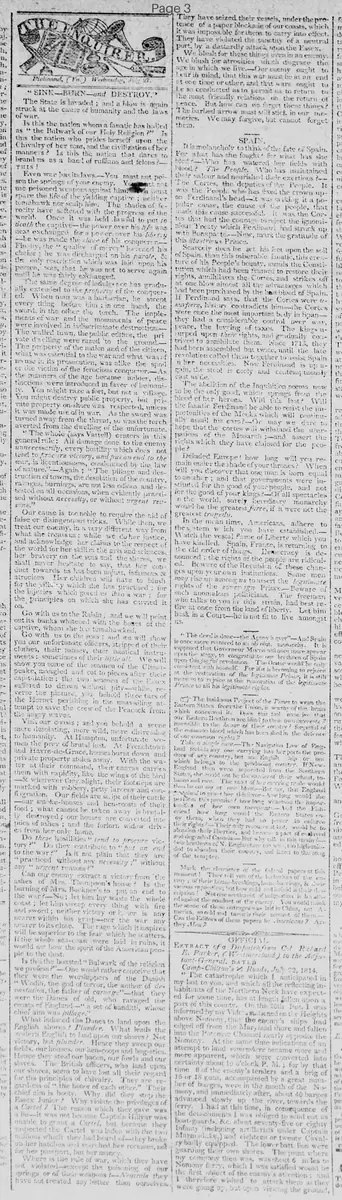
"SINK—BURN—and DESTROY."
The State is invaded: and a blow is again struck at the cause of humanity and the laws of war.
Is this the nation whom a fanatic has hailed as "the Bulwark of our Holy Religion?" Is this the nation who prides herself upon the Chivalry of her sons, and the civilization of her manners? Is this the nation that dares to brand us as a band of ruffians and felons?—THIS!
Even war has its laws. You must not poison the springs of your enemy. You must not use poisoned weapons against him. You must spare the life of the yielding captive: neither tomahawk nor scalp him. The shades of ferocity have softened with the progress of the world. Once it was held lawful to put to death the captive—the power over his life was next exchanged for a power over his liberty—he was made the slave of his conqueror. Finally, the "quality of mercy" loosened his chains: he was discharged on his parole, & the only restriction which was laid upon his person, was, that he was not to serve again until he was fairly exchanged.
The same degree of indulgence has gradually extended to the property of the conquered. When man was a barbarian, he swept every thing before him: in one hand, the sword, in the other the torch. The implements of war and the monuments of peace were involved in indiscriminate destruction. The walled town, the public edifice, the private dwelling were razed to the ground. The property of the nation and of the citizen, what was essential to the war and what was of no use in its prosecution, was alike the spoil or the victim of the ferocious conqueror. As the manners of the age became milder, distinctions were introduced in favor of humanity. You might raze a fort, but not a village. You might destroy public property, but private property on-shore was respected, unless it was made use of in war. As the sword was turned away from the throat, so was the torch averted from the dwelling of the unfortunate.
"The whole (says Vattel) centers in this general rule: All damage done to the enemy unnecessarily, every hostility which does not tend to procure victory, and put an end to the war, is licentiousness, condemned by the law of nature." Again; "The pillage and destruction of towns, the desolation of the country, ravages, burnings, are not less odious and detested on all occasions, when evidently practiced without necessity, or without urgent reason."
Our cause is too noble to require the aid of false or disingenuous tricks. While then, we treat our enemy, in a very different way from what she treats us; while we do her justice, and acknowledge her claims to the respect of the world for her skill in the arts and sciences, her bravery on the seas and the shores, we shall never hesitate to say, that her conduct towards us has been unjust, infamous & atrocious. Her children will hate to blush for the villany which she has practiced; for the injuries which goaded us into a war; for the principles on which she has carried it on.
Go with us to the Raisin: and we will point out its banks whitened with the bones of the captive, whom she has tomahawked. Go with us to the seas; and we will show you our unfortunate officers, stripped of their clothes, their money, their nautical instruments; sometimes of their little all. We will show you some of the seamen of the Chesapeake, mangled and cut to pieces after their capitulation; the two seamen of the Essex suffered to drown without pity—while, reverse the picture, you behold three tars of the Hornet perishing in the unavailing attempt to save the crew of the Peacock from the angry waves.
Visit our coasts; and you behold a scene more desolating, more wild, more distressing to humanity. At Hampton, unfortunate women the prey of brutal lust. At Frenchtown and Havre-de-Grace, houses burnt down and private property stolen away. With the water at their command, their canvas carries them with rapidity, like the wings of the bird—& wherever they alight, their footsteps are marked with robbery, petty larceny and conflagration. Our fields are stripped of their cattle—our smoke-houses and hen-roosts of their food; what cannot be taken away is brutally destroyed; our houses are converted into piles of ashes; and the forlorn widow driven from her only home.
Do these hostilities "tend to procure victory?" Do they contribute to "put an end to the war?" Is it not plain that they are "practiced without any necessity;" without any "urgent reasons?"
Can our enemy extract a victory from the ashes of Mrs. Thompson's house? Is the burning of Mrs. Buckner's to put an end to the war? No: let him lay waste the whole coast: let him sweep every thing with fire and sword; neither victory nor honor is any nearer within his grasp—nor the war any nearer to its close. The rage which it inspires will be superior to the fear which he scatters. If the whole sea-coast were laid in ruins, it would not bow the spirit of the American people to the dust.
Is this the boasted "Bulwark of the religion we profess?"—One would rather conceive that they were the worshippers of the Danish "Wodin, the god of terror, the author of devastation, the father of carnage"—that they were the Danes of old, who ravaged the coasts of England—"a set of banditti, whose chief aim was pillage."
What induced the Danes to land upon the English shores? Plunder. What leads the modern English to land upon our shores? Not victory, but plunder. Hence they sweep our fields, our houses, our hen-coops and hog-sties. Hence they steal our bacon, our fowls and our slaves. The British officers, who land upon our shores, seem to have lost all their regard for the principles of chivalry. They are regardless of "the honor of each other." Their chief aim is booty. Why did they stop the Essex Junior? Why violate the privileges of a Cartel? The reason which they gave was a lie—it was not because Captain Hillyar was unable to give a Cartel, but because they suspected the Cartel was laden with the two millions which they had heard of—they broke up her hatches and searched her recesses, not for her passport, but her money.
Where is the rule of war, which they have not violated—except the poisoning of our springs or of their weapons!— Neutrals they have not treated any better than ourselves.
They have seized their vessels, under the pretence of a paper blockade of our coasts, which it was impossible for them to carry into effect. They have violated the sanctity of a neutral port, by a dastardly attack upon the Essex. We blush for these things even in an enemy. We blush for atrocities which disgrace the age in which we live. Our enemy ought to bear in mind, that this war must be at an end at one time or other, and that wars ought to be so conducted as to permit us to return to the most friendly relations on the return of peace. But how can we forget these things? The barbed arrow must still stick in our memories. We may forgive, but cannot forget them.
The State is invaded: and a blow is again struck at the cause of humanity and the laws of war.
Is this the nation whom a fanatic has hailed as "the Bulwark of our Holy Religion?" Is this the nation who prides herself upon the Chivalry of her sons, and the civilization of her manners? Is this the nation that dares to brand us as a band of ruffians and felons?—THIS!
Even war has its laws. You must not poison the springs of your enemy. You must not use poisoned weapons against him. You must spare the life of the yielding captive: neither tomahawk nor scalp him. The shades of ferocity have softened with the progress of the world. Once it was held lawful to put to death the captive—the power over his life was next exchanged for a power over his liberty—he was made the slave of his conqueror. Finally, the "quality of mercy" loosened his chains: he was discharged on his parole, & the only restriction which was laid upon his person, was, that he was not to serve again until he was fairly exchanged.
The same degree of indulgence has gradually extended to the property of the conquered. When man was a barbarian, he swept every thing before him: in one hand, the sword, in the other the torch. The implements of war and the monuments of peace were involved in indiscriminate destruction. The walled town, the public edifice, the private dwelling were razed to the ground. The property of the nation and of the citizen, what was essential to the war and what was of no use in its prosecution, was alike the spoil or the victim of the ferocious conqueror. As the manners of the age became milder, distinctions were introduced in favor of humanity. You might raze a fort, but not a village. You might destroy public property, but private property on-shore was respected, unless it was made use of in war. As the sword was turned away from the throat, so was the torch averted from the dwelling of the unfortunate.
"The whole (says Vattel) centers in this general rule: All damage done to the enemy unnecessarily, every hostility which does not tend to procure victory, and put an end to the war, is licentiousness, condemned by the law of nature." Again; "The pillage and destruction of towns, the desolation of the country, ravages, burnings, are not less odious and detested on all occasions, when evidently practiced without necessity, or without urgent reason."
Our cause is too noble to require the aid of false or disingenuous tricks. While then, we treat our enemy, in a very different way from what she treats us; while we do her justice, and acknowledge her claims to the respect of the world for her skill in the arts and sciences, her bravery on the seas and the shores, we shall never hesitate to say, that her conduct towards us has been unjust, infamous & atrocious. Her children will hate to blush for the villany which she has practiced; for the injuries which goaded us into a war; for the principles on which she has carried it on.
Go with us to the Raisin: and we will point out its banks whitened with the bones of the captive, whom she has tomahawked. Go with us to the seas; and we will show you our unfortunate officers, stripped of their clothes, their money, their nautical instruments; sometimes of their little all. We will show you some of the seamen of the Chesapeake, mangled and cut to pieces after their capitulation; the two seamen of the Essex suffered to drown without pity—while, reverse the picture, you behold three tars of the Hornet perishing in the unavailing attempt to save the crew of the Peacock from the angry waves.
Visit our coasts; and you behold a scene more desolating, more wild, more distressing to humanity. At Hampton, unfortunate women the prey of brutal lust. At Frenchtown and Havre-de-Grace, houses burnt down and private property stolen away. With the water at their command, their canvas carries them with rapidity, like the wings of the bird—& wherever they alight, their footsteps are marked with robbery, petty larceny and conflagration. Our fields are stripped of their cattle—our smoke-houses and hen-roosts of their food; what cannot be taken away is brutally destroyed; our houses are converted into piles of ashes; and the forlorn widow driven from her only home.
Do these hostilities "tend to procure victory?" Do they contribute to "put an end to the war?" Is it not plain that they are "practiced without any necessity;" without any "urgent reasons?"
Can our enemy extract a victory from the ashes of Mrs. Thompson's house? Is the burning of Mrs. Buckner's to put an end to the war? No: let him lay waste the whole coast: let him sweep every thing with fire and sword; neither victory nor honor is any nearer within his grasp—nor the war any nearer to its close. The rage which it inspires will be superior to the fear which he scatters. If the whole sea-coast were laid in ruins, it would not bow the spirit of the American people to the dust.
Is this the boasted "Bulwark of the religion we profess?"—One would rather conceive that they were the worshippers of the Danish "Wodin, the god of terror, the author of devastation, the father of carnage"—that they were the Danes of old, who ravaged the coasts of England—"a set of banditti, whose chief aim was pillage."
What induced the Danes to land upon the English shores? Plunder. What leads the modern English to land upon our shores? Not victory, but plunder. Hence they sweep our fields, our houses, our hen-coops and hog-sties. Hence they steal our bacon, our fowls and our slaves. The British officers, who land upon our shores, seem to have lost all their regard for the principles of chivalry. They are regardless of "the honor of each other." Their chief aim is booty. Why did they stop the Essex Junior? Why violate the privileges of a Cartel? The reason which they gave was a lie—it was not because Captain Hillyar was unable to give a Cartel, but because they suspected the Cartel was laden with the two millions which they had heard of—they broke up her hatches and searched her recesses, not for her passport, but her money.
Where is the rule of war, which they have not violated—except the poisoning of our springs or of their weapons!— Neutrals they have not treated any better than ourselves.
They have seized their vessels, under the pretence of a paper blockade of our coasts, which it was impossible for them to carry into effect. They have violated the sanctity of a neutral port, by a dastardly attack upon the Essex. We blush for these things even in an enemy. We blush for atrocities which disgrace the age in which we live. Our enemy ought to bear in mind, that this war must be at an end at one time or other, and that wars ought to be so conducted as to permit us to return to the most friendly relations on the return of peace. But how can we forget these things? The barbed arrow must still stick in our memories. We may forgive, but cannot forget them.
What sub-type of article is it?
War Or Peace
Moral Or Religious
What keywords are associated?
Laws Of War
British Atrocities
War Of 1812
Plunder And Destruction
American Resolve
Vattel Principles
What entities or persons were involved?
Britain
Vattel
Captain Hillyar
Mrs. Thompson
Mrs. Buckner
Editorial Details
Primary Topic
British Violations Of Laws Of War During Invasion
Stance / Tone
Strongly Condemnatory Of British Atrocities
Key Figures
Britain
Vattel
Captain Hillyar
Mrs. Thompson
Mrs. Buckner
Key Arguments
War Has Laws Prohibiting Unnecessary Damage And Atrocities
British Massacred Captives At Raisin River
British Committed Rapes At Hampton And Burnings At Frenchtown And Havre De Grace
British Plundered Private Property Without Military Necessity
Such Acts Do Not Lead To Victory But Inspire American Resolve
British Violated Neutral Rights And Cartel Privileges