Thank you for visiting SNEWPapers!
Sign up free
Literary
September 23, 1789
Gazette Of The United States
New York, New York County, New York
What is this article about?
An essay continuation critiquing pure democracy as prone to demagoguery and mob violence, advocating balanced government with legislative power in the people's hands but executive and judicial separated, and a senate to protect the rich's rights alongside the poor's liberty.
Clipping
OCR Quality
98%
Excellent
Full Text
The Right Constitution of a Commonwealth.
WEALTH EXAMINED,
(IN CONTINUATION.)
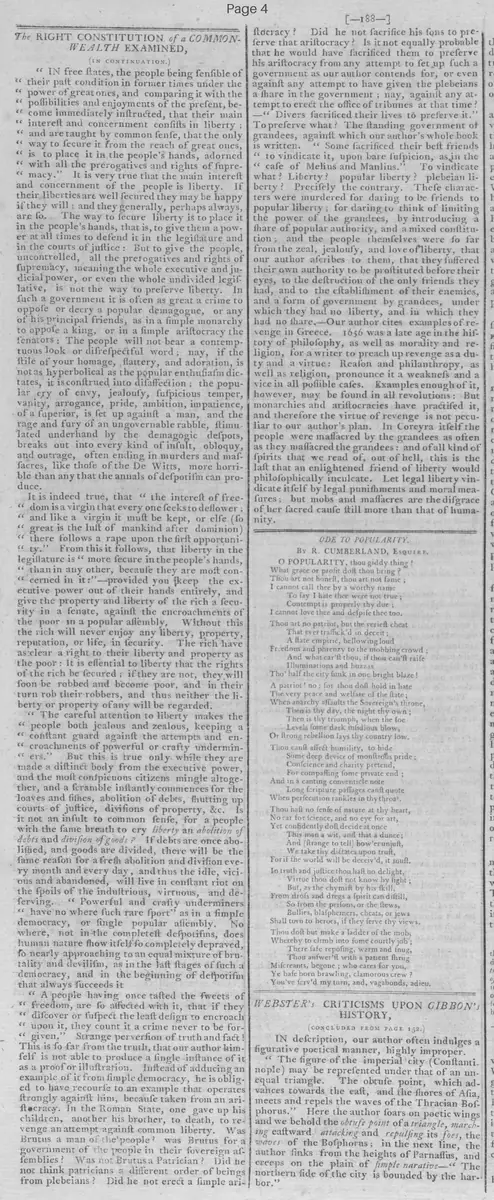
"In free states, the people being sensible of their past condition in former times under the power of great ones, and comparing it with the possibilities and enjoyments of the present, become immediately instructed, that their main interest and concernment consists in liberty; and are taught by common sense, that the only way to secure it from the reach of great ones, is to place it in the people's hands, adorned with all the prerogatives and rights of supremacy." It is very true that the main interest and concernment of the people is liberty. If their liberties are well secured they may be happy if they will; and they generally, perhaps always, are so. The way to secure liberty is to place it in the people's hands, that is, to give them a power at all times to defend it in the legislature and in the courts of justice: But to give the people, uncontrolled, all the prerogatives and rights of supremacy, meaning the whole executive and judicial power, or even the whole undivided legislative, is not the way to preserve liberty. In such a government it is often as great a crime to oppose or decry a popular demagogue, or any of his principal friends, as in a simple monarchy to oppose a king, or in a simple aristocracy the senators: The people will not bear a contemptuous look or disrespectful word; nay, if the style of your homage, flattery, and adoration, is not as hyperbolical as the popular enthusiasm dictates, it is construed into disaffection; the popular cry of envy, jealousy, suspicious temper, vanity, arrogance, pride, ambition, impatience, of a superior, is set up against a man, and the rage and fury of an ungovernable rabble, stimulated underhand by the demagogic despots, breaks out into every kind of insult, obloquy, and outrage, often ending in murders and massacres, like those of the De Witts, more horrible than any that the annals of despotism can produce.
It is indeed true, that "the interest of freedom is a virgin that every one seeks to deflower; and like a virgin it must be kept, or else (so great is the lust of mankind after dominion) there follows a rape upon the first opportunity." From this it follows, that liberty in the legislature is "more secure in the people's hands, than in any other, because they are most concerned in it:"—provided you keep the executive power out of their hands entirely, and give the property and liberty of the rich a security in a senate, against the encroachments of the poor in a popular assembly. Without this the rich will never enjoy any liberty, property, reputation, or life, in security. The rich have as clear a right to their liberty and property as the poor: It is essential to liberty that the rights of the rich be secured; if they are not, they will soon be robbed and become poor, and in their turn rob their robbers, and thus neither the liberty or property of any will be regarded.
"The careful attention to liberty makes the people both jealous and zealous, keeping a constant guard against the attempts and encroachments of powerful or crafty underminers." But this is true only while they are made a distinct body from the executive power, and the most conspicuous citizens mingle altogether, and a scramble instantly commences for the loaves and fishes, abolition of debts, shutting up courts of justice, divisions of property, &c. Is it not an insult to common sense, for a people with the same breath to cry liberty and abolition of debts and division of goods? If debts are once abolished, and goods are divided, there will be the same reason for a fresh abolition and division every month and every day, and thus the idle, vicious and abandoned, will live in constant riot on the spoils of the industrious, virtuous, and deserving.
"Powerful and crafty underminers have no where such rare sport as in a simple democracy, or single popular assembly. No where, not in the completest despotisms, does human nature show itself so completely depraved, so nearly approaching to an equal mixture of brutality and devilism, as in the last stages of such a democracy, and in the beginning of despotism that always succeeds it.
"A people having once tasted the sweets of freedom, are so affected with it, that if they discover or suspect the least design to encroach upon it, they count it a crime never to be forgiven." Strange perversion of truth and fact! This is so far from the truth, that our author himself is not able to produce a single instance of it as a proof or illustration. Instead of adducing an example of it from simple democracy, he is obliged to have recourse to an example that operates strongly against him, because taken from an aristocracy. In the Roman State, one gave up his children, another his brother, to death, to revenge an attempt against common liberty. Was Brutus a man of the people? was Brutus for a government of the people in their sovereign assemblies? Was not Brutus a Patrician? Did he not think patricians a different order of beings from plebeians? Did he not erect a simple aristocracy?
WEALTH EXAMINED,
(IN CONTINUATION.)
"In free states, the people being sensible of their past condition in former times under the power of great ones, and comparing it with the possibilities and enjoyments of the present, become immediately instructed, that their main interest and concernment consists in liberty; and are taught by common sense, that the only way to secure it from the reach of great ones, is to place it in the people's hands, adorned with all the prerogatives and rights of supremacy." It is very true that the main interest and concernment of the people is liberty. If their liberties are well secured they may be happy if they will; and they generally, perhaps always, are so. The way to secure liberty is to place it in the people's hands, that is, to give them a power at all times to defend it in the legislature and in the courts of justice: But to give the people, uncontrolled, all the prerogatives and rights of supremacy, meaning the whole executive and judicial power, or even the whole undivided legislative, is not the way to preserve liberty. In such a government it is often as great a crime to oppose or decry a popular demagogue, or any of his principal friends, as in a simple monarchy to oppose a king, or in a simple aristocracy the senators: The people will not bear a contemptuous look or disrespectful word; nay, if the style of your homage, flattery, and adoration, is not as hyperbolical as the popular enthusiasm dictates, it is construed into disaffection; the popular cry of envy, jealousy, suspicious temper, vanity, arrogance, pride, ambition, impatience, of a superior, is set up against a man, and the rage and fury of an ungovernable rabble, stimulated underhand by the demagogic despots, breaks out into every kind of insult, obloquy, and outrage, often ending in murders and massacres, like those of the De Witts, more horrible than any that the annals of despotism can produce.
It is indeed true, that "the interest of freedom is a virgin that every one seeks to deflower; and like a virgin it must be kept, or else (so great is the lust of mankind after dominion) there follows a rape upon the first opportunity." From this it follows, that liberty in the legislature is "more secure in the people's hands, than in any other, because they are most concerned in it:"—provided you keep the executive power out of their hands entirely, and give the property and liberty of the rich a security in a senate, against the encroachments of the poor in a popular assembly. Without this the rich will never enjoy any liberty, property, reputation, or life, in security. The rich have as clear a right to their liberty and property as the poor: It is essential to liberty that the rights of the rich be secured; if they are not, they will soon be robbed and become poor, and in their turn rob their robbers, and thus neither the liberty or property of any will be regarded.
"The careful attention to liberty makes the people both jealous and zealous, keeping a constant guard against the attempts and encroachments of powerful or crafty underminers." But this is true only while they are made a distinct body from the executive power, and the most conspicuous citizens mingle altogether, and a scramble instantly commences for the loaves and fishes, abolition of debts, shutting up courts of justice, divisions of property, &c. Is it not an insult to common sense, for a people with the same breath to cry liberty and abolition of debts and division of goods? If debts are once abolished, and goods are divided, there will be the same reason for a fresh abolition and division every month and every day, and thus the idle, vicious and abandoned, will live in constant riot on the spoils of the industrious, virtuous, and deserving.
"Powerful and crafty underminers have no where such rare sport as in a simple democracy, or single popular assembly. No where, not in the completest despotisms, does human nature show itself so completely depraved, so nearly approaching to an equal mixture of brutality and devilism, as in the last stages of such a democracy, and in the beginning of despotism that always succeeds it.
"A people having once tasted the sweets of freedom, are so affected with it, that if they discover or suspect the least design to encroach upon it, they count it a crime never to be forgiven." Strange perversion of truth and fact! This is so far from the truth, that our author himself is not able to produce a single instance of it as a proof or illustration. Instead of adducing an example of it from simple democracy, he is obliged to have recourse to an example that operates strongly against him, because taken from an aristocracy. In the Roman State, one gave up his children, another his brother, to death, to revenge an attempt against common liberty. Was Brutus a man of the people? was Brutus for a government of the people in their sovereign assemblies? Was not Brutus a Patrician? Did he not think patricians a different order of beings from plebeians? Did he not erect a simple aristocracy?
What sub-type of article is it?
Essay
What themes does it cover?
Political
Liberty Freedom
What keywords are associated?
Commonwealth
Liberty
Democracy
Senate
Government
Demagogue
Aristocracy
Literary Details
Title
The Right Constitution Of A Commonwealth.
Key Lines
It Is Very True That The Main Interest And Concernment Of The People Is Liberty.
The Way To Secure Liberty Is To Place It In The People's Hands, That Is, To Give Them A Power At All Times To Defend It In The Legislature And In The Courts Of Justice
Powerful And Crafty Underminers Have No Where Such Rare Sport As In A Simple Democracy, Or Single Popular Assembly.
In The Roman State, One Gave Up His Children, Another His Brother, To Death, To Revenge An Attempt Against Common Liberty.