Thank you for visiting SNEWPapers!
Sign up free
Story
August 21, 1952
Atlanta Daily World
Atlanta, Fulton County, Georgia
What is this article about?
Article by Mrs. Y. Scott Ellis explains that over two-thirds of mental illnesses stem from failure to adapt to one's environment, rooted in early childhood improper training and unfavorable conditions, using a twisted tree analogy to show lasting impacts.
Clipping
OCR Quality
98%
Excellent
Full Text
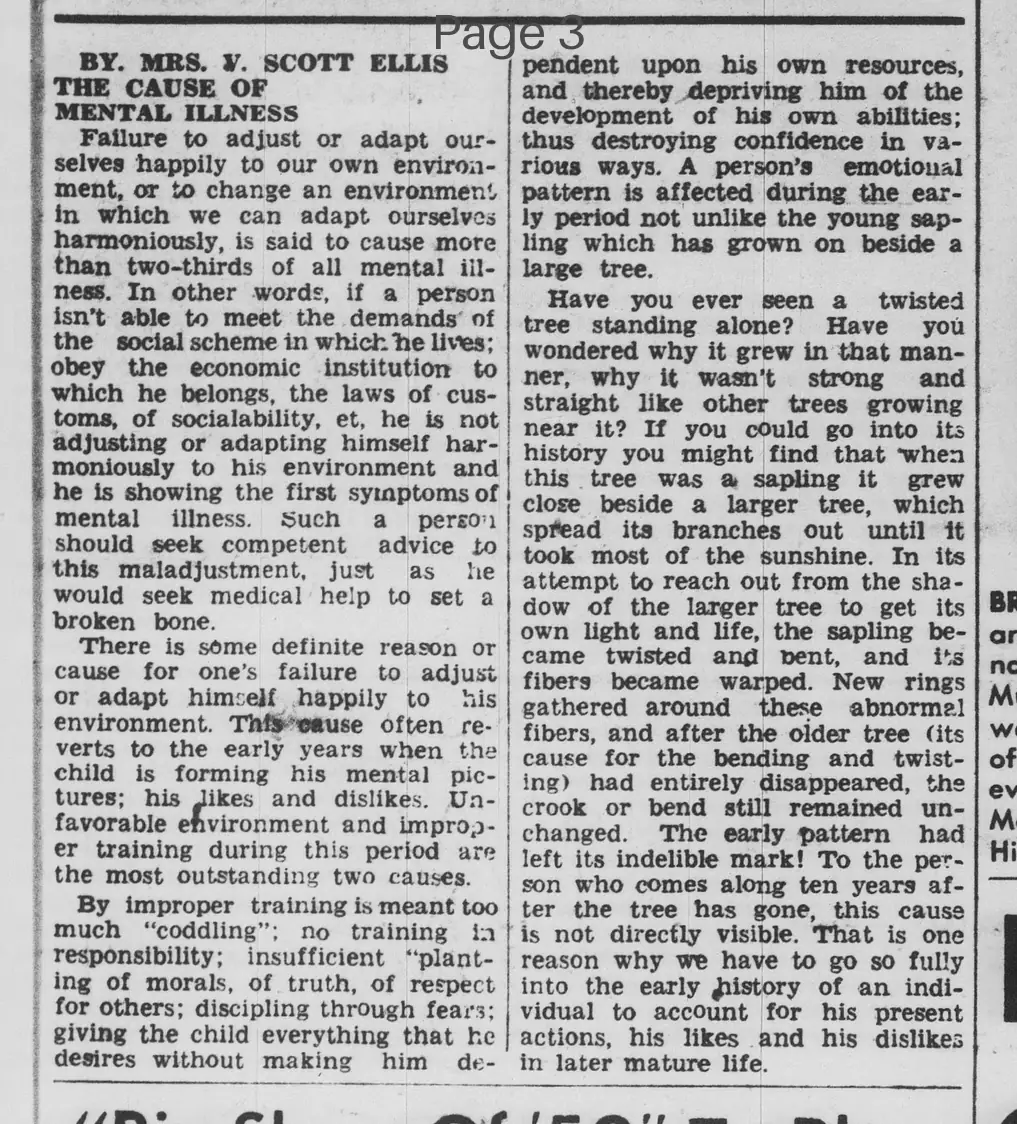
BY. MRS. Y. SCOTT ELLIS
THE CAUSE OF
MENTAL ILLNESS
Failure to adjust or adapt ourselves happily to our own environment, or to change an environment in which we can adapt ourselves harmoniously, is said to cause more than two-thirds of all mental illness. In other words, if a person isn't able to meet the demands of the social scheme in which he lives; obey the economic institution to which he belongs, the laws of customs, of socialability, etc., he is not adjusting or adapting himself harmoniously to his environment and he is showing the first symptoms of mental illness. Such a person should seek competent advice to this maladjustment, just as he would seek medical help to set a broken bone.
There is some definite reason or cause for one's failure to adjust or adapt himself happily to his environment. This cause often reverts to the early years when the child is forming his mental pictures; his likes and dislikes. Unfavorable environment and improper training during this period are the most outstanding two causes. By improper training is meant too much "coddling"; no training in responsibility; insufficient "planting of morals, of truth, of respect for others; disciplining through fears; giving the child everything that he desires without making him dependent upon his own resources, and thereby depriving him of the development of his own abilities; thus destroying confidence in various ways. A person's emotional pattern is affected during the early period not unlike the young sapling which has grown on beside a large tree.
Have you ever seen a twisted tree standing alone? Have you wondered why it grew in that manner, why it wasn't strong and straight like other trees growing near it? If you could go into its history you might find that when this tree was a sapling it grew close beside a larger tree, which spread its branches out until it took most of the sunshine. In its attempt to reach out from the shadow of the larger tree to get its own light and life, the sapling became twisted and bent, and its fibers became warped. New rings gathered around these abnormal fibers, and after the older tree (its cause for the bending and twisting) had entirely disappeared, the crook or bend still remained unchanged. The early pattern had left its indelible mark! To the person who comes along ten years after the tree has gone, this cause is not directly visible. That is one reason why we have to go so fully into the early history of an individual to account for his present actions, his likes and his dislikes in later mature life.
THE CAUSE OF
MENTAL ILLNESS
Failure to adjust or adapt ourselves happily to our own environment, or to change an environment in which we can adapt ourselves harmoniously, is said to cause more than two-thirds of all mental illness. In other words, if a person isn't able to meet the demands of the social scheme in which he lives; obey the economic institution to which he belongs, the laws of customs, of socialability, etc., he is not adjusting or adapting himself harmoniously to his environment and he is showing the first symptoms of mental illness. Such a person should seek competent advice to this maladjustment, just as he would seek medical help to set a broken bone.
There is some definite reason or cause for one's failure to adjust or adapt himself happily to his environment. This cause often reverts to the early years when the child is forming his mental pictures; his likes and dislikes. Unfavorable environment and improper training during this period are the most outstanding two causes. By improper training is meant too much "coddling"; no training in responsibility; insufficient "planting of morals, of truth, of respect for others; disciplining through fears; giving the child everything that he desires without making him dependent upon his own resources, and thereby depriving him of the development of his own abilities; thus destroying confidence in various ways. A person's emotional pattern is affected during the early period not unlike the young sapling which has grown on beside a large tree.
Have you ever seen a twisted tree standing alone? Have you wondered why it grew in that manner, why it wasn't strong and straight like other trees growing near it? If you could go into its history you might find that when this tree was a sapling it grew close beside a larger tree, which spread its branches out until it took most of the sunshine. In its attempt to reach out from the shadow of the larger tree to get its own light and life, the sapling became twisted and bent, and its fibers became warped. New rings gathered around these abnormal fibers, and after the older tree (its cause for the bending and twisting) had entirely disappeared, the crook or bend still remained unchanged. The early pattern had left its indelible mark! To the person who comes along ten years after the tree has gone, this cause is not directly visible. That is one reason why we have to go so fully into the early history of an individual to account for his present actions, his likes and his dislikes in later mature life.
What sub-type of article is it?
Medical Curiosity
What themes does it cover?
Madness
Moral Virtue
Misfortune
What keywords are associated?
Mental Illness
Childhood Training
Environmental Adjustment
Emotional Patterns
Tree Analogy
Story Details
Story Details
Failure to adjust to one's environment causes most mental illness, often due to unfavorable childhood experiences and improper training like excessive coddling and lack of moral education. Analogy of a twisted tree illustrates how early influences indelibly shape later emotional patterns.