Thank you for visiting SNEWPapers!
Sign up free
Literary
November 7, 1821
Alexandria Gazette & Daily Advertiser
Alexandria, Virginia
What is this article about?
Observations on forest tree succession in America, followed by a query from a German paper reprinted in N.Y. American, questioning how plants thrive in unfruitful earth components and the origins of ancient seeds found in deep coastal digs in East Friesland.
Clipping
OCR Quality
95%
Excellent
Full Text
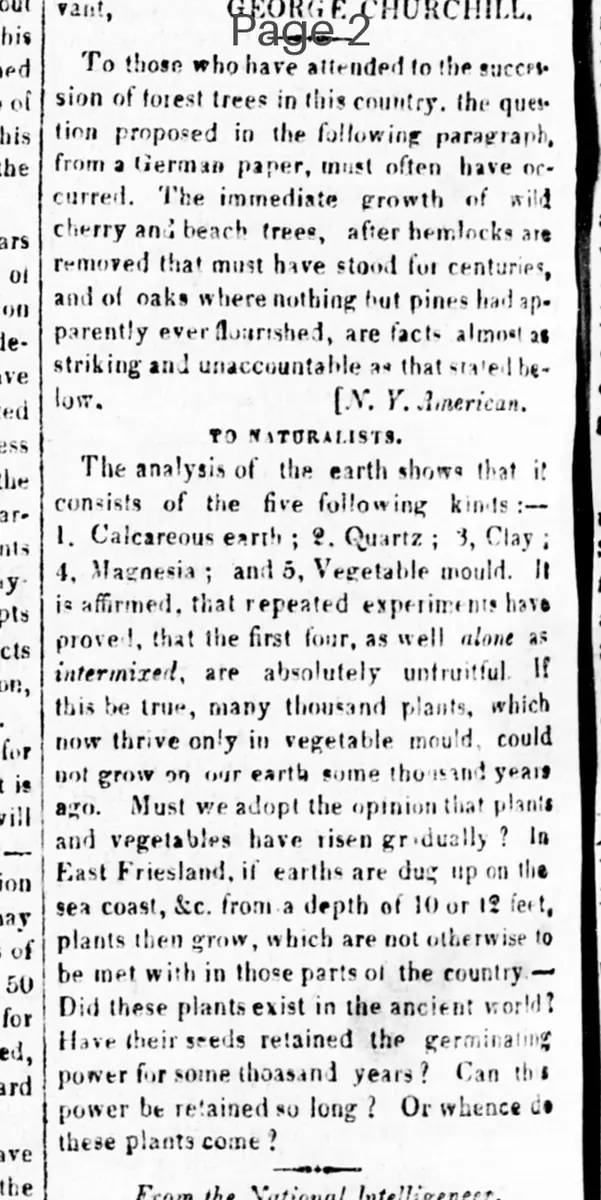
To those who have attended to the succession of forest trees in this country, the question proposed in the following paragraph, from a German paper, must often have occurred. The immediate growth of wild cherry and beach trees, after hemlocks are removed that must have stood for centuries, and of oaks where nothing but pines had apparently ever flourished, are facts almost as striking and unaccountable as that stated below.
[N. Y. American.
TO NATURALISTS.
The analysis of the earth shows that it consists of the five following kinds :-- 1. Calcareous earth; 2. Quartz; 3. Clay: 4. Magnesia; and 5. Vegetable mould. It is affirmed, that repeated experiments have proved, that the first four, as well alone as intermixt, are absolutely unfruitful. If this be true, many thousand plants, which now thrive only in vegetable mould, could not grow on our earth some thousand years ago. Must we adopt the opinion that plants and vegetables have risen gradually? In East Friesland, if earths are dug up on the sea coast, &c. from a depth of 10 or 15 feet, plants then grow, which are not otherwise to be met with in those parts of the country. Did these plants exist in the ancient world? Have their seeds retained the germinating power for some thousand years? Can this power be retained so long? Or whence do these plants come?
[N. Y. American.
TO NATURALISTS.
The analysis of the earth shows that it consists of the five following kinds :-- 1. Calcareous earth; 2. Quartz; 3. Clay: 4. Magnesia; and 5. Vegetable mould. It is affirmed, that repeated experiments have proved, that the first four, as well alone as intermixt, are absolutely unfruitful. If this be true, many thousand plants, which now thrive only in vegetable mould, could not grow on our earth some thousand years ago. Must we adopt the opinion that plants and vegetables have risen gradually? In East Friesland, if earths are dug up on the sea coast, &c. from a depth of 10 or 15 feet, plants then grow, which are not otherwise to be met with in those parts of the country. Did these plants exist in the ancient world? Have their seeds retained the germinating power for some thousand years? Can this power be retained so long? Or whence do these plants come?
What sub-type of article is it?
Essay
What themes does it cover?
Nature
What keywords are associated?
Forest Succession
Tree Growth
Earth Analysis
Vegetable Mould
Plant Origins
Ancient Seeds
East Friesland
Literary Details
Title
To Naturalists
Subject
Questions On Plant Growth And Earth Composition
Form / Style
Prose Reflection On Natural History
Key Lines
The Immediate Growth Of Wild Cherry And Beach Trees, After Hemlocks Are Removed That Must Have Stood For Centuries, And Of Oaks Where Nothing But Pines Had Apparently Ever Flourished, Are Facts Almost As Striking And Unaccountable As That Stated Below.
Must We Adopt The Opinion That Plants And Vegetables Have Risen Gradually?
Have Their Seeds Retained The Germinating Power For Some Thousand Years?