Thank you for visiting SNEWPapers!
Sign up free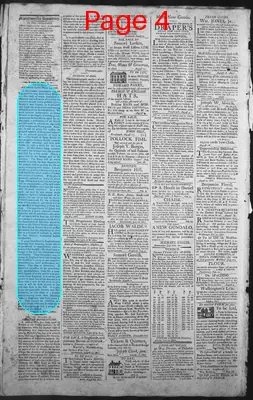
Editorial
August 25, 1807
The New Hampshire Gazette
Portsmouth, Rockingham County, New Hampshire
What is this article about?
An essay urges American farmers to save lambs and expand sheep and flax production to achieve woolen goods independence from Britain amid war threats. It advocates prohibiting British imports, offering bounties, and highlights Philadelphia's manufacturing growth to rival England.
Clipping
OCR Quality
95%
Excellent
Full Text
From the Essay Register.
FARMERS SAVE YOUR LAMBS.
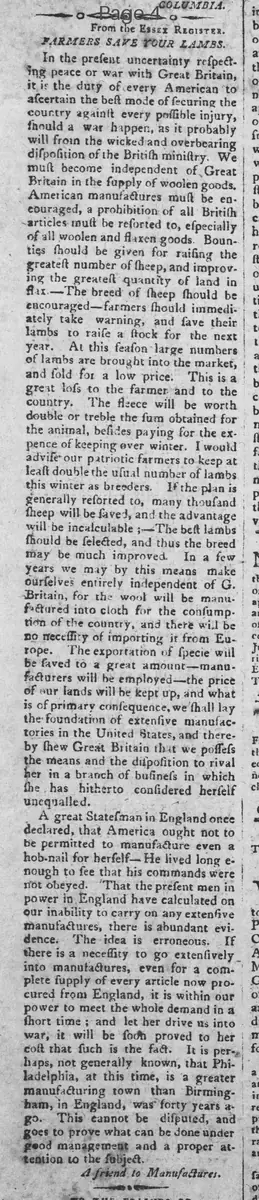
In the present uncertainty respecting peace or war with Great Britain, it is the duty of every American to ascertain the best mode of securing the country against every possible injury, should a war happen, as it probably will from the wicked and overbearing disposition of the British ministry. We must become independent of Great Britain in the supply of woolen goods. American manufactures must be encouraged, a prohibition of all British articles must be resorted to, especially of all woolen and flaxen goods. Bounties should be given for raising the greatest number of sheep, and improving the greatest quantity of land in flax.--The breed of sheep should be encouraged--farmers should immediately take warning, and save their lambs to raise a stock for the next year. At this season large numbers of lambs are brought into the market, and sold for a low price. This is a great loss to the farmer and to the country. The fleece will be worth double or treble the sum obtained for the animal, besides paying for the expense of keeping over winter. I would advise our patriotic farmers to keep at least double the usual number of lambs this winter as breeders. If the plan is generally resorted to, many thousand sheep will be saved, and the advantage will be incalculable;--The best lambs should be selected, and thus the breed may be much improved. In a few years we may by this means make ourselves entirely independent of G. Britain, for the wool will be manufactured into cloth for the consumption of the country, and there will be no necessity of importing it from Europe. The exportation of specie will be saved to a great amount--manufacturers will be employed--the price of our lands will be kept up, and what is of primary consequence, we shall lay the foundation of extensive manufactories in the United States, and thereby show Great Britain that we possess the means and the disposition to rival her in a branch of business in which she has hitherto considered herself unequalled.
A great Statesman in England once declared, that America ought not to be permitted to manufacture even a hobnail for herself-- He lived long enough to see that his commands were not obeyed. That the present men in power in England have calculated on our inability to carry on any extensive manufactures, there is abundant evidence. The idea is erroneous. If there is a necessity to go extensively into manufactures, even for a complete supply of every article now procured from England, it is within our power to meet the whole demand in a short time; and let her drive us into war. it will be soon proved to her cost that such is the fact. It is perhaps, not generally known, that Philadelphia, at this time, is a greater manufacturing town than Birmingham, in England, was forty years ago. This cannot be disputed, and goes to prove what can be done under good management and a proper attention to the subject.
A friend to Manufactures.
FARMERS SAVE YOUR LAMBS.
In the present uncertainty respecting peace or war with Great Britain, it is the duty of every American to ascertain the best mode of securing the country against every possible injury, should a war happen, as it probably will from the wicked and overbearing disposition of the British ministry. We must become independent of Great Britain in the supply of woolen goods. American manufactures must be encouraged, a prohibition of all British articles must be resorted to, especially of all woolen and flaxen goods. Bounties should be given for raising the greatest number of sheep, and improving the greatest quantity of land in flax.--The breed of sheep should be encouraged--farmers should immediately take warning, and save their lambs to raise a stock for the next year. At this season large numbers of lambs are brought into the market, and sold for a low price. This is a great loss to the farmer and to the country. The fleece will be worth double or treble the sum obtained for the animal, besides paying for the expense of keeping over winter. I would advise our patriotic farmers to keep at least double the usual number of lambs this winter as breeders. If the plan is generally resorted to, many thousand sheep will be saved, and the advantage will be incalculable;--The best lambs should be selected, and thus the breed may be much improved. In a few years we may by this means make ourselves entirely independent of G. Britain, for the wool will be manufactured into cloth for the consumption of the country, and there will be no necessity of importing it from Europe. The exportation of specie will be saved to a great amount--manufacturers will be employed--the price of our lands will be kept up, and what is of primary consequence, we shall lay the foundation of extensive manufactories in the United States, and thereby show Great Britain that we possess the means and the disposition to rival her in a branch of business in which she has hitherto considered herself unequalled.
A great Statesman in England once declared, that America ought not to be permitted to manufacture even a hobnail for herself-- He lived long enough to see that his commands were not obeyed. That the present men in power in England have calculated on our inability to carry on any extensive manufactures, there is abundant evidence. The idea is erroneous. If there is a necessity to go extensively into manufactures, even for a complete supply of every article now procured from England, it is within our power to meet the whole demand in a short time; and let her drive us into war. it will be soon proved to her cost that such is the fact. It is perhaps, not generally known, that Philadelphia, at this time, is a greater manufacturing town than Birmingham, in England, was forty years ago. This cannot be disputed, and goes to prove what can be done under good management and a proper attention to the subject.
A friend to Manufactures.
What sub-type of article is it?
Economic Policy
Agriculture
Trade Or Commerce
What keywords are associated?
Wool Production
Sheep Farming
American Manufactures
British Imports
Economic Independence
War Preparation
What entities or persons were involved?
Great Britain
British Ministry
American Farmers
Philadelphia
Birmingham
Editorial Details
Primary Topic
Promoting Domestic Wool And Flax Production For Independence From British Imports
Stance / Tone
Strongly Pro American Manufacturing Independence And Anti British Reliance
Key Figures
Great Britain
British Ministry
American Farmers
Philadelphia
Birmingham
Key Arguments
Become Independent Of British Woolen Goods Through Domestic Production
Prohibit British Woolen And Flaxen Imports
Offer Bounties For Sheep Raising And Flax Land Improvement
Save Lambs To Build Sheep Stock And Improve Breed
Domestic Manufacturing Will Employ People, Save Specie, And Raise Land Prices
America Can Rival Britain In Manufactures, As Shown By Philadelphia's Growth