Thank you for visiting SNEWPapers!
Sign up free
Story
December 21, 1961
Holmes County Herald
Lexington, Holmes County, Mississippi
What is this article about?
Dr. Robert E. Cooke, pediatrician at Johns Hopkins, forecasts voluntary pre-marital genetic tests to identify risks of hereditary birth defects, promoting education and research funded by March of Dimes to prevent tragedies affecting 250,000 U.S. babies yearly.
Clipping
OCR Quality
98%
Excellent
Full Text
March of Dimes Clinic Head Forecasts
Pre-Marital Tests for Birth Defects
Before most thoughtful young couples marry, they do a great deal of planning for the future. They ponder about jobs, homes of their own, saving money for their retirement years.
All well and good, but-
The pediatrician-in-chief at famed Johns Hopkins University Hospital, Baltimore, Md., wishes they would invest as much thought before marriage in their planning for healthy children.
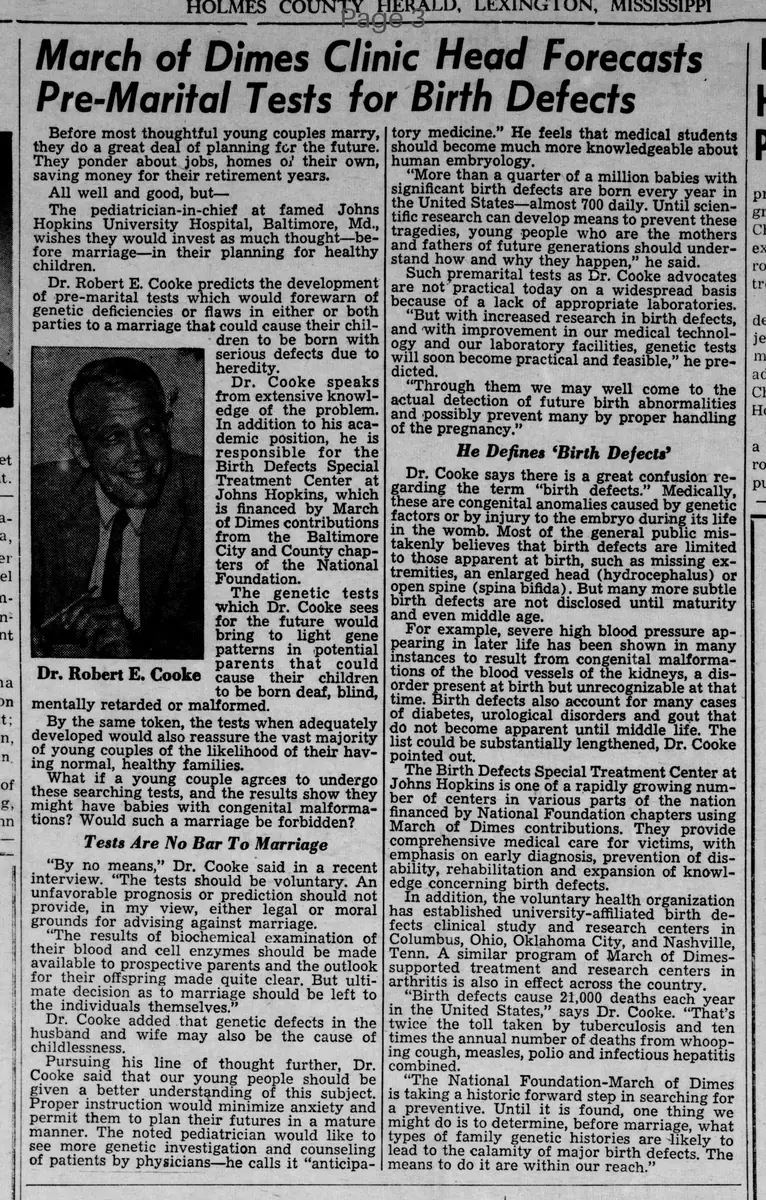
Dr. Robert E. Cooke predicts the development of pre-marital tests which would forewarn of genetic deficiencies or flaws in either or both parties to a marriage that could cause their children to be born with serious defects due to heredity.
Dr. Cooke speaks from extensive knowledge of the problem. In addition to his academic position, he is responsible for the Birth Defects Special Treatment Center at Johns Hopkins, which is financed by March of Dimes contributions from the Baltimore City and County chapters of the National Foundation.
The genetic tests which Dr. Cooke sees for the future would bring to light gene patterns in potential parents that could cause their children to be born deaf, blind, mentally retarded or malformed.
By the same token, the tests when adequately developed would also reassure the vast majority of young couples of the likelihood of their having normal, healthy families.
What if a young couple agrees to undergo these searching tests, and the results show they might have babies with congenital malformations? Would such a marriage be forbidden?
Tests Are No Bar To Marriage
"By no means," Dr. Cooke said in a recent interview. "The tests should be voluntary. An unfavorable prognosis or prediction should not provide, in my view, either legal or moral grounds for advising against marriage.
"The results of biochemical examination of their blood and cell enzymes should be made available to prospective parents and the outlook for their offspring made quite clear. But ultimate decision as to marriage should be left to the individuals themselves."
Dr. Cooke added that genetic defects in the husband and wife may also be the cause of childlessness.
Pursuing his line of thought further, Dr. Cooke said that our young people should be given a better understanding of this subject.
Proper instruction would minimize anxiety and permit them to plan their futures in a mature manner. The noted pediatrician would like to see more genetic investigation and counseling of patients by physicians - he calls it "anticipatory medicine." He feels that medical students should become much more knowledgeable about human embryology.
"More than a quarter of a million babies with significant birth defects are born every year in the United States--almost 700 daily. Until scientific research can develop means to prevent these tragedies, young people who are the mothers and fathers of future generations should understand how and why they happen," he said.
Such premarital tests as Dr. Cooke advocates are not practical today on a widespread basis because of a lack of appropriate laboratories.
"But with increased research in birth defects, and with improvement in our medical technology and our laboratory facilities, genetic tests will soon become practical and feasible," he predicted.
"Through them we may well come to the actual detection of future birth abnormalities and possibly prevent many by proper handling of the pregnancy."
He Defines 'Birth Defects'
Dr. Cooke says there is a great confusion regarding the term "birth defects." Medically, these are congenital anomalies caused by genetic factors or by injury to the embryo during its life in the womb. Most of the general public mistakenly believes that birth defects are limited to those apparent at birth, such as missing extremities, an enlarged head (hydrocephalus) or open spine (spina bifida). But many more subtle birth defects are not disclosed until maturity and even middle age.
For example, severe high blood pressure appearing in later life has been shown in many instances to result from congenital malformations of the blood vessels of the kidneys, a disorder present at birth but unrecognizable at that time. Birth defects also account for many cases of diabetes, urological disorders and gout that do not become apparent until middle life. The list could be substantially lengthened, Dr. Cooke pointed out.
The Birth Defects Special Treatment Center at Johns Hopkins is one of a rapidly growing number of centers in various parts of the nation financed by National Foundation chapters using March of Dimes contributions. They provide comprehensive medical care for victims, with emphasis on early diagnosis, prevention of disability, rehabilitation and expansion of knowledge concerning birth defects.
In addition, the voluntary health organization has established university-affiliated birth defects clinical study and research centers in Columbus, Ohio, Oklahoma City, and Nashville, Tenn. A similar program of March of Dimes-supported treatment and research centers in arthritis is also in effect across the country.
"Birth defects cause 21,000 deaths each year in the United States," says Dr. Cooke. "That's twice the toll taken by tuberculosis and ten times the annual number of deaths from whooping cough, measles, polio and infectious hepatitis combined.
"The National Foundation-March of Dimes is taking a historic forward step in searching for a preventive. Until it is found, one thing we might do is to determine, before marriage, what types of family genetic histories are likely to lead to the calamity of major birth defects. The means to do it are within our reach."
Pre-Marital Tests for Birth Defects
Before most thoughtful young couples marry, they do a great deal of planning for the future. They ponder about jobs, homes of their own, saving money for their retirement years.
All well and good, but-
The pediatrician-in-chief at famed Johns Hopkins University Hospital, Baltimore, Md., wishes they would invest as much thought before marriage in their planning for healthy children.
Dr. Robert E. Cooke predicts the development of pre-marital tests which would forewarn of genetic deficiencies or flaws in either or both parties to a marriage that could cause their children to be born with serious defects due to heredity.
Dr. Cooke speaks from extensive knowledge of the problem. In addition to his academic position, he is responsible for the Birth Defects Special Treatment Center at Johns Hopkins, which is financed by March of Dimes contributions from the Baltimore City and County chapters of the National Foundation.
The genetic tests which Dr. Cooke sees for the future would bring to light gene patterns in potential parents that could cause their children to be born deaf, blind, mentally retarded or malformed.
By the same token, the tests when adequately developed would also reassure the vast majority of young couples of the likelihood of their having normal, healthy families.
What if a young couple agrees to undergo these searching tests, and the results show they might have babies with congenital malformations? Would such a marriage be forbidden?
Tests Are No Bar To Marriage
"By no means," Dr. Cooke said in a recent interview. "The tests should be voluntary. An unfavorable prognosis or prediction should not provide, in my view, either legal or moral grounds for advising against marriage.
"The results of biochemical examination of their blood and cell enzymes should be made available to prospective parents and the outlook for their offspring made quite clear. But ultimate decision as to marriage should be left to the individuals themselves."
Dr. Cooke added that genetic defects in the husband and wife may also be the cause of childlessness.
Pursuing his line of thought further, Dr. Cooke said that our young people should be given a better understanding of this subject.
Proper instruction would minimize anxiety and permit them to plan their futures in a mature manner. The noted pediatrician would like to see more genetic investigation and counseling of patients by physicians - he calls it "anticipatory medicine." He feels that medical students should become much more knowledgeable about human embryology.
"More than a quarter of a million babies with significant birth defects are born every year in the United States--almost 700 daily. Until scientific research can develop means to prevent these tragedies, young people who are the mothers and fathers of future generations should understand how and why they happen," he said.
Such premarital tests as Dr. Cooke advocates are not practical today on a widespread basis because of a lack of appropriate laboratories.
"But with increased research in birth defects, and with improvement in our medical technology and our laboratory facilities, genetic tests will soon become practical and feasible," he predicted.
"Through them we may well come to the actual detection of future birth abnormalities and possibly prevent many by proper handling of the pregnancy."
He Defines 'Birth Defects'
Dr. Cooke says there is a great confusion regarding the term "birth defects." Medically, these are congenital anomalies caused by genetic factors or by injury to the embryo during its life in the womb. Most of the general public mistakenly believes that birth defects are limited to those apparent at birth, such as missing extremities, an enlarged head (hydrocephalus) or open spine (spina bifida). But many more subtle birth defects are not disclosed until maturity and even middle age.
For example, severe high blood pressure appearing in later life has been shown in many instances to result from congenital malformations of the blood vessels of the kidneys, a disorder present at birth but unrecognizable at that time. Birth defects also account for many cases of diabetes, urological disorders and gout that do not become apparent until middle life. The list could be substantially lengthened, Dr. Cooke pointed out.
The Birth Defects Special Treatment Center at Johns Hopkins is one of a rapidly growing number of centers in various parts of the nation financed by National Foundation chapters using March of Dimes contributions. They provide comprehensive medical care for victims, with emphasis on early diagnosis, prevention of disability, rehabilitation and expansion of knowledge concerning birth defects.
In addition, the voluntary health organization has established university-affiliated birth defects clinical study and research centers in Columbus, Ohio, Oklahoma City, and Nashville, Tenn. A similar program of March of Dimes-supported treatment and research centers in arthritis is also in effect across the country.
"Birth defects cause 21,000 deaths each year in the United States," says Dr. Cooke. "That's twice the toll taken by tuberculosis and ten times the annual number of deaths from whooping cough, measles, polio and infectious hepatitis combined.
"The National Foundation-March of Dimes is taking a historic forward step in searching for a preventive. Until it is found, one thing we might do is to determine, before marriage, what types of family genetic histories are likely to lead to the calamity of major birth defects. The means to do it are within our reach."
What sub-type of article is it?
Medical Curiosity
What themes does it cover?
Misfortune
Moral Virtue
Recovery
What keywords are associated?
Birth Defects
Pre Marital Tests
Genetic Screening
March Of Dimes
Johns Hopkins
What entities or persons were involved?
Dr. Robert E. Cooke
Where did it happen?
Baltimore, Md., Johns Hopkins University Hospital
Story Details
Key Persons
Dr. Robert E. Cooke
Location
Baltimore, Md., Johns Hopkins University Hospital
Story Details
Dr. Robert E. Cooke predicts future pre-marital genetic tests to detect risks of birth defects in children, emphasizing voluntary testing, education, and anticipatory medicine to prevent tragedies funded by March of Dimes.