Thank you for visiting SNEWPapers!
Sign up free
Editorial
June 12, 1946
The Daily Alaska Empire
Juneau, Juneau County, Alaska
What is this article about?
Editorial discusses Rep. Monroney's proposal for federal funding of presidential campaigns to curb corruption, citing historical precedents and current issues like high costs and circumvention of spending limits.
Clipping
OCR Quality
98%
Excellent
Full Text
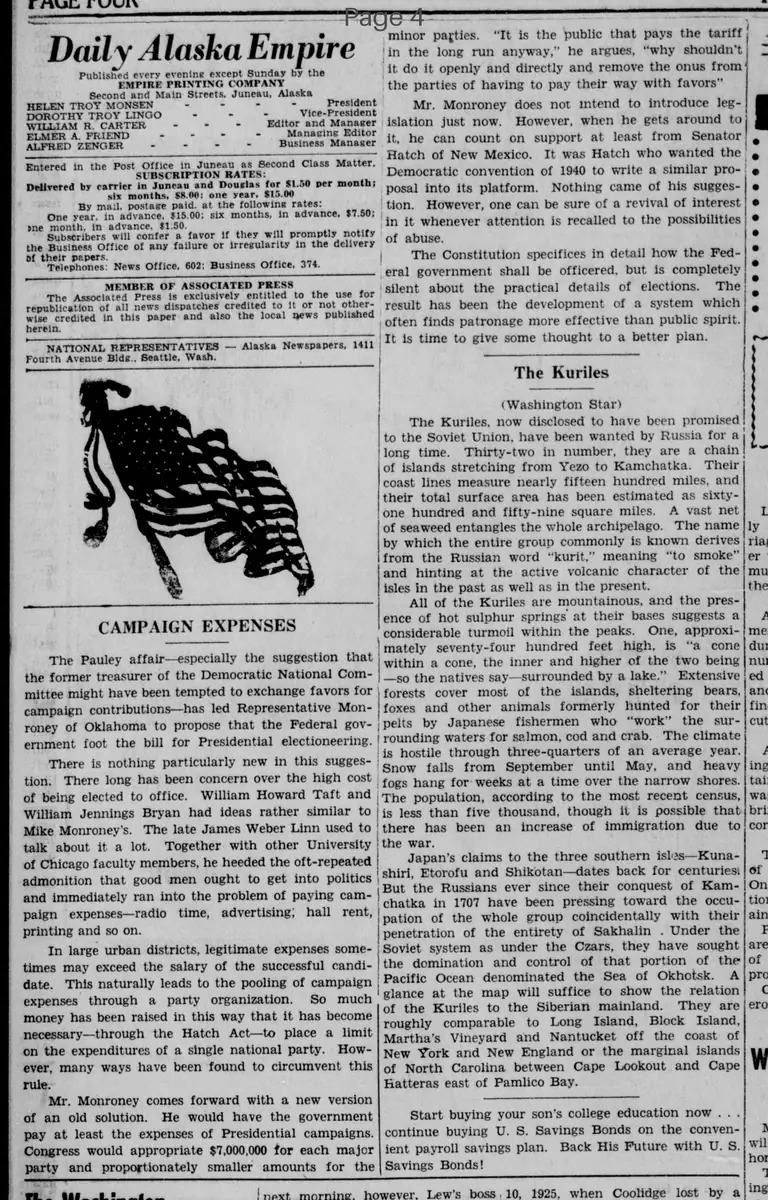
CAMPAIGN EXPENSES
The Pauley affair-especially the suggestion that the former treasurer of the Democratic National Committee might have been tempted to exchange favors for campaign contributions-has led Representative Monroney of Oklahoma to propose that the Federal government foot the bill for Presidential electioneering.
There is nothing particularly new in this suggestion. There long has been concern over the high cost of being elected to office. William Howard Taft and William Jennings Bryan had ideas rather similar to Mike Monroney's. The late James Weber Linn used to talk about it a lot. Together with other University of Chicago faculty members, he heeded the oft-repeated admonition that good men ought to get into politics and immediately ran into the problem of paying campaign expenses-radio time, advertising; hall rent, printing and so on.
In large urban districts, legitimate expenses sometimes may exceed the salary of the successful candidate. This naturally leads to the pooling of campaign expenses through a party organization. So much money has been raised in this way that it has become necessary-through the Hatch Act--to place a limit on the expenditures of a single national party. However, many ways have been found to circumvent this rule.
Mr. Monroney comes forward with a new version of an old solution. He would have the government pay at least the expenses of Presidential campaigns. Congress would appropriate $7,000,000 for each major party and proportionately smaller amounts for the minor parties. "It is the public that pays the tariff in the long run anyway." he argues. "why shouldn't it do it openly and directly and remove the onus from the parties of having to pay their way with favors"
Mr. Monroney does not intend to introduce legislation just now. However. when he gets around to it, he can count on support at least from Senator Hatch of New Mexico. It was Hatch who wanted the Democratic convention of 1940 to write a similar proposal into its platform. Nothing came of his suggestion. However. one can be sure of a revival of interest in it whenever attention is recalled to the possibilities of abuse.
The Constitution specifices in detail how the Federal government shall be officered, but is completely silent about the practical details of elections. The result has been the development of a system which often finds patronage more effective than public spirit. It is time to give some thought to a better plan.
The Pauley affair-especially the suggestion that the former treasurer of the Democratic National Committee might have been tempted to exchange favors for campaign contributions-has led Representative Monroney of Oklahoma to propose that the Federal government foot the bill for Presidential electioneering.
There is nothing particularly new in this suggestion. There long has been concern over the high cost of being elected to office. William Howard Taft and William Jennings Bryan had ideas rather similar to Mike Monroney's. The late James Weber Linn used to talk about it a lot. Together with other University of Chicago faculty members, he heeded the oft-repeated admonition that good men ought to get into politics and immediately ran into the problem of paying campaign expenses-radio time, advertising; hall rent, printing and so on.
In large urban districts, legitimate expenses sometimes may exceed the salary of the successful candidate. This naturally leads to the pooling of campaign expenses through a party organization. So much money has been raised in this way that it has become necessary-through the Hatch Act--to place a limit on the expenditures of a single national party. However, many ways have been found to circumvent this rule.
Mr. Monroney comes forward with a new version of an old solution. He would have the government pay at least the expenses of Presidential campaigns. Congress would appropriate $7,000,000 for each major party and proportionately smaller amounts for the minor parties. "It is the public that pays the tariff in the long run anyway." he argues. "why shouldn't it do it openly and directly and remove the onus from the parties of having to pay their way with favors"
Mr. Monroney does not intend to introduce legislation just now. However. when he gets around to it, he can count on support at least from Senator Hatch of New Mexico. It was Hatch who wanted the Democratic convention of 1940 to write a similar proposal into its platform. Nothing came of his suggestion. However. one can be sure of a revival of interest in it whenever attention is recalled to the possibilities of abuse.
The Constitution specifices in detail how the Federal government shall be officered, but is completely silent about the practical details of elections. The result has been the development of a system which often finds patronage more effective than public spirit. It is time to give some thought to a better plan.
What sub-type of article is it?
Partisan Politics
Legal Reform
Suffrage
What keywords are associated?
Campaign Expenses
Public Funding
Election Costs
Political Reform
Hatch Act
Presidential Campaigns
Party Financing
What entities or persons were involved?
Pauley
Monroney
Taft
Bryan
Linn
Hatch
Democratic National Committee
Hatch Act
Editorial Details
Primary Topic
Proposal For Government Funding Of Presidential Campaigns
Stance / Tone
Supportive Of Public Financing To Reduce Corruption In Elections
Key Figures
Pauley
Monroney
Taft
Bryan
Linn
Hatch
Democratic National Committee
Hatch Act
Key Arguments
High Cost Of Campaigns Tempts Favors For Contributions
Government Should Pay For Presidential Electioneering To Remove Onus Of Favors
Historical Precedents From Taft, Bryan, And Linn
Legitimate Expenses Exceed Salaries In Urban Districts
Hatch Act Limits Expenditures But Is Circumvented
Appropriate $7m For Major Parties, Less For Minors
Public Pays Indirectly Anyway, Better Openly
Constitution Silent On Election Details, Leading To Patronage Over Public Spirit