Thank you for visiting SNEWPapers!
Sign up free
Editorial
April 15, 1803
Alexandria Advertiser And Commercial Intelligencer
Alexandria, Virginia
What is this article about?
An editorial argues against Thomas Jefferson's recommendation for speedy admission of immigrants to suffrage rights, citing historical betrayals of native hospitality by Europeans, risks from monarchist or revolutionary immigrants, and parallels to Rome's fall under Caesar due to alien influences in elections.
Clipping
OCR Quality
88%
Good
Full Text
From the BALANCE.
ON THE IMPOLICY OF A SPEEDY ADMISSION OF ALIENS TO A PARTICIPATION OF THE RIGHTS OF SUFFRAGE.
No. V.
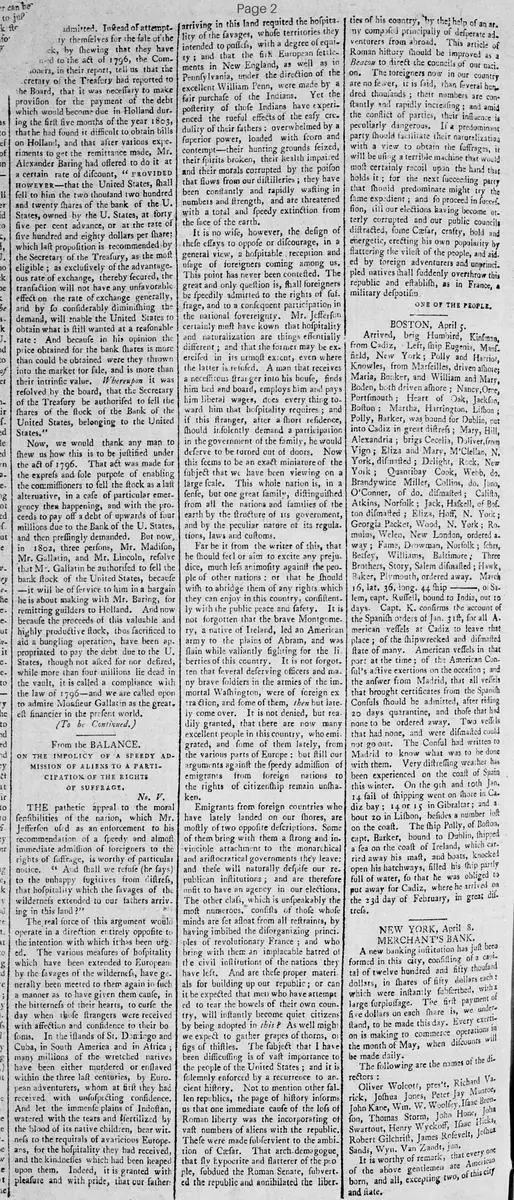
THE pathetic appeal to the moral sensibilities of the nation, which Mr. Jefferson used as an enforcement to his recommendation of a speedy and almost immediate admission of foreigners to the rights of suffrage, is worthy of particular notice. " And shall we refuse (he says) to the unhappy fugitives from distress, that hospitality which the savages of the wilderness extended to our fathers arriving in this land ?"
The real force of this argument would operate in a direction entirely opposite to the intention with which it has been urged. The various measures of hospitality which have been extended to Europeans by the savages of the wilderness, have generally been meted to them again in such a manner as to have given them cause in the bitterness of their hearts, to curse the day when those strangers were received with affection and confidence to their bosoms. In the islands of St. Domingo and Cuba, in South America and in Africa: many millions of the wretched natives have been either murdered or enslaved within the three last centuries, by European adventurers, whom at first they had received with unsusp[ec]ting confidence. And let the immense plains of Hindostan, watered with the tears and fertilized by the blood of its native children, bear witness to the requitals of avaricious Europeans, for the hospitality they had received, and the kindness which had been heaped upon them. Indeed, it is granted with pleasure and with pride, that our fathers arriving in this land requited the hospitality of the savages, whose territories they intended to possess, with a degree of equity; and that the first European settlements in New England, as well as in Pennsylvania, under the direction of the excellent William Penn, were made by a fair purchase of the Indians. Yet the posterity of those Indians have experienced the rueful effects of the easy credulity of their fathers: overwhelmed by a superior power, loaded with scorn and contempt--their hunting grounds seized, their spirits broken, their health impaired and their morals corrupted by the poison that flows from our distilleries; they have been constantly and rapidly wasting in numbers and strength, and are threatened with a total and speedy extinction from the face of the earth.
It is now, however, the design of these essays to oppose or discourage, in a general view, a hospitable reception and usage of foreigners coming among us. This point has never been contested. The great and only question is, shall foreigners be speedily admitted to the rights of suffrage, and to a consequent participation in the national sovereignty. Mr. Jefferson certainly must have known that hospitality and naturalization are things essentially different; and that the former may be exercised in its utmost extent, even where the latter is refused. A man that receives a necessitous stranger into his house, finds him bed and board, employs him and pays him liberal wages, does every thing toward him that hospitality requires; and if this stranger, after a short residence, should insolently demand a participation in the government of the family, he would deserve to be turned out of doors. Now this seems to be an exact miniature of the subject that we have been viewing on a large scale. This whole nation is, in a sense, but one great family, distinguished from all the nations and families of the earth by the structure of its government, and by the peculiar nature of its regulations, laws and customs.
Far be it from the writer of this. that he should feel or aim to excite any prejudice, much less animosity against the people of other nations: or that he should wish to abridge them of any rights which they can enjoy in this country, consistently with the public peace and safety. It is not forgotten that the brave Montgomery, a native of Ireland, led an American army to the plains of Abraham, and was slain while valiantly fighting for the liberties of this country. It is not forgotten that several deserving officers and many brave soldiers in the armies of the immortal Washington, were of foreign extraction, and some of them, then but lately come over. It is not denied, but readily granted, that there are now many excellent people in this country, who emigrated, and some of them lately, from the various parts of Europe: but still our arguments against the speedy admission of emigrants from foreign nations to the rights of citizenship remain unshaken.
Emigrants from foreign countries who have lately landed on our shores, are mostly of two opposite descriptions. Some of them bring with them a strong and invincible attachment to the monarchical and aristocratical governments they leave: and these will naturally despise our republican institutions; and are therefore unfit to have an agency in our elections. The other class, which is unspeakably the most numerous, consists of those whose minds are set afloat from all restraints, by having imbibed the disorganizing principles of revolutionary France: and who bring with them an implacable hatred of the civil institutions of the nations they have left. And are these proper materials for building up our republic; or can it be expected that men who have attempted to tear the bowels of their own country, will instantly become quiet citizens by being adopted in this? As well might we expect to gather grapes of thorns, or figs of thistles. The subject that I have been discussing is of vast importance to the people of the United States; and it is solemnly enforced by a recurrence to ancient history. Not to mention other fallen republics, the page of history informs us that one immediate cause of the loss of Roman liberty was the incorporating of vast numbers of aliens with the republic. These were made subservient to the ambition of Cæsar. That arch-demagogue that sly hypocrite and flatterer of the people, subdued the Roman Senate, subverted the republic and annihilated the liberties of his country, by the help of an army composed principally of desperate adventurers from abroad. This article of Roman history should be improved as a Beacon to direct the councils of our nation. The foreigners now in our country are no fewer, it is said, than several hundred thousands; their numbers are constantly and rapidly increasing; and amid the conflict of parties, their influence is peculiarly dangerous. If a predominant party should facilitate their naturalization with a view to obtain the suffrages, it will be using a terrible machine that would most certainly recoil upon the hand that holds it; for the next succeeding party that should predominate might try the same expedient; and so proceed in succession, till our elections having become utterly corrupted and our public councils distracted, some Cæsar, crafty, bold and energetic, erecting his own popularity by flattering the vilest of the people, and aided by foreign adventurers and unprincipled natives shall suddenly overthrow this republic and establish, as in France, a military despotism.
ON THE IMPOLICY OF A SPEEDY ADMISSION OF ALIENS TO A PARTICIPATION OF THE RIGHTS OF SUFFRAGE.
No. V.
THE pathetic appeal to the moral sensibilities of the nation, which Mr. Jefferson used as an enforcement to his recommendation of a speedy and almost immediate admission of foreigners to the rights of suffrage, is worthy of particular notice. " And shall we refuse (he says) to the unhappy fugitives from distress, that hospitality which the savages of the wilderness extended to our fathers arriving in this land ?"
The real force of this argument would operate in a direction entirely opposite to the intention with which it has been urged. The various measures of hospitality which have been extended to Europeans by the savages of the wilderness, have generally been meted to them again in such a manner as to have given them cause in the bitterness of their hearts, to curse the day when those strangers were received with affection and confidence to their bosoms. In the islands of St. Domingo and Cuba, in South America and in Africa: many millions of the wretched natives have been either murdered or enslaved within the three last centuries, by European adventurers, whom at first they had received with unsusp[ec]ting confidence. And let the immense plains of Hindostan, watered with the tears and fertilized by the blood of its native children, bear witness to the requitals of avaricious Europeans, for the hospitality they had received, and the kindness which had been heaped upon them. Indeed, it is granted with pleasure and with pride, that our fathers arriving in this land requited the hospitality of the savages, whose territories they intended to possess, with a degree of equity; and that the first European settlements in New England, as well as in Pennsylvania, under the direction of the excellent William Penn, were made by a fair purchase of the Indians. Yet the posterity of those Indians have experienced the rueful effects of the easy credulity of their fathers: overwhelmed by a superior power, loaded with scorn and contempt--their hunting grounds seized, their spirits broken, their health impaired and their morals corrupted by the poison that flows from our distilleries; they have been constantly and rapidly wasting in numbers and strength, and are threatened with a total and speedy extinction from the face of the earth.
It is now, however, the design of these essays to oppose or discourage, in a general view, a hospitable reception and usage of foreigners coming among us. This point has never been contested. The great and only question is, shall foreigners be speedily admitted to the rights of suffrage, and to a consequent participation in the national sovereignty. Mr. Jefferson certainly must have known that hospitality and naturalization are things essentially different; and that the former may be exercised in its utmost extent, even where the latter is refused. A man that receives a necessitous stranger into his house, finds him bed and board, employs him and pays him liberal wages, does every thing toward him that hospitality requires; and if this stranger, after a short residence, should insolently demand a participation in the government of the family, he would deserve to be turned out of doors. Now this seems to be an exact miniature of the subject that we have been viewing on a large scale. This whole nation is, in a sense, but one great family, distinguished from all the nations and families of the earth by the structure of its government, and by the peculiar nature of its regulations, laws and customs.
Far be it from the writer of this. that he should feel or aim to excite any prejudice, much less animosity against the people of other nations: or that he should wish to abridge them of any rights which they can enjoy in this country, consistently with the public peace and safety. It is not forgotten that the brave Montgomery, a native of Ireland, led an American army to the plains of Abraham, and was slain while valiantly fighting for the liberties of this country. It is not forgotten that several deserving officers and many brave soldiers in the armies of the immortal Washington, were of foreign extraction, and some of them, then but lately come over. It is not denied, but readily granted, that there are now many excellent people in this country, who emigrated, and some of them lately, from the various parts of Europe: but still our arguments against the speedy admission of emigrants from foreign nations to the rights of citizenship remain unshaken.
Emigrants from foreign countries who have lately landed on our shores, are mostly of two opposite descriptions. Some of them bring with them a strong and invincible attachment to the monarchical and aristocratical governments they leave: and these will naturally despise our republican institutions; and are therefore unfit to have an agency in our elections. The other class, which is unspeakably the most numerous, consists of those whose minds are set afloat from all restraints, by having imbibed the disorganizing principles of revolutionary France: and who bring with them an implacable hatred of the civil institutions of the nations they have left. And are these proper materials for building up our republic; or can it be expected that men who have attempted to tear the bowels of their own country, will instantly become quiet citizens by being adopted in this? As well might we expect to gather grapes of thorns, or figs of thistles. The subject that I have been discussing is of vast importance to the people of the United States; and it is solemnly enforced by a recurrence to ancient history. Not to mention other fallen republics, the page of history informs us that one immediate cause of the loss of Roman liberty was the incorporating of vast numbers of aliens with the republic. These were made subservient to the ambition of Cæsar. That arch-demagogue that sly hypocrite and flatterer of the people, subdued the Roman Senate, subverted the republic and annihilated the liberties of his country, by the help of an army composed principally of desperate adventurers from abroad. This article of Roman history should be improved as a Beacon to direct the councils of our nation. The foreigners now in our country are no fewer, it is said, than several hundred thousands; their numbers are constantly and rapidly increasing; and amid the conflict of parties, their influence is peculiarly dangerous. If a predominant party should facilitate their naturalization with a view to obtain the suffrages, it will be using a terrible machine that would most certainly recoil upon the hand that holds it; for the next succeeding party that should predominate might try the same expedient; and so proceed in succession, till our elections having become utterly corrupted and our public councils distracted, some Cæsar, crafty, bold and energetic, erecting his own popularity by flattering the vilest of the people, and aided by foreign adventurers and unprincipled natives shall suddenly overthrow this republic and establish, as in France, a military despotism.
What sub-type of article is it?
Immigration
Suffrage
Constitutional
What keywords are associated?
Immigration Policy
Naturalization
Suffrage Rights
Foreigners
Republican Institutions
Historical Warnings
Roman Republic
What entities or persons were involved?
Mr. Jefferson
William Penn
Montgomery
Washington
Cæsar
Editorial Details
Primary Topic
Impolicy Of Speedy Admission Of Aliens To Suffrage Rights
Stance / Tone
Strongly Opposed To Quick Naturalization And Suffrage For Immigrants
Key Figures
Mr. Jefferson
William Penn
Montgomery
Washington
Cæsar
Key Arguments
Jefferson's Appeal To Hospitality Misapplies To Suffrage Rights
Historical Betrayals By Europeans Of Native Hospitality
Early American Fairness To Indians Led To Their Decline
Hospitality Differs From Naturalization; Quick Suffrage Like Demanding Family Governance
Foreigners Include Monarchists Despising Republicanism And French Revolutionaries Disrupting Society
Roman Liberty Lost Due To Alien Incorporation Aiding Caesar's Rise
Rapidly Increasing Foreigners Pose Danger To Elections And Republic