Thank you for visiting SNEWPapers!
Sign up free
Washington Telegraph
Washington, Hempstead County, Arkansas
What is this article about?
Account from San Francisco Times on Navigator's Islands (Samoa), detailing missionary activities, resident experiences of Dr. Van Camp and George C. Bissell, local customs like marriage, trade with whalers and traders, products, and settlements at Apia and Upolu.
Clipping
OCR Quality
Full Text
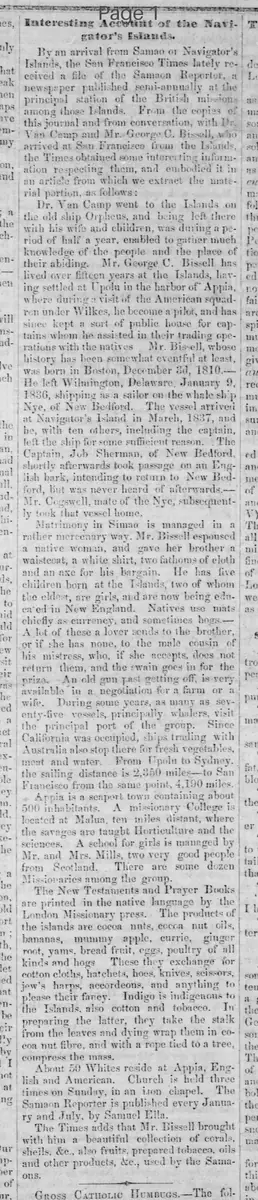
By an arrival from Samoa or Navigator's Islands, the San Francisco Times lately received a file of the Samoan Reporter, a newspaper published semi-annually at the principal station of the British mission among those Islands. From the copies of this journal and from conversation, with Dr. Van Camp and Mr. George C. Bissell, who arrived at San Francisco from the Islands, the Times obtained some interesting information respecting them, and embodied it in an article from which we extract the material portion, as follows:
Dr. Van Camp went to the Islands on the old ship Orpheus, and being left there with his wife and children, was during a period of half a year, enabled to gather much knowledge of the people and the place of their abiding. Mr. George C. Bissell has lived over fifteen years at the Islands, having settled at Upolu in the harbor of Apia, where during a visit of the American squadron under Wilkes, he became a pilot, and has since kept a sort of public house for captains whom he assisted in their trading operations with the natives. Mr. Bissell, whose history has been somewhat eventful at least, was born in Boston, December 3d, 1810. He left Wilmington, Delaware, January 9, 1836, shipping as a sailor on the whale ship Nye, of New Bedford. The vessel arrived at Navigator's Island in March, 1837, and he, with ten others, including the captain, left the ship for some sufficient reason. The Captain, Job Sherman, of New Bedford, shortly afterwards took passage on an English bark, intending to return to New Bedford, but was never heard of afterwards.— Mr. Cogswell, mate of the Nye, subsequently took that vessel home.
Matrimony in Samoa is managed in a rather mercenary way. Mr. Bissell espoused a native woman, and gave her brother a waistcoat, a white shirt, two fathoms of cloth and an axe for his bargain. He has five children born at the Islands, two of whom, the eldest, are girls, and are now being educated in New England. Natives use mats chiefly as currency, and sometimes hogs.— A lot of these a lover sends to the brother, or if she has none, to the male cousin of his mistress, who, if she accepts, does not return them, and the swain goes in for the prize. An old gun just getting off, is very available in a negotiation for a farm or a wife. During some years, as many as seventy-five vessels, principally whalers, visit the principal port of the group. Since California was occupied, ships trading with Australia also stop there for fresh vegetables, meat and water. From Upolu to Sydney, the sailing distance is 2,350 miles—to San Francisco from the same point, 4,190 miles.
Apia is a seaport town containing about 500 inhabitants. "A missionary College is located at Malua, ten miles distant, where the savages are taught Horticulture and the sciences. A school for girls is managed by Mr. and Mrs. Mills, two very good people from Scotland. There are some dozen Missionaries among the group."
The New Testaments and Prayer Books are printed in the native language by the London Missionary press. The products of the islands are cocoa nuts, cocoa nut oils, bananas, mummy apple, curry, ginger root, yams, bread fruit, eggs, poultry of all kinds and hogs. These they exchange for cotton cloths, hatchets, hoes, knives, scissors, jew's harps, accordions, and anything to please their fancy. Indigo is indigenous to the Islands, also cotton and tobacco. In preparing the latter, they take the stalk from the leaves and drying wrap them in cocoa nut fibre, and with a rope tied to a tree, compress the mass.
About 50 Whites reside at Apia, English and American. Church is held three times on Sunday, in an iron chapel. The Samoan Reporter is published every January and July, by Samuel Ella.
The Times adds that Mr. Bissell brought with him a beautiful collection of corals, shells, &c., also fruits, prepared tobacco, oils and other products, &c., used by the Samoans.
What sub-type of article is it?
What keywords are associated?
What entities or persons were involved?
Where did it happen?
Foreign News Details
Primary Location
Navigator's Islands (Samoa)
Key Persons
Event Details
Report from San Francisco Times based on arrivals from Samoa, including insights from Dr. Van Camp (recent resident with family) and long-term settler George C. Bissell (15+ years at Upolu/Apia, former pilot and trader). Describes Samoan customs like mercenary marriages using mats, hogs, or guns as currency; trade with up to 75 whalers and Australia-bound ships for vegetables, meat, water; products including cocoa nuts, oils, fruits, indigo, cotton, tobacco exchanged for tools and goods. Missionary activities: British mission, college at Malua teaching horticulture and sciences, girls' school by Mills from Scotland, dozen missionaries, iron chapel, native-language Bibles from London press, semi-annual Samoan Reporter by Samuel Ella. Apia has 500 inhabitants, 50 whites (English/American). Bissell brought specimens of corals, shells, fruits, tobacco, oils.