Thank you for visiting SNEWPapers!
Sign up free
Arizona Sun
Phoenix, Maricopa County, Arizona
What is this article about?
The National Bar Association's Committee on Human Rights urges Arizona Governor McFarland to support H.B. 115, a civil rights bill prohibiting discrimination in public accommodations based on race, color, religion, or national origin. The letter highlights successful laws in other western states, recent legislative efforts, and moral arguments against racial prejudice.
Merged-components note: Merged editorial continuation from page 1 to page 8, including the quoted solicitation letter.
Clippings
1 of 2
OCR Quality
Full Text
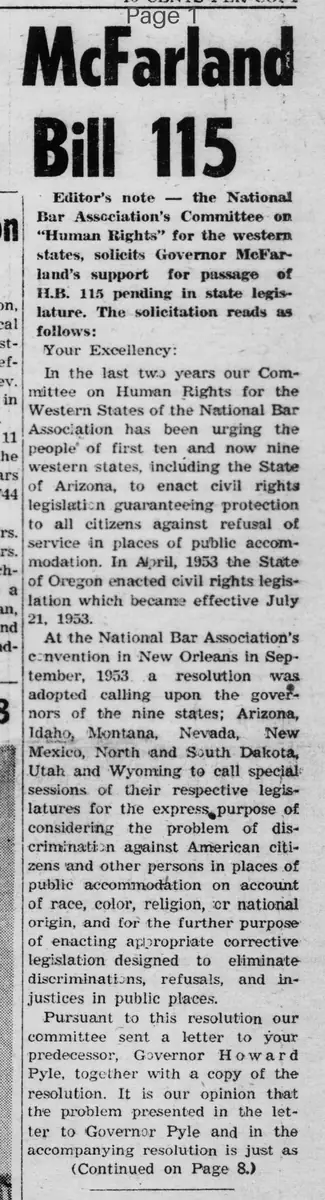
Editor's note the National Bar Association's Committee on "Human Rights" for the western states, solicits Governor McFarland's support for passage of H.B. 115 pending in state legislature. The solicitation reads as follows:
Your Excellency:
In the last two years our Committee on Human Rights for the Western States of the National Bar Association has been urging the people of first ten and now nine western states, including the State of Arizona, to enact civil rights legislation guaranteeing protection to all citizens against refusal of service in places of public accommodation. In April, 1953 the State of Oregon enacted civil rights legislation which became effective July 21, 1953.
At the National Bar Association's convention in New Orleans in September, 1953 a resolution was adopted calling upon the governors of the nine states; Arizona, Idaho, Montana, Nevada, New Mexico, North and South Dakota, Utah and Wyoming to call special sessions of their respective legislatures for the express purpose of considering the problem of discrimination against American citizens and other persons in places of public accommodation on account of race, color, religion, or national origin, and for the further purpose of enacting appropriate corrective legislation designed to eliminate discriminations, refusals, and injustices in public places.
Pursuant to this resolution our committee sent a letter to your predecessor, Governor Howard Pyle, together with a copy of the resolution. It is our opinion that the problem presented in the letter to Governor Pyle and in the accompanying resolution is just as (Continued on Page 8.)
Support Gov.
(Continued from Page 1.)
serious today as it was then. We understand that the legislature of the State of Arizona is now in regular session. We have been informed that Messrs. Daniels and Sims of Maricopa County introduced a civil rights bill in the House of Representatives in the Twentieth Legislature, H.B. 292, and that Messrs. Sims and Benson of Maricopa County and Mr. Robles of Pima County introduced H.B. 91 in the Twenty-first Legislature. We are informed that Mr. Sims made a motion to discharge the committees in respect to H.B. 91 and his motion to discharge was defeated 37 to 32.
We believe that the problem of racial-discrimination in places of public accommodation is a great and pressing evil which requires the adoption of corrective legislative means which operate in the general impersonal way and on a state wide basis. Many western states already have civil rights statutes and have had them for a long time. California, Washington, Colorado, and now Oregon since 1953. We understand that the law enacted in Oregon is working well and that the evils of racial discrimination in public places which it sought to correct are being eliminated.
We think that everywhere throughout the western states there is a rising public sentiment in favor of the passage of civil rights laws. As evidence of this growing public opinion we point out that civil rights bills were introduced in 1953 in the legislatures of New Mexico and Nevada and were defeated on the floors of the lower houses by very close votes—in the case of New Mexico by the tie vote of 24 to 24: however, a civil rights bill was passed by the House of Representatives of the Montana legislature in February 1953. A civil rights bill was introduced in the Utah legislature three or four years ago and there is greatly increased civil rights activity in the states of Wyoming, Idaho and Utah which we believe will lead to immediate serious consideration of civil rights bills and the ultimate passage of such legislation.
We agree with the National Council of the Churches of Christ in the U.S.A. and the other church bodies, that "racial prejudice in any and all forms is contrary to the will and the design of God" and that "it is sin". Of course, we believe that racial discrimination, which is the overt result of race prejudice is a sin. It is our firm conviction that the denial of food, drink, shelter, and other services and facilities in places of public accommodation on account of race, color, religion or national origin is not only immoral and sinful but it is likewise a cruel violation of the spirit of our federal and state laws and our equalitarian common law principles if not, the letter of those laws.
We sincerely hope and trust that you will add your great influence to the movement in Arizona to adopt very much needed civil rights legislation at this session of your legislature.
May we hear from you at your earliest convenience?
With every good wish for your health and success, I have the honor to remain
Yours very truly,
CORA T. WALKER, Chairman
c.c.:
Messrs. Sims, Benson, and
What sub-type of article is it?
What keywords are associated?
What entities or persons were involved?
Editorial Details
Primary Topic
Support For Civil Rights Legislation Against Discrimination In Public Accommodations
Stance / Tone
Urging Gubernatorial Support For Anti Discrimination Laws
Key Figures
Key Arguments