Thank you for visiting SNEWPapers!
Sign up free
Story
February 10, 1863
Memphis Daily Appeal
Memphis, Shelby County, Tennessee
What is this article about?
Confederate report from Vicksburg on February 3, 1863, details Union troop movements across the Mississippi, possible evacuation due to high water, and plans to cross at Warrenton, with optimism that river and batteries will thwart them.
Clipping
OCR Quality
95%
Excellent
Full Text
Vicksburg, February 3, 1863.
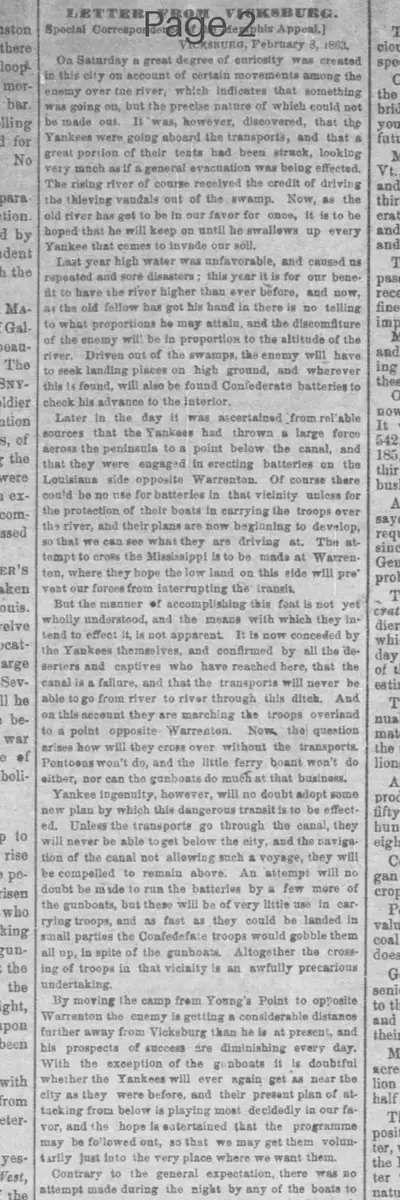
On Saturday a great degree of curiosity was created in this city on account of certain movements among the enemy over the river, which indicated that something was going on, but the precise nature of which could not be made out. It was, however, discovered, that the Yankees were going aboard the transports, and that a great portion of their tents had been struck, looking very much as if a general evacuation was being effected. The rising river of course received the credit of driving the thieving vandals out of the swamp. Now, as the old river has got to be in our favor for once, it is to be hoped that he will keep on until he swallows up every Yankee that comes to invade our soil.
Last year high water was unfavorable, and caused us repeated and sore disasters; this year it is for our benefit to have the river higher than ever before, and now, as the old fellow has got his hand in there is no telling to what proportions he may attain and the discomfiture of the enemy will be in proportion to the altitude of the river. Driven out of the swamps, the enemy will have to seek landing places on high ground, and wherever this is found, will also be found Confederate batteries to check his advance to the interior.
Later in the day it was ascertained from reliable sources that the Yankees had thrown a large force across the peninsula to a point below the canal, and that they were engaged in erecting batteries on the Louisiana side opposite Warrenton. Of course there could be no use for batteries in that vicinity unless for the protection of their boats in carrying the troops over the river, and their plans are now beginning to develop, so that we can see what they are driving at. The attempt to cross the Mississippi is to be made at Warrenton, where they hope the low land on this side will prevent our forces from interrupting the transit.
But the manner of accomplishing this feat is not yet wholly understood, and the means with which they intend to effect it, is not apparent. It is now conceded by the Yankees themselves, and confirmed by all the deserters and captives who have reached here, that the canal is a failure, and that the transports will never be able to go from river to river through this ditch. And on this account they are marching the troops overland to a point opposite Warrenton. Now the question arises how will they cross over without the transports. Pontoons won't do, and the little ferry boats won't do either, nor can the gunboats do much at that business. Yankee ingenuity, however, will no doubt adopt some new plan by which this dangerous transit is to be effected. Unless the transports go through the canal, they will never be able to get below the city, and the navigation of the canal not allowing such a voyage, they will be compelled to remain above. An attempt will no doubt be made to run the batteries by a few more of the gunboats, but these will be of very little use in carrying troops, and as fast as they could be landed in small parties the Confederate troops would gobble them all up, in spite of the gunboats. Altogether the crossing of troops in that vicinity is an awfully precarious undertaking.
By moving the camp from Young's Point to opposite Warrenton the enemy is getting a considerable distance further away from Vicksburg than he is at present, and his prospects of success are diminishing every day. With the exception of the gunboats it is doubtful whether the Yankees will ever again get as near the city as they were before, and their present plan of attacking from below is playing most decidedly in our favor, and the hope is entertained that the programme may be followed out, so that we may get them voluntarily just into the very place where we want them.
Contrary to the general expectation, there was no attempt made during the night by any of the boats to pass down, and no other annoyance occurred. As usual, the reveille could be distinctly heard this morning, and the motion among the fleet was also indicative of activity. The most unaccountable proceeding that could be noticed was the going away of the gunboats—whither they are bound or what their object, no one can tell; but it is certain that some of them have been seen going up the river this morning.
It would not be surprising to hear that our cavalry had reached some point on the river above and made sad havoc with the Yankees, which requires the gunboats to go up and see what is going on. This is the only way in which this movement can be accounted for, especially as they did not attempt an advance up the Yazoo, as had been expected. If the gunboats should be withdrawn from here the assault may be delayed for some time.
NESTOR.
On Saturday a great degree of curiosity was created in this city on account of certain movements among the enemy over the river, which indicated that something was going on, but the precise nature of which could not be made out. It was, however, discovered, that the Yankees were going aboard the transports, and that a great portion of their tents had been struck, looking very much as if a general evacuation was being effected. The rising river of course received the credit of driving the thieving vandals out of the swamp. Now, as the old river has got to be in our favor for once, it is to be hoped that he will keep on until he swallows up every Yankee that comes to invade our soil.
Last year high water was unfavorable, and caused us repeated and sore disasters; this year it is for our benefit to have the river higher than ever before, and now, as the old fellow has got his hand in there is no telling to what proportions he may attain and the discomfiture of the enemy will be in proportion to the altitude of the river. Driven out of the swamps, the enemy will have to seek landing places on high ground, and wherever this is found, will also be found Confederate batteries to check his advance to the interior.
Later in the day it was ascertained from reliable sources that the Yankees had thrown a large force across the peninsula to a point below the canal, and that they were engaged in erecting batteries on the Louisiana side opposite Warrenton. Of course there could be no use for batteries in that vicinity unless for the protection of their boats in carrying the troops over the river, and their plans are now beginning to develop, so that we can see what they are driving at. The attempt to cross the Mississippi is to be made at Warrenton, where they hope the low land on this side will prevent our forces from interrupting the transit.
But the manner of accomplishing this feat is not yet wholly understood, and the means with which they intend to effect it, is not apparent. It is now conceded by the Yankees themselves, and confirmed by all the deserters and captives who have reached here, that the canal is a failure, and that the transports will never be able to go from river to river through this ditch. And on this account they are marching the troops overland to a point opposite Warrenton. Now the question arises how will they cross over without the transports. Pontoons won't do, and the little ferry boats won't do either, nor can the gunboats do much at that business. Yankee ingenuity, however, will no doubt adopt some new plan by which this dangerous transit is to be effected. Unless the transports go through the canal, they will never be able to get below the city, and the navigation of the canal not allowing such a voyage, they will be compelled to remain above. An attempt will no doubt be made to run the batteries by a few more of the gunboats, but these will be of very little use in carrying troops, and as fast as they could be landed in small parties the Confederate troops would gobble them all up, in spite of the gunboats. Altogether the crossing of troops in that vicinity is an awfully precarious undertaking.
By moving the camp from Young's Point to opposite Warrenton the enemy is getting a considerable distance further away from Vicksburg than he is at present, and his prospects of success are diminishing every day. With the exception of the gunboats it is doubtful whether the Yankees will ever again get as near the city as they were before, and their present plan of attacking from below is playing most decidedly in our favor, and the hope is entertained that the programme may be followed out, so that we may get them voluntarily just into the very place where we want them.
Contrary to the general expectation, there was no attempt made during the night by any of the boats to pass down, and no other annoyance occurred. As usual, the reveille could be distinctly heard this morning, and the motion among the fleet was also indicative of activity. The most unaccountable proceeding that could be noticed was the going away of the gunboats—whither they are bound or what their object, no one can tell; but it is certain that some of them have been seen going up the river this morning.
It would not be surprising to hear that our cavalry had reached some point on the river above and made sad havoc with the Yankees, which requires the gunboats to go up and see what is going on. This is the only way in which this movement can be accounted for, especially as they did not attempt an advance up the Yazoo, as had been expected. If the gunboats should be withdrawn from here the assault may be delayed for some time.
NESTOR.
What sub-type of article is it?
Historical Event
Military Action
What themes does it cover?
Fortune Reversal
Triumph
What keywords are associated?
Vicksburg
Civil War
Union Troops
Mississippi Crossing
Confederate Defense
High Water
Warrenton Batteries
Where did it happen?
Vicksburg, Mississippi River, Warrenton
Story Details
Location
Vicksburg, Mississippi River, Warrenton
Event Date
February 3, 1863
Story Details
Confederate observers in Vicksburg note Union forces moving troops and tents, possibly evacuating due to rising river, but actually shifting to cross Mississippi at Warrenton; canal effort failed, uncertain crossing method anticipated, with confidence in Confederate defenses and river aiding their position.