Thank you for visiting SNEWPapers!
Sign up free
The Anderson Intelligencer
Anderson, Anderson County, South Carolina
What is this article about?
The Supreme Court of South Carolina held a special session last week and admitted three Black men—J.J. Wright, R.B. Elliott, and W.J. Whipper—to practice law, amid criticism of the court's composition during Reconstruction.
Clipping
OCR Quality
Full Text
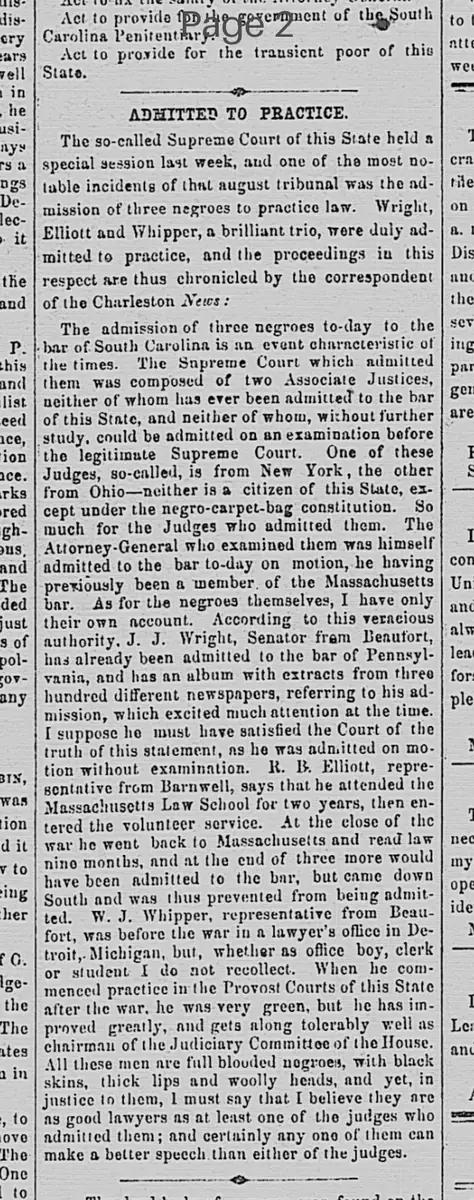
The so-called Supreme Court of this State held a special session last week, and one of the most notable incidents of that august tribunal was the admission of three negroes to practice law. Wright, Elliott and Whipper, a brilliant trio, were duly admitted to practice, and the proceedings in this respect are thus chronicled by the correspondent of the Charleston News:
The admission of three negroes to-day to the bar of South Carolina is an event characteristic of the times. The Supreme Court which admitted them was composed of two Associate Justices, neither of whom has ever been admitted to the bar of this State, and neither of whom, without further study, could be admitted on an examination before the legitimate Supreme Court. One of these Judges, so-called, is from New York, the other from Ohio—neither is a citizen of this State, except under the negro-carpet-bag constitution. So much for the Judges who admitted them. The Attorney-General who examined them was himself admitted to the bar to-day on motion, he having previously been a member of the Massachusetts bar. As for the negroes themselves, I have only their own account. According to this veracious authority, J. J. Wright, Senator from Beaufort, has already been admitted to the bar of Pennsylvania, and has an album with extracts from three hundred different newspapers, referring to his admission, which excited much attention at the time. I suppose he must have satisfied the Court of the truth of this statement, as he was admitted on motion without examination. R. B. Elliott, representative from Barnwell, says that he attended the Massachusetts Law School for two years, then entered the volunteer service. At the close of the war he went back to Massachusetts and read law nine months, and at the end of three more would have been admitted to the bar, but came down South and was thus prevented from being admitted. W. J. Whipper, representative from Beaufort, was before the war in a lawyer's office in Detroit, Michigan, but, whether as office boy, clerk or student I do not recollect. When he commenced practice in the Provost Courts of this State after the war, he was very green, but he has improved greatly, and gets along tolerably well as chairman of the Judiciary Committee of the House. All these men are full blooded negroes, with black skins, thick lips and woolly heads, and yet, in justice to them, I must say that I believe they are as good lawyers as at least one of the judges who admitted them; and certainly any one of them can make a better speech than either of the judges.
What sub-type of article is it?
What keywords are associated?
What entities or persons were involved?
Where did it happen?
Domestic News Details
Primary Location
South Carolina
Event Date
Last Week
Key Persons
Outcome
three negroes admitted to practice law in south carolina.
Event Details
The Supreme Court held a special session and admitted Wright, Elliott, and Whipper to the bar. The court consisted of two Associate Justices from New York and Ohio, and the Attorney-General from Massachusetts was also admitted that day. Backgrounds: Wright, Senator from Beaufort, previously admitted in Pennsylvania; Elliott, representative from Barnwell, studied in Massachusetts; Whipper, representative from Beaufort, experience in Detroit and Provost Courts.