Thank you for visiting SNEWPapers!
Sign up free
Literary
February 15, 1845
Mississippi Advertiser
Aberdeen, Monroe County, Mississippi
What is this article about?
At a birthday gathering, guests debate treating first offenses with leniency. The host recounts forgiving a young clerk's theft, who redeems himself, becomes loyal, and dies gratefully, emphasizing mercy over severity in moral reform.
Clipping
OCR Quality
95%
Excellent
Full Text
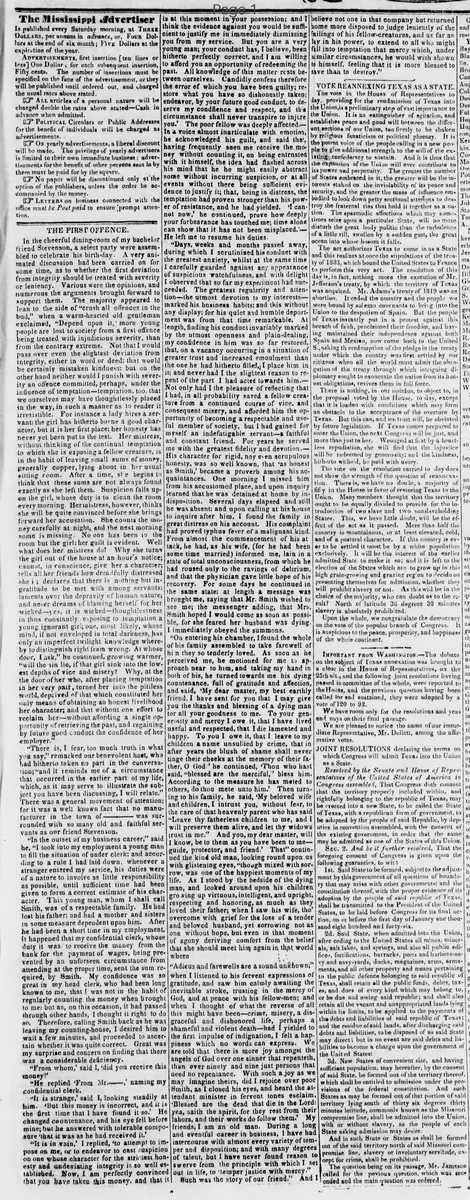
THE FIRST OFFENCE.
In the cheerful dining-room of my bachelor friend Stevenson, a select party were assembled to celebrate his birth-day. A very animated discussion had been carried on for some time, as to whether the first deviation from integrity should be treated with severity or leniency. Various were the opinions, and numerous the arguments brought forward to support them. The majority appeared to lean to the side of "crush all offences in the bud," when a warm-hearted old gentleman exclaimed, "Depend upon it, more young people are lost to society from a first offence being treated with injudicious severity, than from the contrary extreme. Not that I would pass over even the slightest deviation from integrity, either in word or deed; that would be certainly mistaken kindness: but on the other hand neither would I punish with severity an offence committed, perhaps, under the influence of temptation—temptation, too, that we ourselves may have thoughtlessly placed in the way, in such a manner as to render it irresistible. For instance a lady hires a servant; the girl has hitherto borne a good character, but it is her first place; her honesty has never yet been put to the test. Her mistress, without thinking of the continual temptation to which she is exposing a fellow creature, is in the habit of leaving small sums of money, generally copper, lying about in her usual sitting room. After a time, she begins to think that these sums are not always found exactly as she left them. Suspicion falls upon the girl, whose duty is to clean the room every morning. Her mistress, however, thinks she will be quite convinced before she brings forward her accusation. She counts the money carefully at night, and the next morning some is missing. No one has been in the room but the girl: her guilt is evident. Well, what does her mistress do? Why she turns the girl out of the house at an hour's notice, cannot, in conscience, give her a character, tells all her friends how dreadfully distressed she is; declares that there is nothing but ingratitude to be met with among servants, laments over the depravity of human nature, and never dreams of blaming herself for her wicked—yes, it is wicked—thoughtlessness in thus constantly exposing to temptation a young ignorant girl; one, most likely, whose mind, if not enveloped in total darkness, has only an imperfect twilight knowledge whereby to distinguish right from wrong. At whose door, I ask," he continued, growing warmer, "will the sin lie, if that girl sink into the lowest depths of vice and misery? Why, at the door of her who, after placing temptation in her very path, turned her into the pitiless world, deprived of that which constituted her only means of obtaining an honest livelihood—her character; and that without one effort to reclaim her—without affording a single opportunity of retrieving the past, and regaining by future good conduct the confidence of her employer."
"There is, I fear, too much truth in what you say," remarked our benevolent host, who had hitherto taken no part in the conversation; "and it reminds me of a circumstance that occurred in the earlier part of my life, which, as it may serve to illustrate the subject you have been discussing, I will relate." There was a general movement of attention; for it was a well known fact that no manufacturer in the town of was surrounded with so many old and faithful servants as our friend Stevenson.
"In the outset of my business career," said he, "I took into my employment a young man to fill the situation of under clerk; and according to a rule I had laid down, whenever a stranger entered my service, his duties were of a nature to involve as little responsibility as possible, until sufficient time had been given to form a correct estimate of his character. This young man, whom I shall call Smith, was of a respectable family. He had lost his father; and had a mother and sisters in some measure dependent upon him. After he had been a short time in my employment, it happened that my confidential clerk, whose duty it was to receive the money from the bank for the payment of wages, being prevented by an unforeseen circumstance from attending at the proper time, sent the sum required, by Smith. My confidence was so great in my head clerk, who had been long known to me, that I was not in the habit of regularly counting the money when brought to me: but as, on this occasion, it had passed through other hands, I thought it right to do so. Therefore, calling Smith back as he was leaving my counting-house, I desired him to wait a few minutes, and proceeded to ascertain whether it was quite correct. Great was my surprise and concern on finding that there was a considerable deficiency.
"From whom,' said I, 'did you receive this money?'
"He replied 'From Mr.——,' naming my confidential clerk.
'It is strange,' said I, looking steadily at him. 'But this money is incorrect, and it is the first time that I have found it so.' He changed countenance, and his eye fell before mine; but he answered with tolerable composure that it was as he had received it.'
"It is in vain,' I replied, 'to attempt to impose on me, or to endeavor to cast suspicion on one whose character for the strictest honesty and undeviating integrity is so well established. Now, I am perfectly convinced that you have taken this money, and that it is at this moment in your possession: and I think the evidence against you would be sufficient to justify me in immediately dismissing you from my service. But you are a very young man; your conduct has, I believe, been hitherto perfectly correct, and I am willing to afford you an opportunity of redeeming the past. All knowledge of this matter rests between ourselves. Candidly confess therefore the error of which you have been guilty; restore what you have so dishonestly taken; endeavor, by your future good conduct, to deserve my confidence and respect, and this circumstance shall never transpire to injure you.' The poor fellow was deeply affected.—In a voice almost inarticulate with emotion, he acknowledged his guilt, and said that, having frequently seen me receive the money without counting it, on being entrusted with it himself, the idea had flashed across his mind that he might easily abstract some without incurring suspicion, or at all events without there being sufficient evidence to justify it; that, being in distress, the temptation had proven stronger than his power of resistance, and he had yielded. 'I cannot now,' he continued, 'prove how deeply your forbearance has touched me; time alone can show that it has not been misplaced.' He left me to resume his duties.
"Days, weeks and months passed away, during which I scrutinized his conduct with the greatest anxiety, whilst at the same time I carefully guarded against any appearance of suspicious watchfulness, and with delight I observed that so far my experiment had succeeded. The greatest regularity and attention—the utmost devotion to my interests—marked his business habits; and this without any display; for his quiet and humble deportment was from that time remarkable. At length, finding his conduct invariably marked by the utmost openness and plain-dealing, my confidence in him was so far restored, that, on a vacancy occurring in a situation of greater trust and increased emolument than the one he had hitherto filled, I placed him in it; and never had I the slightest reason to repent of the part I had acted towards him.—Not only had I the pleasure of reflecting that I had, in all probability saved a fellow creature from a continued course of vice, and consequent misery, and afforded him the opportunity of becoming a respectable and useful member of society, but I had gained for myself an indefatigable servant—a faithful and constant friend. For years he served me with the greatest fidelity and devotion.—His character for rigid, nay even scrupulous honesty, was so well known, that 'as honest as Smith,' became a proverb among his acquaintances. One morning I missed him from his accustomed place, and upon inquiry learned that he was detained at home by indisposition. Several days elapsed and still he was absent; and upon calling at his house to inquire after him, I found the family in great distress on his account. His complaint had proved typhus fever of a malignant kind. From almost the commencement of his attack, he had, as his wife, (for he had been some time married) informed me, lain in a state of total unconsciousness, from which he had roused only to the ravings of delirium, and that the physician gave little hope of his recovery. For some days he continued in the same state; at length a message was brought me, saying that Mr. Smith wished to see me; the messenger adding, that Mrs. Smith hoped I would come as soon as possible, for she feared her husband was dying. I immediately obeyed the summons.
"On entering his chamber, I found the whole of his family assembled to take farewell of him they so tenderly loved. As soon as he perceived me, he motioned for me to approach near to him, and taking my hand in both of his, he turned towards me his dying countenance, full of gratitude and affection, and said, 'My dear master, my best earthly friend, I have sent for you that I may give you the thanks and blessing of a dying man for all your goodness to me. To your generosity and mercy I owe it, that I have lived useful and respected, that I die lamented and happy. To you I owe it, that I leave to my children a name unsullied by crime, that in after years the blush of shame shall never tinge their cheeks at the memory of their father, O God:' he continued, 'Thou who hast said, "blessed are the merciful," bless him. According to the measure he has meted to others, do thou mete unto him.' Then turning to his family, he said, 'My beloved wife and children, I intrust you, without fear, to the care of that heavenly parent who has said "Leave thy fatherless children to me, and I will preserve them alive, and let thy widows trust in me." And you, my dear master, will I know, be to them as you have been to me—guide, protector, and friend.' That," continued the kind old man, looking round upon us with glistening eyes, "though mixed with sorrow, was one of the happiest moments of my life. As I stood by the bedside of the dying man, and looked around upon his children growing up virtuous, intelligent, and upright, respecting and honoring, as much as they loved their father; when I saw his wife, though overcome with grief for the loss of a tender and beloved husband, yet sorrowing not as one without hope, but even in that moment of agony deriving comfort from the belief that she should meet him again in that world where
"Adieus and farewells are a sound unknown;"
when I listened to his fervent expressions of gratitude, and saw him calmly awaiting the inevitable stroke, trusting in the mercy of God, and at peace with his fellow-men; and when I thought of what the reverse of all this might have been—crime, misery, a disgraceful and dishonored life, perhaps a shameful and violent death—had I yielded to the first impulse of indignation, I felt a happiness which no words can express. We are told that there is more joy amongst the angels of God over one sinner that repenteth, than over ninety and nine just persons that need no repentance. With such a joy as we may imagine theirs, did I rejoice over poor Smith, as I closed his eyes, and heard the attendant minister in fervent tones exclaim, 'Blessed are the dead that die in the Lord: yea, saith the spirit, for they rest from their labors, and their works do follow them.' My friends, I am an old man. During a long and eventful career in business, I have had intercourse with almost every variety of temper and disposition; and with many degrees of talent, but I have never found reason to swerve from the principle with which I set out in life, to 'temper justice with mercy.'"
Such was the story of our friend." And believe not one in that company but returned home more disposed to judge leniently of the failings of his fellow-creatures, and as far as lay in his power, to extend to all who might fall into temptation that mercy which, under similar circumstances, he would wish shown to himself, feeling that it is more blessed to save than to destroy.
In the cheerful dining-room of my bachelor friend Stevenson, a select party were assembled to celebrate his birth-day. A very animated discussion had been carried on for some time, as to whether the first deviation from integrity should be treated with severity or leniency. Various were the opinions, and numerous the arguments brought forward to support them. The majority appeared to lean to the side of "crush all offences in the bud," when a warm-hearted old gentleman exclaimed, "Depend upon it, more young people are lost to society from a first offence being treated with injudicious severity, than from the contrary extreme. Not that I would pass over even the slightest deviation from integrity, either in word or deed; that would be certainly mistaken kindness: but on the other hand neither would I punish with severity an offence committed, perhaps, under the influence of temptation—temptation, too, that we ourselves may have thoughtlessly placed in the way, in such a manner as to render it irresistible. For instance a lady hires a servant; the girl has hitherto borne a good character, but it is her first place; her honesty has never yet been put to the test. Her mistress, without thinking of the continual temptation to which she is exposing a fellow creature, is in the habit of leaving small sums of money, generally copper, lying about in her usual sitting room. After a time, she begins to think that these sums are not always found exactly as she left them. Suspicion falls upon the girl, whose duty is to clean the room every morning. Her mistress, however, thinks she will be quite convinced before she brings forward her accusation. She counts the money carefully at night, and the next morning some is missing. No one has been in the room but the girl: her guilt is evident. Well, what does her mistress do? Why she turns the girl out of the house at an hour's notice, cannot, in conscience, give her a character, tells all her friends how dreadfully distressed she is; declares that there is nothing but ingratitude to be met with among servants, laments over the depravity of human nature, and never dreams of blaming herself for her wicked—yes, it is wicked—thoughtlessness in thus constantly exposing to temptation a young ignorant girl; one, most likely, whose mind, if not enveloped in total darkness, has only an imperfect twilight knowledge whereby to distinguish right from wrong. At whose door, I ask," he continued, growing warmer, "will the sin lie, if that girl sink into the lowest depths of vice and misery? Why, at the door of her who, after placing temptation in her very path, turned her into the pitiless world, deprived of that which constituted her only means of obtaining an honest livelihood—her character; and that without one effort to reclaim her—without affording a single opportunity of retrieving the past, and regaining by future good conduct the confidence of her employer."
"There is, I fear, too much truth in what you say," remarked our benevolent host, who had hitherto taken no part in the conversation; "and it reminds me of a circumstance that occurred in the earlier part of my life, which, as it may serve to illustrate the subject you have been discussing, I will relate." There was a general movement of attention; for it was a well known fact that no manufacturer in the town of was surrounded with so many old and faithful servants as our friend Stevenson.
"In the outset of my business career," said he, "I took into my employment a young man to fill the situation of under clerk; and according to a rule I had laid down, whenever a stranger entered my service, his duties were of a nature to involve as little responsibility as possible, until sufficient time had been given to form a correct estimate of his character. This young man, whom I shall call Smith, was of a respectable family. He had lost his father; and had a mother and sisters in some measure dependent upon him. After he had been a short time in my employment, it happened that my confidential clerk, whose duty it was to receive the money from the bank for the payment of wages, being prevented by an unforeseen circumstance from attending at the proper time, sent the sum required, by Smith. My confidence was so great in my head clerk, who had been long known to me, that I was not in the habit of regularly counting the money when brought to me: but as, on this occasion, it had passed through other hands, I thought it right to do so. Therefore, calling Smith back as he was leaving my counting-house, I desired him to wait a few minutes, and proceeded to ascertain whether it was quite correct. Great was my surprise and concern on finding that there was a considerable deficiency.
"From whom,' said I, 'did you receive this money?'
"He replied 'From Mr.——,' naming my confidential clerk.
'It is strange,' said I, looking steadily at him. 'But this money is incorrect, and it is the first time that I have found it so.' He changed countenance, and his eye fell before mine; but he answered with tolerable composure that it was as he had received it.'
"It is in vain,' I replied, 'to attempt to impose on me, or to endeavor to cast suspicion on one whose character for the strictest honesty and undeviating integrity is so well established. Now, I am perfectly convinced that you have taken this money, and that it is at this moment in your possession: and I think the evidence against you would be sufficient to justify me in immediately dismissing you from my service. But you are a very young man; your conduct has, I believe, been hitherto perfectly correct, and I am willing to afford you an opportunity of redeeming the past. All knowledge of this matter rests between ourselves. Candidly confess therefore the error of which you have been guilty; restore what you have so dishonestly taken; endeavor, by your future good conduct, to deserve my confidence and respect, and this circumstance shall never transpire to injure you.' The poor fellow was deeply affected.—In a voice almost inarticulate with emotion, he acknowledged his guilt, and said that, having frequently seen me receive the money without counting it, on being entrusted with it himself, the idea had flashed across his mind that he might easily abstract some without incurring suspicion, or at all events without there being sufficient evidence to justify it; that, being in distress, the temptation had proven stronger than his power of resistance, and he had yielded. 'I cannot now,' he continued, 'prove how deeply your forbearance has touched me; time alone can show that it has not been misplaced.' He left me to resume his duties.
"Days, weeks and months passed away, during which I scrutinized his conduct with the greatest anxiety, whilst at the same time I carefully guarded against any appearance of suspicious watchfulness, and with delight I observed that so far my experiment had succeeded. The greatest regularity and attention—the utmost devotion to my interests—marked his business habits; and this without any display; for his quiet and humble deportment was from that time remarkable. At length, finding his conduct invariably marked by the utmost openness and plain-dealing, my confidence in him was so far restored, that, on a vacancy occurring in a situation of greater trust and increased emolument than the one he had hitherto filled, I placed him in it; and never had I the slightest reason to repent of the part I had acted towards him.—Not only had I the pleasure of reflecting that I had, in all probability saved a fellow creature from a continued course of vice, and consequent misery, and afforded him the opportunity of becoming a respectable and useful member of society, but I had gained for myself an indefatigable servant—a faithful and constant friend. For years he served me with the greatest fidelity and devotion.—His character for rigid, nay even scrupulous honesty, was so well known, that 'as honest as Smith,' became a proverb among his acquaintances. One morning I missed him from his accustomed place, and upon inquiry learned that he was detained at home by indisposition. Several days elapsed and still he was absent; and upon calling at his house to inquire after him, I found the family in great distress on his account. His complaint had proved typhus fever of a malignant kind. From almost the commencement of his attack, he had, as his wife, (for he had been some time married) informed me, lain in a state of total unconsciousness, from which he had roused only to the ravings of delirium, and that the physician gave little hope of his recovery. For some days he continued in the same state; at length a message was brought me, saying that Mr. Smith wished to see me; the messenger adding, that Mrs. Smith hoped I would come as soon as possible, for she feared her husband was dying. I immediately obeyed the summons.
"On entering his chamber, I found the whole of his family assembled to take farewell of him they so tenderly loved. As soon as he perceived me, he motioned for me to approach near to him, and taking my hand in both of his, he turned towards me his dying countenance, full of gratitude and affection, and said, 'My dear master, my best earthly friend, I have sent for you that I may give you the thanks and blessing of a dying man for all your goodness to me. To your generosity and mercy I owe it, that I have lived useful and respected, that I die lamented and happy. To you I owe it, that I leave to my children a name unsullied by crime, that in after years the blush of shame shall never tinge their cheeks at the memory of their father, O God:' he continued, 'Thou who hast said, "blessed are the merciful," bless him. According to the measure he has meted to others, do thou mete unto him.' Then turning to his family, he said, 'My beloved wife and children, I intrust you, without fear, to the care of that heavenly parent who has said "Leave thy fatherless children to me, and I will preserve them alive, and let thy widows trust in me." And you, my dear master, will I know, be to them as you have been to me—guide, protector, and friend.' That," continued the kind old man, looking round upon us with glistening eyes, "though mixed with sorrow, was one of the happiest moments of my life. As I stood by the bedside of the dying man, and looked around upon his children growing up virtuous, intelligent, and upright, respecting and honoring, as much as they loved their father; when I saw his wife, though overcome with grief for the loss of a tender and beloved husband, yet sorrowing not as one without hope, but even in that moment of agony deriving comfort from the belief that she should meet him again in that world where
"Adieus and farewells are a sound unknown;"
when I listened to his fervent expressions of gratitude, and saw him calmly awaiting the inevitable stroke, trusting in the mercy of God, and at peace with his fellow-men; and when I thought of what the reverse of all this might have been—crime, misery, a disgraceful and dishonored life, perhaps a shameful and violent death—had I yielded to the first impulse of indignation, I felt a happiness which no words can express. We are told that there is more joy amongst the angels of God over one sinner that repenteth, than over ninety and nine just persons that need no repentance. With such a joy as we may imagine theirs, did I rejoice over poor Smith, as I closed his eyes, and heard the attendant minister in fervent tones exclaim, 'Blessed are the dead that die in the Lord: yea, saith the spirit, for they rest from their labors, and their works do follow them.' My friends, I am an old man. During a long and eventful career in business, I have had intercourse with almost every variety of temper and disposition; and with many degrees of talent, but I have never found reason to swerve from the principle with which I set out in life, to 'temper justice with mercy.'"
Such was the story of our friend." And believe not one in that company but returned home more disposed to judge leniently of the failings of his fellow-creatures, and as far as lay in his power, to extend to all who might fall into temptation that mercy which, under similar circumstances, he would wish shown to himself, feeling that it is more blessed to save than to destroy.
What sub-type of article is it?
Prose Fiction
What themes does it cover?
Moral Virtue
Religious
What keywords are associated?
First Offence
Mercy
Temptation
Forgiveness
Redemption
Moral Tale
Honesty
Literary Details
Title
The First Offence.
Key Lines
"Depend Upon It, More Young People Are Lost To Society From A First Offence Being Treated With Injudicious Severity, Than From The Contrary Extreme."
"Blessed Are The Merciful," Bless Him. According To The Measure He Has Meted To Others, Do Thou Mete Unto Him.'
We Are Told That There Is More Joy Amongst The Angels Of God Over One Sinner That Repenteth, Than Over Ninety And Nine Just Persons That Need No Repentance.
"Temper Justice With Mercy."