Thank you for visiting SNEWPapers!
Sign up free
Morning Star
Limerick, York County, Maine
What is this article about?
Historical explanation of the Samaritans' origins from Assyrian conquest of Samaria, mixing with imported idolaters, partial Jewish adoption of their faith, and conflicts with Jews over temple building and worship sites, leading to deep-seated hatred.
Clipping
OCR Quality
Full Text
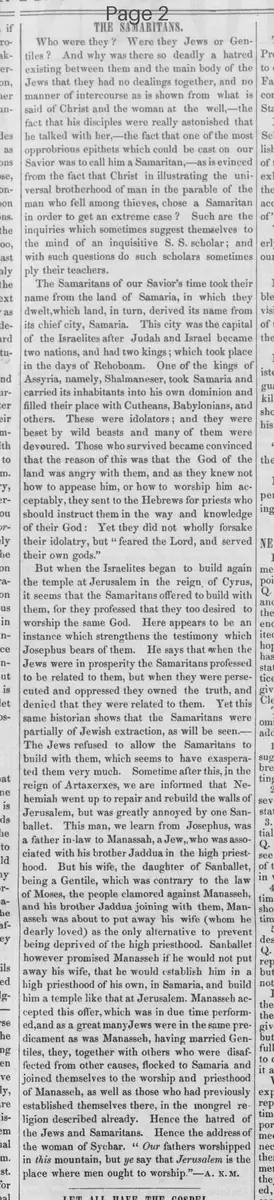
Who were they? Were they Jews or Gentiles? And why was there so deadly a hatred existing between them and the main body of the Jews that they had no dealings together, and no manner of intercourse as is shown from what is said of Christ and the woman at the well,-the fact that his disciples were really astonished that he talked with her,the fact that one of the most opprobrious epithets which could be cast on our Savior was to call him a Samaritan,—as is evinced from the fact that Christ in illustrating the universal brotherhood of man in the parable of the man who fell among thieves, chose a Samaritan in order to get an extreme case? Such are the inquiries which sometimes suggest themselves to the mind of an inquisitive S. S. scholar; and with such questions do such scholars sometimes ply their teachers.
The Samaritans of our Savior's time took their name from the land of Samaria, in which they dwelt,which land, in turn, derived its name from its chief city, Samaria. This city was the capital of the Israelites after Judah and Israel became two nations, and had two kings; which took place in the days of Rehoboam. One of the kings of Assyria, namely, Shalmaneser, took Samaria and carried its inhabitants into his own dominion and filled their place with Cutheans, Babylonians, and others. These were idolators; and they were beset by wild beasts and many of them were devoured. Those who survived became convinced that the reason of this was that the God of the land was angry with them, and as they knew not how to appease him, or how to worship him acceptably, they sent to the Hebrews for priests who should instruct them in the way and knowledge of their God: Yet they did not wholly forsake their idolatry. but "feared the Lord, and served their own gods."
But when the Israelites began to build again the temple at Jerusalem in the reign of Cyrus. it seems that the Samaritans offered to build with them, for they professed that they too desired to worship the same God. Here appears to be an instance which strengthens the testimony which Josephus bears of them. He says that when the Jews were in prosperity the Samaritans professed to be related to them, but when they were persecuted and oppressed they owned the truth, and denied that they were related to them. Yet this same historian shows that the Samaritans were partially of Jewish extraction, as will be seen.— The Jews refused to allow the Samaritans to build with them, which seems to have exasperated them very much. Sometime after this, in the reign of Artaxerxes, we are informed that Nehemiah went up to repair and rebuild the walls of Jerusalem. but was greatly annoyed by one Sanballat. This man, we learn from Josephus, was a father in-law to Manassah, a Jew., who was associated with his brother Jaddua in the high priesthood. But his wife, the daughter of Sanballat. being a Gentile, which was contrary to the law of Moses, the people clamored against Manasseh, and his brother Jaddua joining with them, Manasseh was about to put away his wife (whom he dearly loved) as the only alternative to prevent being deprived of the high priesthood. Sanballat however promised Manasseh if he would not put away his wife, that he would establish him in a high priesthood of his own, in Samaria, and build him a temple like that at Jerusalem. Manasseh accepted this offer, which was in due time performed,and as a great many Jews were in the same predicament as was Manasseh, having married Gentiles, they, together with others who were dissatisfied from other causes, flocked to Samaria and joined themselves to the worship and priesthood of Manasseh, as well as those who had previously established themselves there, in the mongrel religion described already. Hence the hatred of the Jews and Samaritans. Hence the address of the woman of Sychar. "Our fathers worshipped in this mountain, but ye say that Jerusalem is the place where men ought to worship."—A. K.M.
What sub-type of article is it?
What themes does it cover?
What keywords are associated?
What entities or persons were involved?
Where did it happen?
Story Details
Key Persons
Location
Samaria, Jerusalem
Event Date
From The Days Of Rehoboam To The Reign Of Artaxerxes
Story Details
The Samaritans originated from Assyrian deportation of Israelites from Samaria, replacement with idolaters who partially adopted Jewish worship; later, Jews like Manasseh, marrying Gentiles, joined them in Samaria, establishing a rival temple and priesthood, leading to refusal of joint building and deep enmity between Jews and Samaritans over worship sites.