Thank you for visiting SNEWPapers!
Sign up free
Literary
April 9, 1845
The Northern Galaxy
Middlebury, Addison County, Vermont
What is this article about?
In a quaint cottage, young May cares for her alcoholic father Job while tending their garden. Despite her love for neighbor Harry Lovell, she refuses marriage due to Job's drinking. Overhearing their conversation, Job reforms, pledges abstinence from alcohol on May 15, 1842, and blesses their union, living soberly with them thereafter.
Clipping
OCR Quality
95%
Excellent
Full Text
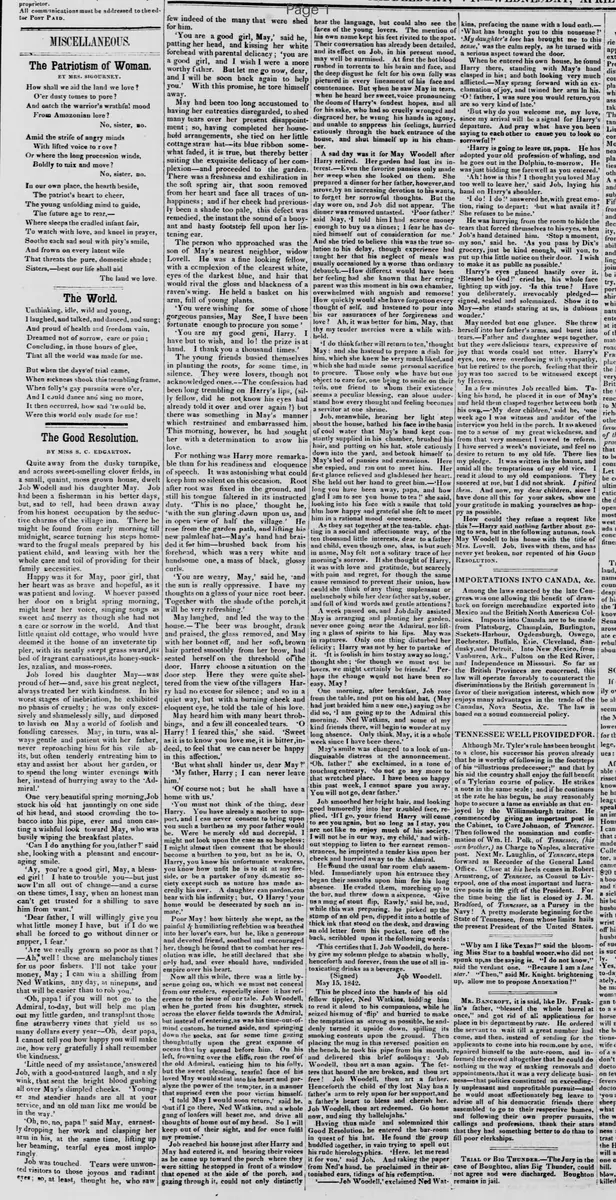
The Good Resolution.
BY MISS S. C. EDGARTON.
Quite away from the dusky turnpike, and across sweet-smelling clover fields, in a small, quaint, moss grown house, dwelt Job Woodell and his daughter May. Job had been a fisherman in his better days, but, sad to tell, had been drawn away from his honest occupation by the seductive charms of the village inn. There he might be found from early morning till midnight, scarce turning his steps homeward to the frugal meals prepared by his patient child, and leaving with her the whole care and toil of providing for their family necessities.
Happy was it for May, poor girl, that her heart was as brave and hopeful, as it was patient and loving. Whoever passed her door on a bright spring morning, might hear her voice, singing songs as sweet and merry as though she had not a care or sorrow in the world. And that little quaint old cottage, who would have deemed it the home of an inveterate tippler, with its neatly swept grass sward, its bed of fragrant carnations, its honey-suckles, azalias, and moss-roses.
Job loved his daughter May-was proud of her-and, save his great neglect, always treated her with kindness. In his worst stages of inebriation, he exhibited no phase of cruelty; he was only excessively and shamelessly silly, and disposed to lavish on May a world of foolish and fondling caresses. May, in turn, was always gentle and patient with her father, never reproaching him for his vile habits, but often tenderly entreating him to stay and assist her about her garden, or to spend the long winter evenings with her, instead of hurrying away to the 'Admiral.'
One very beautiful spring morning, Job stuck his old hat jauntingly on one side of his head, and stood crowding the tobacco into his pipe, ever and anon casting a wishful look toward May, who was busily wiping the breakfast plates.
'Can I do anything for you, father?' said she, looking with a pleasant and encouraging smile.
'Ay, you're a good girl, May, a blessed girl! I hate to trouble you--but just now I'm all out of change--and a curse on these times, I say, when an honest man can't get trusted for a shilling to save him from want.'
'Dear father, I will willingly give you what little money I have, but if I do we shall be forced to go without dinner or supper, I fear.'
'Are we really grown so poor as that? --Ah, well! these are melancholy times for us poor fishers. I'll not take your money, May; I can win a shilling from Ned Watkins, any day, at ninepins, and that will be easier than to rob you.'
'Oh, papa! if you will not go to the Admiral, to-day, but will help me plan out my little garden, and transplant those fine strawberry vines that yield us so many dollars every year--Oh, dear papa, I cannot tell you how happy you will make me, how very gratefully I shall remember the kindness.'
'Little need of my assistance,' answered Job, with a good-natured laugh, and a sly wink, that sent the bright blood gushing all over May's dimpled cheeks. 'Younger and steadier hands are all at your service, and an old man like me would be in the way.'
'Oh, no, no, papa!' said May, earnestly dropping her work and clasping her arm in his, at the same time, lifting up her beaming, tearful eyes most imploringly.
Job was touched. Tears were unwonted visitors to those joyous and radiant eyes; or, at least, thought he, who saw few indeed of the many that were shed for him.
'You are a good girl, May,' said he, patting her head, and kissing her white forehead with parental delicacy; 'you are a good girl, and I wish I were a more worthy father. But let me go now, dear, and I will be soon back again to help you.'
With this promise, he tore himself away.
May had been too long accustomed to having her entreaties disregarded, to shed many tears over her present disappointment; so, having completed her household arrangements, she tied on her little cottage straw hat--its blue ribbon somewhat faded, it is true, but thereby better suiting the exquisite delicacy of her complexion--and proceeded to the garden.
There was a freshness and exhilaration in the soft spring air, that soon removed from her heart and face all traces of unhappiness; and if her cheek had previously been a shade too pale, this defect was remedied, the instant the sound of a boyant and hasty footstep fell upon her listening ear.
The person who approached was the son of May's nearest neighbor, widow Lovell. He was a fine looking fellow, with a complexion of the clearest white, eyes of the darkest blue, and hair that would rival the gloss and blackness of a raven's wing.
He held a basket on his arm, full of young plants.
'You were wishing for some of those gorgeous pansies, May. See, I have been fortunate enough to procure you some.'
'You are my good genius, Harry. I have but to wish, and lo! the prize is at hand. I thank you a thousand times.'
The young friends busied themselves in planting the roots, for some time, in silence. They were lovers, though not acknowledged ones.--The confession had been long trembling on Harry's lips, (silly fellow, did he not know his eyes had already told it over and over again?) but there was something in May's manner which restrained and embarrassed him.
This morning, however, he had sought her with a determination to avow his love.
For nothing was Harry more remarkable than for his readiness and eloquence of speech. It was astonishing what could keep him so silent on this occasion.
Root after root was fixed in the ground, and still his tongue faltered in its instructed duty. 'This is no place,' thought he, 'with the sun glaring down upon us, and in open view of half the village.' He rose from the garden path, and lifting his new palm-leaf hat--May's hand had braided it for him--brushed back from his forehead, which was a very white and handsome one, a mass of black, glossy curls.
'You are weary, May,' said he, 'and the sun is really oppressive. I have my thoughts on a glass of your nice root beer. Together with the shade of the porch, it will be very refreshing.'
May laughed, and led the way to the house.--The beer was brought, drank and praised, the glass removed, and May with her bonnet off, and her soft, brown hair parted smoothly from her brow, had seated herself on the threshold of the door.
Harry chose a situation on the door step. Here they were quite sheltered from the view of the villagers. Harry had no excuse for silence; and so in a quiet way, but with a burning cheek and eloquent eye, he told the tale of his love.
May heard him with many heart throbbings, and a few ill concealed tears.
'O Harry! I feared this,' she said. 'Sweet as it is to know you love me, it is bitter, indeed, to feel that we can never be happy in this affection.'
'But what shall hinder us, dear May?'
'My father, Harry; I can never leave him.'
'Of course not; but he shall have a home with us.'
'You must not think of the thing, dear Harry. You have already a mother to support, and I can never consent to bring upon you such a burden as my poor father would be. Were he merely old and decrepit, I might not look upon the case as so hopeless; I might almost then consent that he should become a burden to you, but as he is, O, Harry, you know his unfortunate weakness, you know how unfit he is to sit at any fireside, or be a partaker of any domestic society except such as nature has made sacredly his own. A daughter can pardon, can bear with his infirmity; but, O Harry! your home would be desecrated by such an inmate.'
Poor May! how bitterly she wept, as the painful and humiliating reflection was breathed into her lover's ears, but he, like a generous and devoted friend, soothed and encouraged her, though he found that to combat her resolution was idle, he still declared that she only had, and ever should have, undivided empire over his heart.
Now all this while, there was a little by-scene going on, which we must not conceal from our readers, especially since it has reference to the issue of our tale. Job Woodell, when he parted from his daughter, struck across the clover fields towards the Admiral, but instead of entering, as was his time-out-of-mind custom, he turned aside, and springing down the rocks, sat for some time gazing thoughtfully upon the great expanse of ocean that lay spread before him. On his left, frowning over the cliffs, rose the roof of the old Admiral, enticing him to his folly, but the sweet pleading, tearful face of his loved May would steal into his heart and paralyze the power of the tempter, in a manner that surprised even the poor victim himself.
'I told May I would soon return,' said he, 'but if I go there, Ned Watkins, and a whole gang of loafers will beset me, and drive all thoughts of home out of my head. So I will keep out of their sight, and for once fulfil my promise.'
Job reached his house just after Harry and May had entered it, and hearing their voices as he came up toward the porch where they were sitting he stopped in front of a window that opened at the side of the porch, and gazing through it, could not only distinctly hear the language, but could also see the faces of the young lovers. The mention of his own name kept his feet riveted to the spot.
Their conversation has already been detailed, and its effect on Job, in his present mood, may well be surmised. At first the hot blood rushed in torrents to his brain and face, and the deep disgust he felt for his own folly was pictured in every lineament of his face and countenance. But when he saw May in tears, when he heard her sweet, voice pronouncing the doom of Harry's fondest hopes, and all for his sake, who had so cruelly wronged and disgraced her, he wrung his hands in agony, and unable to suppress his feelings, hurried cautiously through the back entrance of the house, and shut himself up in his chamber.
A sad day was it for May Woodell after Harry retired. Her garden had lost its interest.--Even the favorite pansies only made her weep when she looked on them. She prepared a dinner for her father, however, and strove, by an increasing devotion to his wants, to forget her sorrowful thoughts. But the day wore on, and Job did not appear. The dinner was removed untasted. 'Poor father!' said May, 'I told him I had scarce money enough to buy us a dinner; I fear he has denied himself out of consideration for me.'
And she tried to believe this was the true solution to his delay, though experience had taught her that his neglect of meals was usually occasioned by a worse than ordinary debauch.--How different would have been her feeling had she known that her erring parent was this moment in his own chamber, overwhelmed with anguish and remorse!
How quickly would she have forgotten every thought of self, and hastened to pour into his ear assurances of her forgiveness and love? Ah, it was better for him, May, that thy tender mercies were a while withheld.
'I do think father will return to tea,' thought May: and she hastened to prepare a dish for him, which she knew he very much liked, and which she had made some personal sacrifice to procure. Those only who have but one object to care for, one being to smile on their toils, one friend to whom their existence seems a peculiar blessing, can alone understand how every thought and feeling becomes a servitor at one shrine.
Job, meanwhile, hearing her light step about the house, bathed his face in the basin of cool water that May's hand kept constantly supplied in his chamber, brushed his hair, and putting on his hat, stole cautiously down into the yard, and betook himself to May's bed of pansies and carnations.
Here she espied, and ran out to meet him. Her first glance relieved and gladdened her heart. She held out her hand to greet him.--'How long you have been away, papa, and how glad I am to see you home to tea!' she said, looking into his face with a smile that told him how happy and grateful she felt to meet him in a rational mood once more.
As they sat together at the tea-table, chatting in a social and affectionate way, of the ten thousand little interests, dear to a father and child, even though one, alas, is but such in name, May felt not a solitary trace of her morning's sorrow. If she thought of Harry, it was with love and gratitude, but scarcely with pain and regret, for though the same cause remained to prevent their union, how could she think of anything unpleasant or melancholy while her dear father sat by, sober, and full of kind words and gentle attentions?
A week passed on, and Job daily assisted May in arranging and planting her garden, never once going near the Admiral, nor lifting a glass of spirits to his lips. May was in raptures. Only one thing disturbed her felicity; Harry was not by her to partake of it. 'It is foolish in him to stay away so long,' thought she; 'for though we must not be lovers, we might certainly be friends.' Perhaps the change would not have been so easy, May?
One morning, after breakfast, Job rose from the table, and put on his old hat, (May had just braided him a new one,) saying as he did so, 'I am going up to the Admiral this morning. Ned Watkins, and some of my kind friends there, will begin to wonder at my long absence. Only think, May, it is a whole week since I have been there.'
May's smile was changed to a look of undisguisable distress at the announcement.
'Oh, father!' she exclaimed, in a tone of touching entreaty, 'do not go any more to that wretched place. I have been so happy this past week, I cannot spare you away. You will not go, dear father.'
Job smoothed her bright hair, and looking good humoredly into her troubled face, replied, 'If I go, your friend Harry will come to see you again, but so long as I stay, you are not like to enjoy much of his society. I will not be in our way, my child,' and without stopping to listen to her earnest remonstrances, he imprinted a tender kiss upon her cheek and hurried away to the Admiral.
He found the usual bar room club assembled. Immediately upon his entrance they began their assaults upon him for his long absence. He evaded them, marching up to the bar, and threw down a sixpence.
'Give us a mug of stout flip, Rawly,' said he, and, while this was preparing, he picked up the stump of an old pen, dipped it into a bottle of thick ink that stood on the desk, and drawing an old letter from his pocket, tore off the back, scribbled upon it the following words:
'This certifies that I, Job Woodell, do hereby give my solemn pledge to abstain wholly, henceforth and forever, from the use of all intoxicating drinks as a beverage.
(Signed) Jqb Woodell.
May 15, 1842.'
This he placed into the hands of his old fellow tippler, Ned Watkins, bidding him to read it aloud to his companions, while he seized his mug of 'flip' and hurried to make the temptation as strong as possible, he suddenly turned it upside down, spilling its smoking contents upon the ground. Then placing the mug in this reversed position on the bench, he took his pipe from his mouth, and delivered this brief soliloquy: 'Job Woodell, thou art a man again. The fetters that bound thee are broken, and thou art free! Job Woodell, thou art a father. Henceforth the child of thy love, May, has a father's arm to rely upon for her support, and a father's heart to bless and cherish her. Job Woodell, thou art redeemed. Go home now, and sing thy hallelujahs.'
Having thus made and solemnized this Good Resolution, he entered the bar-room in quest of his hat. He found the group huddled together, in vain trying to spell out his rude hieroglyphics. 'Here, let me read it for you,' said Job. And taking the paper from Ned's hand, he proclaimed in their astonished ears, tidings of his redemption.
'Job Woodell,' exclaimed Ned Watkins, prefacing the name with a loud oath.- 'What has brought you to this nonsense?'
'My daughter's love has brought me to this sense,' was the calm reply, as he turned with a serious aspect toward the door.
When he entered his own house, he found Harry there, standing with May's hand clasped in his; and both looking very much afflicted.--May sprang forward with an exclamation of joy, and twined her arm in his.
'O! father, I was sure you would return, you are so very kind of late.'
'But why do you welcome me, my love, since my arrival will be a signal for Harry's departure.
And pray what have you been saying to each other to cause you to look so sorrowful?'
'Harry is going to leave us, papa. He has adopted your old profession-of whaling, and he goes out in the Dolphin, to-morrow. He was just bidding me farewell as you entered.'
'Ah! how is this? I thought you loved May too well to leave her,' said Job, laying his hand on Harry's shoulder.
'I do! I do!' answered he, with great emotion, rising to depart: but what avails it? She refuses to be mine.'
He was hurrying from the room to hide the tears that forced themselves to his eyes, when Job's hand detained him.
'Stop a moment, my son,' said he. 'As you pass by Dix's grocery, just be kind enough, will you, to put up this little notice on their door. I wish to make it as public as possible.'
Harry's eyes glanced hastily over it.
'Blessed be God!' cried he, his whole face lighting up with joy. 'Is this true? Have you deliberately, irrevocably pledged--signed, sealed and solemnized. Show it to May--she stands staring at us, is dubious wonder.'
May needed but one glance. She threw herself into her father's arms, and burst into tears.--Father and daughter wept together, but they were delicious tears, expressive of joy that words could not utter. Harry's eyes, too, were overflowing with sympathy. but he retired to the porch, feeling that their joy was too sacred to be witnessed except by Heaven.
In a few minutes Job recalled him. Taking his hand, he placed it in one of May's and held them clasped together between both his own.--'My dear children,' said he, 'one week ago I was witness and auditor of the interview you held in the porch. It awakened me to a sense of my great wickedness, and from that very moment I vowed to reform. I have served a week's novitiate, and feel no desire to return to my old life. There lies my pledge. It was written in the haunt, and amid all the temptations of my old vice. I read it aloud to my old companions. They sneered at me, but I did not shrink. I pitied them. And now, my dear children, since I have done all this for your sakes, show me your gratitude in making yourselves as happy as possible.'
How could they refuse a request like this?--Harry said nothing farther about going to sea, but in the following autumn, took May Woodell to his home with the title of Mrs. Lovell. Job, lives with them, and has never yet broken, nor repented of his Good Resolution.
BY MISS S. C. EDGARTON.
Quite away from the dusky turnpike, and across sweet-smelling clover fields, in a small, quaint, moss grown house, dwelt Job Woodell and his daughter May. Job had been a fisherman in his better days, but, sad to tell, had been drawn away from his honest occupation by the seductive charms of the village inn. There he might be found from early morning till midnight, scarce turning his steps homeward to the frugal meals prepared by his patient child, and leaving with her the whole care and toil of providing for their family necessities.
Happy was it for May, poor girl, that her heart was as brave and hopeful, as it was patient and loving. Whoever passed her door on a bright spring morning, might hear her voice, singing songs as sweet and merry as though she had not a care or sorrow in the world. And that little quaint old cottage, who would have deemed it the home of an inveterate tippler, with its neatly swept grass sward, its bed of fragrant carnations, its honey-suckles, azalias, and moss-roses.
Job loved his daughter May-was proud of her-and, save his great neglect, always treated her with kindness. In his worst stages of inebriation, he exhibited no phase of cruelty; he was only excessively and shamelessly silly, and disposed to lavish on May a world of foolish and fondling caresses. May, in turn, was always gentle and patient with her father, never reproaching him for his vile habits, but often tenderly entreating him to stay and assist her about her garden, or to spend the long winter evenings with her, instead of hurrying away to the 'Admiral.'
One very beautiful spring morning, Job stuck his old hat jauntingly on one side of his head, and stood crowding the tobacco into his pipe, ever and anon casting a wishful look toward May, who was busily wiping the breakfast plates.
'Can I do anything for you, father?' said she, looking with a pleasant and encouraging smile.
'Ay, you're a good girl, May, a blessed girl! I hate to trouble you--but just now I'm all out of change--and a curse on these times, I say, when an honest man can't get trusted for a shilling to save him from want.'
'Dear father, I will willingly give you what little money I have, but if I do we shall be forced to go without dinner or supper, I fear.'
'Are we really grown so poor as that? --Ah, well! these are melancholy times for us poor fishers. I'll not take your money, May; I can win a shilling from Ned Watkins, any day, at ninepins, and that will be easier than to rob you.'
'Oh, papa! if you will not go to the Admiral, to-day, but will help me plan out my little garden, and transplant those fine strawberry vines that yield us so many dollars every year--Oh, dear papa, I cannot tell you how happy you will make me, how very gratefully I shall remember the kindness.'
'Little need of my assistance,' answered Job, with a good-natured laugh, and a sly wink, that sent the bright blood gushing all over May's dimpled cheeks. 'Younger and steadier hands are all at your service, and an old man like me would be in the way.'
'Oh, no, no, papa!' said May, earnestly dropping her work and clasping her arm in his, at the same time, lifting up her beaming, tearful eyes most imploringly.
Job was touched. Tears were unwonted visitors to those joyous and radiant eyes; or, at least, thought he, who saw few indeed of the many that were shed for him.
'You are a good girl, May,' said he, patting her head, and kissing her white forehead with parental delicacy; 'you are a good girl, and I wish I were a more worthy father. But let me go now, dear, and I will be soon back again to help you.'
With this promise, he tore himself away.
May had been too long accustomed to having her entreaties disregarded, to shed many tears over her present disappointment; so, having completed her household arrangements, she tied on her little cottage straw hat--its blue ribbon somewhat faded, it is true, but thereby better suiting the exquisite delicacy of her complexion--and proceeded to the garden.
There was a freshness and exhilaration in the soft spring air, that soon removed from her heart and face all traces of unhappiness; and if her cheek had previously been a shade too pale, this defect was remedied, the instant the sound of a boyant and hasty footstep fell upon her listening ear.
The person who approached was the son of May's nearest neighbor, widow Lovell. He was a fine looking fellow, with a complexion of the clearest white, eyes of the darkest blue, and hair that would rival the gloss and blackness of a raven's wing.
He held a basket on his arm, full of young plants.
'You were wishing for some of those gorgeous pansies, May. See, I have been fortunate enough to procure you some.'
'You are my good genius, Harry. I have but to wish, and lo! the prize is at hand. I thank you a thousand times.'
The young friends busied themselves in planting the roots, for some time, in silence. They were lovers, though not acknowledged ones.--The confession had been long trembling on Harry's lips, (silly fellow, did he not know his eyes had already told it over and over again?) but there was something in May's manner which restrained and embarrassed him.
This morning, however, he had sought her with a determination to avow his love.
For nothing was Harry more remarkable than for his readiness and eloquence of speech. It was astonishing what could keep him so silent on this occasion.
Root after root was fixed in the ground, and still his tongue faltered in its instructed duty. 'This is no place,' thought he, 'with the sun glaring down upon us, and in open view of half the village.' He rose from the garden path, and lifting his new palm-leaf hat--May's hand had braided it for him--brushed back from his forehead, which was a very white and handsome one, a mass of black, glossy curls.
'You are weary, May,' said he, 'and the sun is really oppressive. I have my thoughts on a glass of your nice root beer. Together with the shade of the porch, it will be very refreshing.'
May laughed, and led the way to the house.--The beer was brought, drank and praised, the glass removed, and May with her bonnet off, and her soft, brown hair parted smoothly from her brow, had seated herself on the threshold of the door.
Harry chose a situation on the door step. Here they were quite sheltered from the view of the villagers. Harry had no excuse for silence; and so in a quiet way, but with a burning cheek and eloquent eye, he told the tale of his love.
May heard him with many heart throbbings, and a few ill concealed tears.
'O Harry! I feared this,' she said. 'Sweet as it is to know you love me, it is bitter, indeed, to feel that we can never be happy in this affection.'
'But what shall hinder us, dear May?'
'My father, Harry; I can never leave him.'
'Of course not; but he shall have a home with us.'
'You must not think of the thing, dear Harry. You have already a mother to support, and I can never consent to bring upon you such a burden as my poor father would be. Were he merely old and decrepit, I might not look upon the case as so hopeless; I might almost then consent that he should become a burden to you, but as he is, O, Harry, you know his unfortunate weakness, you know how unfit he is to sit at any fireside, or be a partaker of any domestic society except such as nature has made sacredly his own. A daughter can pardon, can bear with his infirmity; but, O Harry! your home would be desecrated by such an inmate.'
Poor May! how bitterly she wept, as the painful and humiliating reflection was breathed into her lover's ears, but he, like a generous and devoted friend, soothed and encouraged her, though he found that to combat her resolution was idle, he still declared that she only had, and ever should have, undivided empire over his heart.
Now all this while, there was a little by-scene going on, which we must not conceal from our readers, especially since it has reference to the issue of our tale. Job Woodell, when he parted from his daughter, struck across the clover fields towards the Admiral, but instead of entering, as was his time-out-of-mind custom, he turned aside, and springing down the rocks, sat for some time gazing thoughtfully upon the great expanse of ocean that lay spread before him. On his left, frowning over the cliffs, rose the roof of the old Admiral, enticing him to his folly, but the sweet pleading, tearful face of his loved May would steal into his heart and paralyze the power of the tempter, in a manner that surprised even the poor victim himself.
'I told May I would soon return,' said he, 'but if I go there, Ned Watkins, and a whole gang of loafers will beset me, and drive all thoughts of home out of my head. So I will keep out of their sight, and for once fulfil my promise.'
Job reached his house just after Harry and May had entered it, and hearing their voices as he came up toward the porch where they were sitting he stopped in front of a window that opened at the side of the porch, and gazing through it, could not only distinctly hear the language, but could also see the faces of the young lovers. The mention of his own name kept his feet riveted to the spot.
Their conversation has already been detailed, and its effect on Job, in his present mood, may well be surmised. At first the hot blood rushed in torrents to his brain and face, and the deep disgust he felt for his own folly was pictured in every lineament of his face and countenance. But when he saw May in tears, when he heard her sweet, voice pronouncing the doom of Harry's fondest hopes, and all for his sake, who had so cruelly wronged and disgraced her, he wrung his hands in agony, and unable to suppress his feelings, hurried cautiously through the back entrance of the house, and shut himself up in his chamber.
A sad day was it for May Woodell after Harry retired. Her garden had lost its interest.--Even the favorite pansies only made her weep when she looked on them. She prepared a dinner for her father, however, and strove, by an increasing devotion to his wants, to forget her sorrowful thoughts. But the day wore on, and Job did not appear. The dinner was removed untasted. 'Poor father!' said May, 'I told him I had scarce money enough to buy us a dinner; I fear he has denied himself out of consideration for me.'
And she tried to believe this was the true solution to his delay, though experience had taught her that his neglect of meals was usually occasioned by a worse than ordinary debauch.--How different would have been her feeling had she known that her erring parent was this moment in his own chamber, overwhelmed with anguish and remorse!
How quickly would she have forgotten every thought of self, and hastened to pour into his ear assurances of her forgiveness and love? Ah, it was better for him, May, that thy tender mercies were a while withheld.
'I do think father will return to tea,' thought May: and she hastened to prepare a dish for him, which she knew he very much liked, and which she had made some personal sacrifice to procure. Those only who have but one object to care for, one being to smile on their toils, one friend to whom their existence seems a peculiar blessing, can alone understand how every thought and feeling becomes a servitor at one shrine.
Job, meanwhile, hearing her light step about the house, bathed his face in the basin of cool water that May's hand kept constantly supplied in his chamber, brushed his hair, and putting on his hat, stole cautiously down into the yard, and betook himself to May's bed of pansies and carnations.
Here she espied, and ran out to meet him. Her first glance relieved and gladdened her heart. She held out her hand to greet him.--'How long you have been away, papa, and how glad I am to see you home to tea!' she said, looking into his face with a smile that told him how happy and grateful she felt to meet him in a rational mood once more.
As they sat together at the tea-table, chatting in a social and affectionate way, of the ten thousand little interests, dear to a father and child, even though one, alas, is but such in name, May felt not a solitary trace of her morning's sorrow. If she thought of Harry, it was with love and gratitude, but scarcely with pain and regret, for though the same cause remained to prevent their union, how could she think of anything unpleasant or melancholy while her dear father sat by, sober, and full of kind words and gentle attentions?
A week passed on, and Job daily assisted May in arranging and planting her garden, never once going near the Admiral, nor lifting a glass of spirits to his lips. May was in raptures. Only one thing disturbed her felicity; Harry was not by her to partake of it. 'It is foolish in him to stay away so long,' thought she; 'for though we must not be lovers, we might certainly be friends.' Perhaps the change would not have been so easy, May?
One morning, after breakfast, Job rose from the table, and put on his old hat, (May had just braided him a new one,) saying as he did so, 'I am going up to the Admiral this morning. Ned Watkins, and some of my kind friends there, will begin to wonder at my long absence. Only think, May, it is a whole week since I have been there.'
May's smile was changed to a look of undisguisable distress at the announcement.
'Oh, father!' she exclaimed, in a tone of touching entreaty, 'do not go any more to that wretched place. I have been so happy this past week, I cannot spare you away. You will not go, dear father.'
Job smoothed her bright hair, and looking good humoredly into her troubled face, replied, 'If I go, your friend Harry will come to see you again, but so long as I stay, you are not like to enjoy much of his society. I will not be in our way, my child,' and without stopping to listen to her earnest remonstrances, he imprinted a tender kiss upon her cheek and hurried away to the Admiral.
He found the usual bar room club assembled. Immediately upon his entrance they began their assaults upon him for his long absence. He evaded them, marching up to the bar, and threw down a sixpence.
'Give us a mug of stout flip, Rawly,' said he, and, while this was preparing, he picked up the stump of an old pen, dipped it into a bottle of thick ink that stood on the desk, and drawing an old letter from his pocket, tore off the back, scribbled upon it the following words:
'This certifies that I, Job Woodell, do hereby give my solemn pledge to abstain wholly, henceforth and forever, from the use of all intoxicating drinks as a beverage.
(Signed) Jqb Woodell.
May 15, 1842.'
This he placed into the hands of his old fellow tippler, Ned Watkins, bidding him to read it aloud to his companions, while he seized his mug of 'flip' and hurried to make the temptation as strong as possible, he suddenly turned it upside down, spilling its smoking contents upon the ground. Then placing the mug in this reversed position on the bench, he took his pipe from his mouth, and delivered this brief soliloquy: 'Job Woodell, thou art a man again. The fetters that bound thee are broken, and thou art free! Job Woodell, thou art a father. Henceforth the child of thy love, May, has a father's arm to rely upon for her support, and a father's heart to bless and cherish her. Job Woodell, thou art redeemed. Go home now, and sing thy hallelujahs.'
Having thus made and solemnized this Good Resolution, he entered the bar-room in quest of his hat. He found the group huddled together, in vain trying to spell out his rude hieroglyphics. 'Here, let me read it for you,' said Job. And taking the paper from Ned's hand, he proclaimed in their astonished ears, tidings of his redemption.
'Job Woodell,' exclaimed Ned Watkins, prefacing the name with a loud oath.- 'What has brought you to this nonsense?'
'My daughter's love has brought me to this sense,' was the calm reply, as he turned with a serious aspect toward the door.
When he entered his own house, he found Harry there, standing with May's hand clasped in his; and both looking very much afflicted.--May sprang forward with an exclamation of joy, and twined her arm in his.
'O! father, I was sure you would return, you are so very kind of late.'
'But why do you welcome me, my love, since my arrival will be a signal for Harry's departure.
And pray what have you been saying to each other to cause you to look so sorrowful?'
'Harry is going to leave us, papa. He has adopted your old profession-of whaling, and he goes out in the Dolphin, to-morrow. He was just bidding me farewell as you entered.'
'Ah! how is this? I thought you loved May too well to leave her,' said Job, laying his hand on Harry's shoulder.
'I do! I do!' answered he, with great emotion, rising to depart: but what avails it? She refuses to be mine.'
He was hurrying from the room to hide the tears that forced themselves to his eyes, when Job's hand detained him.
'Stop a moment, my son,' said he. 'As you pass by Dix's grocery, just be kind enough, will you, to put up this little notice on their door. I wish to make it as public as possible.'
Harry's eyes glanced hastily over it.
'Blessed be God!' cried he, his whole face lighting up with joy. 'Is this true? Have you deliberately, irrevocably pledged--signed, sealed and solemnized. Show it to May--she stands staring at us, is dubious wonder.'
May needed but one glance. She threw herself into her father's arms, and burst into tears.--Father and daughter wept together, but they were delicious tears, expressive of joy that words could not utter. Harry's eyes, too, were overflowing with sympathy. but he retired to the porch, feeling that their joy was too sacred to be witnessed except by Heaven.
In a few minutes Job recalled him. Taking his hand, he placed it in one of May's and held them clasped together between both his own.--'My dear children,' said he, 'one week ago I was witness and auditor of the interview you held in the porch. It awakened me to a sense of my great wickedness, and from that very moment I vowed to reform. I have served a week's novitiate, and feel no desire to return to my old life. There lies my pledge. It was written in the haunt, and amid all the temptations of my old vice. I read it aloud to my old companions. They sneered at me, but I did not shrink. I pitied them. And now, my dear children, since I have done all this for your sakes, show me your gratitude in making yourselves as happy as possible.'
How could they refuse a request like this?--Harry said nothing farther about going to sea, but in the following autumn, took May Woodell to his home with the title of Mrs. Lovell. Job, lives with them, and has never yet broken, nor repented of his Good Resolution.
What sub-type of article is it?
Prose Fiction
What themes does it cover?
Temperance
Moral Virtue
Love Romance
What keywords are associated?
Temperance Tale
Drunkard Reform
Father Daughter Bond
Romantic Love
Moral Resolution
Abstinence Pledge
Family Redemption
What entities or persons were involved?
By Miss S. C. Edgarton.
Literary Details
Title
The Good Resolution.
Author
By Miss S. C. Edgarton.
Key Lines
'This Certifies That I, Job Woodell, Do Hereby Give My Solemn Pledge To Abstain Wholly, Henceforth And Forever, From The Use Of All Intoxicating Drinks As A Beverage.
(Signed) Jqb Woodell.
May 15, 1842.'
'Job Woodell, Thou Art A Man Again. The Fetters That Bound Thee Are Broken, And Thou Art Free! Job Woodell, Thou Art A Father. Henceforth The Child Of Thy Love, May, Has A Father's Arm To Rely Upon For Her Support, And A Father's Heart To Bless And Cherish Her. Job Woodell, Thou Art Redeemed. Go Home Now, And Sing Thy Hallelujahs.'
'My Daughter's Love Has Brought Me To This Sense,'
'My Dear Children,' Said He, 'One Week Ago I Was Witness And Auditor Of The Interview You Held In The Porch. It Awakened Me To A Sense Of My Great Wickedness, And From That Very Moment I Vowed To Reform.'