Thank you for visiting SNEWPapers!
Sign up free
Editorial
August 1, 1886
Workmen's Advocate
New Haven, New Haven County, Connecticut
What is this article about?
Editorial from New York Volks Zeitung responds to Governor Hill's questions on pardoning labor union members convicted for boycotting, arguing the trial was unfair, biased by Judge Barrett, boycotting was legal then, and public outrage demands clemency.
Clipping
OCR Quality
98%
Excellent
Full Text
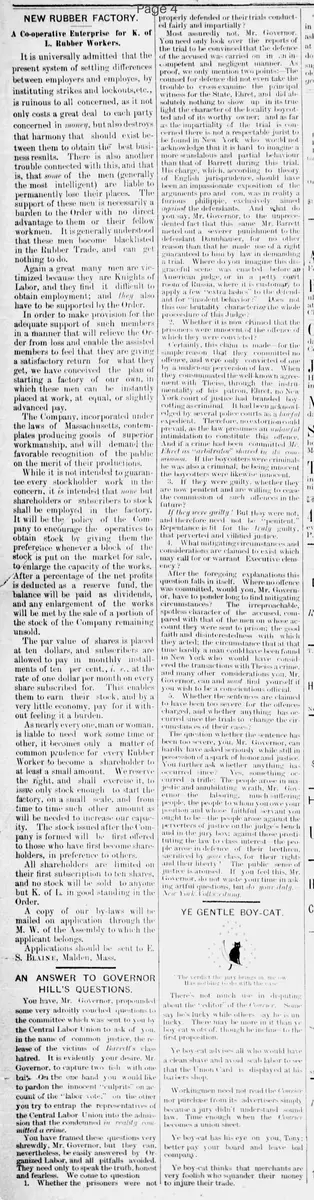
AN ANSWER TO GOVERNOR HILL'S QUESTIONS.
You have, Mr. Governor, propounded some very adroitly couched questions to the committee which was sent to you by the Central Labor Union to ask of you, in the name of common justice, the release of the victims of Barrett's class hatred. It is evidently your desire, Mr. Governor, to capture two fish with one bait. On the one hand you would like to pardon the innocent "culprits" on account of the "labor vote," on the other you try to entrap the representatives of the Central Labor Union into the admission that the condemned in reality committed a crime.
You have framed these questions very shrewdly, Mr. Governor, but they can, nevertheless, be easily answered by Organized Labor, and all pitfalls avoided. They need only to speak the truth, honest and fearless. We come to question
1. Whether the prisoners were not properly defended or their trials conducted fairly and impartially?
Most assuredly not, Mr. Governor. You need only look over the reports of the trial to be convinced that the defence of the accused was carried on in an incompetent and negligent manner. As proof, we only mention two points: The counsel for defence did not even take the trouble to cross examine the principal witness for the State, Ehret, and did absolutely nothing to show up in its true light the character of the locality boycotted and of its worthy owner; and as far as the impartiality of the trial is concerned there is not a respectable jurist to be found in New York who would not acknowledge that it is hard to imagine a more scandalous and partial behavior than that of Barrett during this trial. His charge, which, according to theory of English jurisprudence, should have been an impassioned exposition of the arguments pro and con, was in reality a furious philippic, exclusively aimed against the defendants. And what do you say, Mr. Governor, to the unprecedented fact that this same Mr. Barrett meted out a severer punishment to the defendant Dannhauser, for no other reason than that he made use of a right guaranteed to him by law in demanding a trial. Where do you imagine this disgraceful scene was enacted before an American judge, or in a petty court room of Russia, where it is customary to apply a few "extra lashes" to the defendant for "insolent behavior?" Does not this one brutality characterize the whole procedure of this Judge?
2. Whether it is now claimed that the prisoners were innocent of the offence of which they were convicted?
Certainly, this claim is made for the simple reason that they committed no offence, and were only convicted of one by a malicious perversion of law. When they consummated the well-known agreement with Theiss, through the instrumentality of his patron, Ehret, no New York court of justice had branded boycotting as criminal. It had been acknowledged by several police courts as a lawful expedient. Therefore, no extortion could prevail, as the law presumes an unlawful intimidation to constitute this offence. And if a crime had been committed Mr. Ehret as "arbitrator" shared in its commission. If the boycotters were criminals he was also a criminal; he being innocent the boycotters were likewise innocent.
3. If they were guilty, whether they are now penitent and are willing to cease the commission of such offences in the future?
If they were guilty! But they were not, and therefore need not be "penitent." Repentance is fit for the truly guilty, that perverted and vilified justice.
4. What mitigating circumstances and considerations are claimed to exist which may call for or warrant Executive clemency?
After the foregoing explanations this question falls in itself. Where no offence was committed, would you, Mr. Governor, have to ponder long to find mitigating circumstances? The irreproachable, spotless character of the accused, compared with that of the men on whose account they were sent to prison; the good faith and disinterestedness with which they acted; the circumstance that at that time hardly a man could have been found in New York who would have considered the transactions with Theiss a crime; and many other considerations you, Mr. Governor, can and must find yourself if you wish to be a conscientious official.
5. Whether the sentences are claimed to have been too severe for the offences charged, and whether anything has occurred since the trials to change the circumstances of their cases?
The question whether the sentence has been too severe, you, Mr. Governor, can hardly have asked seriously while still in possession of a spark of honor and justice. You further ask whether anything has occurred since? Yes, something occurred a trifle: The people arose in majestic and annihilating wrath, Mr. Governor, the laboring, much suffering people, the people to whom you owe your position and whose faithful servant you ought to be - the people arose against the perverters of justice on the judge's bench and in the jury box; against those prostituting the law to class interest the people arose in defence of their brethren, sacrificed by ghoulish class, for their rights and their liberty! The public sense of justice is aroused. If you feel this, Mr. Governor, do not waste your time in asking artful questions, but do your duty.
New York Volks Zeitung.
You have, Mr. Governor, propounded some very adroitly couched questions to the committee which was sent to you by the Central Labor Union to ask of you, in the name of common justice, the release of the victims of Barrett's class hatred. It is evidently your desire, Mr. Governor, to capture two fish with one bait. On the one hand you would like to pardon the innocent "culprits" on account of the "labor vote," on the other you try to entrap the representatives of the Central Labor Union into the admission that the condemned in reality committed a crime.
You have framed these questions very shrewdly, Mr. Governor, but they can, nevertheless, be easily answered by Organized Labor, and all pitfalls avoided. They need only to speak the truth, honest and fearless. We come to question
1. Whether the prisoners were not properly defended or their trials conducted fairly and impartially?
Most assuredly not, Mr. Governor. You need only look over the reports of the trial to be convinced that the defence of the accused was carried on in an incompetent and negligent manner. As proof, we only mention two points: The counsel for defence did not even take the trouble to cross examine the principal witness for the State, Ehret, and did absolutely nothing to show up in its true light the character of the locality boycotted and of its worthy owner; and as far as the impartiality of the trial is concerned there is not a respectable jurist to be found in New York who would not acknowledge that it is hard to imagine a more scandalous and partial behavior than that of Barrett during this trial. His charge, which, according to theory of English jurisprudence, should have been an impassioned exposition of the arguments pro and con, was in reality a furious philippic, exclusively aimed against the defendants. And what do you say, Mr. Governor, to the unprecedented fact that this same Mr. Barrett meted out a severer punishment to the defendant Dannhauser, for no other reason than that he made use of a right guaranteed to him by law in demanding a trial. Where do you imagine this disgraceful scene was enacted before an American judge, or in a petty court room of Russia, where it is customary to apply a few "extra lashes" to the defendant for "insolent behavior?" Does not this one brutality characterize the whole procedure of this Judge?
2. Whether it is now claimed that the prisoners were innocent of the offence of which they were convicted?
Certainly, this claim is made for the simple reason that they committed no offence, and were only convicted of one by a malicious perversion of law. When they consummated the well-known agreement with Theiss, through the instrumentality of his patron, Ehret, no New York court of justice had branded boycotting as criminal. It had been acknowledged by several police courts as a lawful expedient. Therefore, no extortion could prevail, as the law presumes an unlawful intimidation to constitute this offence. And if a crime had been committed Mr. Ehret as "arbitrator" shared in its commission. If the boycotters were criminals he was also a criminal; he being innocent the boycotters were likewise innocent.
3. If they were guilty, whether they are now penitent and are willing to cease the commission of such offences in the future?
If they were guilty! But they were not, and therefore need not be "penitent." Repentance is fit for the truly guilty, that perverted and vilified justice.
4. What mitigating circumstances and considerations are claimed to exist which may call for or warrant Executive clemency?
After the foregoing explanations this question falls in itself. Where no offence was committed, would you, Mr. Governor, have to ponder long to find mitigating circumstances? The irreproachable, spotless character of the accused, compared with that of the men on whose account they were sent to prison; the good faith and disinterestedness with which they acted; the circumstance that at that time hardly a man could have been found in New York who would have considered the transactions with Theiss a crime; and many other considerations you, Mr. Governor, can and must find yourself if you wish to be a conscientious official.
5. Whether the sentences are claimed to have been too severe for the offences charged, and whether anything has occurred since the trials to change the circumstances of their cases?
The question whether the sentence has been too severe, you, Mr. Governor, can hardly have asked seriously while still in possession of a spark of honor and justice. You further ask whether anything has occurred since? Yes, something occurred a trifle: The people arose in majestic and annihilating wrath, Mr. Governor, the laboring, much suffering people, the people to whom you owe your position and whose faithful servant you ought to be - the people arose against the perverters of justice on the judge's bench and in the jury box; against those prostituting the law to class interest the people arose in defence of their brethren, sacrificed by ghoulish class, for their rights and their liberty! The public sense of justice is aroused. If you feel this, Mr. Governor, do not waste your time in asking artful questions, but do your duty.
New York Volks Zeitung.
What sub-type of article is it?
Labor
Legal Reform
Crime Or Punishment
What keywords are associated?
Labor Union
Boycott
Governor Hill
Judge Barrett
Trial Injustice
Executive Clemency
Class Hatred
What entities or persons were involved?
Governor Hill
Judge Barrett
Central Labor Union
Ehret
Theiss
Dannhauser
Editorial Details
Primary Topic
Defense Of Labor Boycotters Convicted In Unfair Trial
Stance / Tone
Strongly Pro Labor, Critical Of Judicial Bias And Governor's Questions
Key Figures
Governor Hill
Judge Barrett
Central Labor Union
Ehret
Theiss
Dannhauser
Key Arguments
Defense Was Incompetent, Failing To Cross Examine Key Witness Ehret
Trial Was Partial, With Barrett's Biased Charge And Harsher Punishment For Demanding Trial
Boycotting Was Not Criminal At The Time, Acknowledged As Lawful By Courts
No Extortion Occurred Without Unlawful Intimidation
Ehret As Arbitrator Shares Any Guilt
Accused Have Spotless Character And Acted In Good Faith
Public Outrage Demands Justice And Clemency