Thank you for visiting SNEWPapers!
Sign up free
The Rhode Island American, And General Advertiser
Providence, Providence County, Rhode Island
What is this article about?
Letter to the editor sharing anecdotes from Virginia, South-Carolina, and elsewhere debunking snake 'fascination' as terror-induced paralysis in prey like rats, rabbits, and squirrels, rather than charm. Signed Caroliniensis.
Merged-components note: Continuation of the same letter to the editor, split across three sequential components on pages 1 and 2; the third was mislabeled as literary but is part of the letter.
Clippings
1 of 2
OCR Quality
Full Text
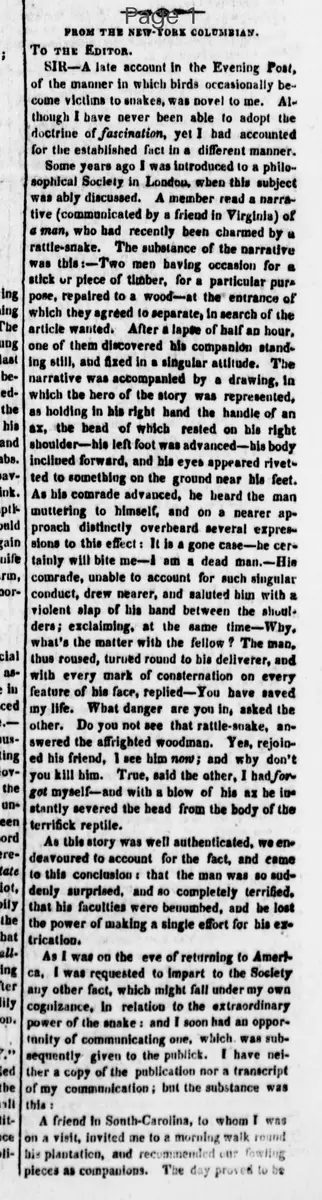
TO THE EDITOR.
SIR—A late account in the Evening Post, of the manner in which birds occasionally become victims to snakes, was novel to me. Although I have never been able to adopt the doctrine of fascination, yet I had accounted for the established fact in a different manner.
Some years ago I was introduced to a philosophical Society in London, when this subject was ably discussed. A member read a narrative (communicated by a friend in Virginia) of a man, who had recently been charmed by a rattle-snake. The substance of the narrative was this:—Two men having occasion for a stick or piece of timber, for a particular purpose, repaired to a wood—at the entrance of which they agreed to separate, in search of the article wanted. After a lapse of half an hour, one of them discovered his companion standing still, and fixed in a singular attitude. The narrative was accompanied by a drawing, in which the hero of the story was represented, as holding in his right hand the handle of an ax, the head of which rested on his right shoulder—his left foot was advanced—his body inclined forward, and his eyes appeared riveted to something on the ground near his feet. As his comrade advanced, he heard the man muttering to himself, and on a nearer approach distinctly overheard several expressions to this effect: It is a gone case—he certainly will bite me—I am a dead man. His comrade, unable to account for such singular conduct, drew nearer, and saluted him with a violent slap of his hand between the shoulders; exclaiming, at the same time—Why, what's the matter with the fellow? The man, thus roused, turned round to his deliverer, and with every mark of consternation on every feature of his face, replied—You have saved my life. What danger are you in, asked the other. Do you not see that rattle-snake, answered the affrighted woodman. Yes, rejoined his friend, I see him now; and why don't you kill him. True, said the other, I had forgot myself—and with a blow of his ax he instantly severed the head from the body of the terrifick reptile.
As this story was well authenticated, we endeavoured to account for the fact, and came to this conclusion: that the man was so suddenly surprised, and so completely terrified, that his faculties were benumbed, and he lost the power of making a single effort for his extrication.
As I was on the eve of returning to America, I was requested to impart to the Society any other fact, which might fall under my own cognizance, in relation to the extraordinary power of the snake: and I soon had an opportunity of communicating one, which was subsequently given to the publick. I have neither a copy of the publication nor a transcript of my communication; but the substance was this:
A friend in South-Carolina, to whom I was on a visit, invited me to a morning walk round his plantation, and recommended our fowling pieces as companions. The day proved to be dry, and while my friend proceeded to give some directions to a gang of his negroes at a distance, he advised me to take the benefit of a shade formed by a wood adjoining the field in which we then were. I took the hint; and while leaning on the fence (which was constructed on a bank between two dry ditches) I was alarmed by the rattle of a snake very near me. I instantly sprung on the top rail of the fence, and the next moment discovered the monster in one of the ditches, within ten feet of the spot where I was seated. As I levelled my gun at his head, and was in the act of pulling the trigger, his tail ceased to vibrate. Conscious, from his position, that I was not the object of his regard, and that I was in no danger from him, and confident that I could destroy him at any moment I pleased, I sat still to observe his further movements. As his eyes seemed to be rivetted to a particular spot I followed their direction, and discovered a wood-rat. At the moment of my first seeing this little animal, he was rising from a crouching posture, and endeavouring to retire by a retrograde movement. This attempt was immediately followed by a second tremendous exercise of the rattle, and the rat again sunk to the ground. I witnessed several repetitions of this operation; and the result was, that at length, the rat appeared perfectly exhausted; the snake advanced toward his prey, and was in the act of taking it into his mouth, when I discharged my two barrels at his head, and killed him on the spot. Whether any of my pellets struck the rat, I am unable to say: but after the closest search we could detect no mark of violence about his body, and he was dead when I took him up.
Some years after the foregoing circumstance had taken place, as I was accompanying a lady to church in a gig, we were alarmed by the rattle of a snake on the road side. After I had tranquillized the horse, and prevailed on the lady to hold the reins, I returned to the spot from whence the noise seemed to issue. I soon discovered the subject of our alarm. The monster was lying in a coil, ready to strike, but manifested no concern at my approach. Having armed myself with a long fence rail, I was in the act of crushing his head, when I saw a rabbit in the very same posture and condition which the rat had exhibited. The fall of my weapon disabled the snake, and I soon despatched him. The rabbit I took into my hands, without an effort on its part to resist or escape, and deposited it in my companion's lap; but it died before we reached the Church. I am confident that the animal had sustained no bodily injury either from the snake or myself.
That small birds will, in the air, sometimes attack with success crows, and other large birds of prey, I admit: but that they should prove bold enough to assail a large snake on the ground, I much doubt. Admitting, however, the fact; is it credible that a wood-rat, a squirrel, or a rabbit, could be induced by resentment, or emboldened by any motive, to assail so formidable a foe as a large rattle-snake?
Terrour is well known to every medical man to be highly sedative: it is said, on good grounds, to be sufficiently powerful to destroy life. What objection to our hypothesis can then be urged, viz.—that feeble and timid animals, suddenly surprised by the presence of a formidable and deadly enemy, may become so paralyzed, as to be incapable of making any effectual effort for their rescue, and thus fall an easy prey to their devourer? Such, at least, is the opinion of many others, as well as of CAROLINIENSIS.
* I once rescued (I firmly believe) a squirrel from impending death: he appeared to me to be in convulsions at the sight of a tremendous black snake near him. The snake was not killed: but he quitted his position at my approach, glided into the wood, and left the squirrel to recover his scattered energies.
What sub-type of article is it?
What themes does it cover?
What keywords are associated?
What entities or persons were involved?
Letter to Editor Details
Author
Caroliniensis
Recipient
The Editor
Main Argument
the writer rejects the doctrine of snake fascination, attributing animals' immobilization to terror-induced paralysis, supported by personal anecdotes of encounters with rattlesnakes and prey animals.
Notable Details