Thank you for visiting SNEWPapers!
Sign up free
Editorial
November 10, 1802
The Recorder
Richmond, Virginia
What is this article about?
This Virginia editorial vehemently opposes slave emancipation, arguing it causes laziness, crime, and societal ruin among free blacks, cites anecdotes and St. Domingo revolts as warnings, and criticizes Jefferson and Madison's policies.
Merged-components note: Direct textual continuations of the long editorial on free negroes, emancipation, and related topics across columns on the same page.
Clipping
OCR Quality
95%
Excellent
Full Text
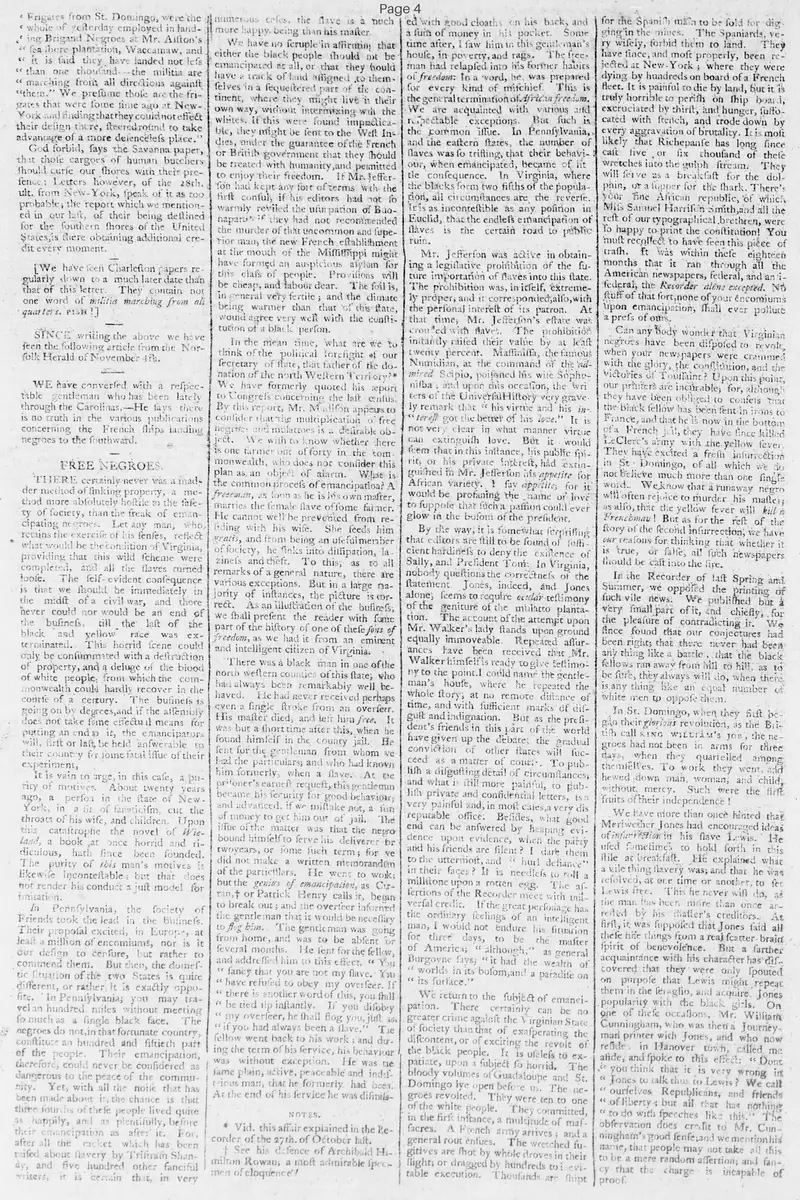
numerous cases, the slave is a much more happy being than his master. We have no scruple in affirming that either the black people should not be emancipated at all, or that they should have a tract of land assigned to themselves in a sequestered part of the continent, where they might live in their own way, without intermixing with the whites. If this were found impracticable, they might be sent to the West Indies, under the guarantee of the French or British government that they should be treated with humanity, and permitted to enjoy their freedom. If Mr. Jefferson had kept any sort of terms with the first consul, if his editors had not so warmly reviled the usurpation of Bonaparte, if they had not recommended the murder of that uncommon and superior man, the new French establishment at the mouth of the Mississippi might have formed an auspicious asylum for this class of people. Provisions will be cheap, and labour dear. The soil is, in general very fertile; and the climate being warmer than that of this state, would agree very well with the constitution of a black person.
In the mean time, what are we to think of the political foresight of our secretary of state, that father of the donation of the north Western Territory? We have formerly quoted his report to Congress concerning the last census. By this report, Mr. Madison appears to consider that the multiplication of free negroes and mulattoes is a desirable object. We wish to know whether there is one farmer out of forty in the commonwealth, who does not consider this plan as an object of alarm. What is the common process of emancipation? A freeman, as soon as he is his own master, marries the female slave of some farmer. He cannot well be prevented from residing with his wife. She feeds him gratis, and from being an useful member of society, he sinks into dissipation, laziness and theft. To this; as to all remarks of a general nature, there are various exceptions. But in a large majority of instances, the picture is correct. As an illustration of the business: we shall present the reader with some part of the history of one of these sons of freedom, as we had it from an eminent and intelligent citizen of Virginia:
There was a black man in one of the north western counties of this state; who had always been remarkably well behaved. He had never received perhaps even a single stroke from an overseer. His master died, and left him free. It was but a short time after this, when he found himself in the county jail. He sent for the gentleman from whom we had the particulars; and who had known him formerly, when a slave. At the prisoner's earnest request, this gentleman became his security for good behaviour; and advanced, if we mistake not, a sum of money to get him out of jail. The issue of the matter was that the negro bound himself to serve his deliverer for two years, or some such term; for we did not make a written memorandum of the particulars. He went to work; but the genius of emancipation, as Curran, or Patrick Henry calls it, began to break out; and the overseer informed the gentleman that it would be necessary to flog him. The gentleman was going from home, and was to be absent for several months. He sent for the fellow, and addressed him to this effect. "You fancy that you are not my slave. You have refused to obey my overseer. If there is another word of this, you shall be tied up instantly. If you disobey my overseer, he shall flog you, just as if you had always been a slave." The fellow went back to his work; and during the term of his service, his behaviour was without exception. He was the same plain, active, peaceable and industrious man, that he formerly had been. At the end of his service he was dismissed
NOTES.
Vid. this affair explained in the Recorder of the 27th. of October last.
See his defence of Archibald Hamilton Rowan; a most admirable specimen of eloquence!
ed with good cloaths on his back, and a sum of money in his pocket. Some time after, I saw him in this gentleman's house, in poverty and rags. The freeman had relapsed into his former habits of freedom: In a word, he was prepared for every kind of mischief. This is the general termination of African freedom. We are acquainted with various and respectable exceptions. But such is the common issue. In Pennsylvania, and the eastern states, the number of slaves was so trifling, that their behaviour, when emancipated, became of little consequence. In Virginia, where the blacks form two fifths of the population, all circumstances are the reverse. It is as incontestable as any position in Euclid, that the endless emancipation of slaves is the certain road to public ruin.
Mr. Jefferson was active in obtaining a legislative prohibition of the future importation of slaves into this state. The prohibition was, in itself, extremely proper; and it corresponded, also, with the personal interest of its patron. At that time, Mr. Jefferson's estate was crowded with slaves. The prohibition instantly raised their value by at least twenty percent. Massinissa, the famous Numidian, at the command of the admired Scipio, poisoned his wife Sophonisba, and upon this occasion, the writers of the Universal History very gravely remark that "his virtue and his interest got the better of his love." It is not very clear in what manner virtue can extinguish love. But it would seem that in this instance, his public spirit, or his private interest, had extinguished Mr. Jefferson his appetite for African variety. I say appetite; for it would be profaning the name of love to suppose that such a passion could ever glow in the bosom of the president.
By the way, it is somewhat surprising that editors are still to be found of sufficient hardiness to deny the existence of Sally, and President Tom: In Virginia, nobody questions the correctness of the statement. Jones, indeed, and Jones alone; seems to require ocular testimony of the geniture of the mulatto plantation. The account of the attempt upon Mr. Walker's lady stands upon ground equally immoveable. Repeated assurances have been received that Mr. Walker himself is ready to give testimony to the point. I could name the gentleman's house, where he repeated the whole story; at no remote distance of time, and with sufficient marks of disgust and indignation. But as the president's friends in this part of the world have given up the debate; the gradual conviction of other states will succeed as a matter of course. To publish a disgusting detail of circumstances; and what is still more painful, to publish private and confidential letters, is a very painful and, in most cases, a very disreputable office: Besides, what good end can be answered by heaping evidence upon evidence, when the party and his friends are silent? I dare them to the utmost, and hurl defiance in their faces? It is needless to toll a millstone upon a rotten egg. The assertions of the Recorder meet with universal credit. If the great personage has the ordinary feelings of an intelligent man, I would not endure his situation for three days, to be the master of America; "although," as general Burgoyne says; "it had the wealth of worlds in its bosom, and a paradise on its surface."
We return to the subject of emancipation. There certainly can be no greater crime against the Virginian State of society than that of exasperating the discontent, or of exciting the revolt of the black people. It is useless to expatiate, upon a subject so horrid. The bloody volumes of Guadaloupe and St. Domingo lie open before us. The negroes revolted. They were ten to one of the white people. They committed, in the first instance, a multitude of massacres. A French army arrives; and a general rout ensues. The wretched fugitives are shot by whole droves in their flight; or dragged by hundreds to inevitable execution. Thousands are shipped
for the Spanish main to be sold for digging in the mines. The Spaniards, very wisely, forbid them to land. They have since, and most properly, been rejected at New-York; where they were dying by hundreds on board of a French fleet. It is painful to die by land, but it is truly horrible to perish on ship board, excruciated by thirst, and hunger, suffocated with stench, and trode down by every aggravation of brutality. It is most likely that Richepanse has long since cast five or six thousand of these wretches into the gulf stream. They will serve as a breakfast for the dolphin, or a supper for the shark. There's your fine African republic, of which Mr. Samuel Harrison Smith, and all the rest of our typographical brethren, were so happy to print the constitution! You must recollect to have seen this piece of trash. It was within these eighteen months that it ran through all the American newspapers, federal, and anti-federal, the Recorder alone excepted. No stuff of that sort, none of your Encomiums upon emancipation, shall ever pollute a press of ours.
Can any body wonder that Virginian negroes have been disposed to revolt, when your newspapers were crammed with the glory, the constitution, and the victories of Touffaint? Upon this point, our printers are incurable; for, although they have been obliged to confess that the black fellow has been sent in irons to France, and that he is now in the bottom of a French jail, they have since killed Leclerc's army with the yellow fever. They have excited a fresh insurrection in St. Domingo, of all which we do not believe much more than one single word. We know that a runaway negro will often rejoice to murder his master; as also, that the yellow fever will kill a Frenchman! But as for the rest of the story of the second insurrection, we have our reasons for thinking that whether it is true, or false; all such newspapers should be cast into the fire.
In the Recorder of last Spring and Summer, we opposed the printing of such vile news. We published but a very small part of it, and chiefly, for the pleasure of contradicting it. We since found that our conjectures had been right; that there never had been any thing like a battle, that the black fellows ran away from him to hill, as to be sure, they always will do, when there is any thing like an equal number of white men to oppose them.
In St. Domingo, when they first began their glorious revolution, as the British call king William's you, the negroes had not been in arms for three days, when they quarrelled among themselves. To work they went, and hewed down man, woman, and child: without mercy. Such were the first fruits of their independence!
We have more than once hinted that Meriwether Jones had encouraged ideas of insurrection in his slave Lewis. He used sometimes to hold forth in this style at breakfast. He explained what a vile thing slavery was; and that he was resolved, at one time or another, to set Lewis free. This he never will do, as the man has been more than once arrested by his master's creditors. At first, it was supposed that Jones did all these fine things from a real scatter-brain spirit of benevolence. But a farther acquaintance with his character has discovered that they were only spouted on purpose that Lewis might repeat them in the seraglio, and acquire Jones popularity with the black girls. On one of these occasions, Mr. William Cunningham, who was then a Journey-man printer with Jones, and who now resides in Hanover town, called me aside, and spoke to this effect: "Dont you think that it is very wrong in Jones to talk thus to Lewis? We call ourselves Republicans, and friends of liberty; but all that has nothing to do with speeches like this." The observation does credit to Mr. Cunningham's good sense; and we mention his name, that people may not take all this to be a mere random assertion; and fancy that the charge is incapable of proof.
In the mean time, what are we to think of the political foresight of our secretary of state, that father of the donation of the north Western Territory? We have formerly quoted his report to Congress concerning the last census. By this report, Mr. Madison appears to consider that the multiplication of free negroes and mulattoes is a desirable object. We wish to know whether there is one farmer out of forty in the commonwealth, who does not consider this plan as an object of alarm. What is the common process of emancipation? A freeman, as soon as he is his own master, marries the female slave of some farmer. He cannot well be prevented from residing with his wife. She feeds him gratis, and from being an useful member of society, he sinks into dissipation, laziness and theft. To this; as to all remarks of a general nature, there are various exceptions. But in a large majority of instances, the picture is correct. As an illustration of the business: we shall present the reader with some part of the history of one of these sons of freedom, as we had it from an eminent and intelligent citizen of Virginia:
There was a black man in one of the north western counties of this state; who had always been remarkably well behaved. He had never received perhaps even a single stroke from an overseer. His master died, and left him free. It was but a short time after this, when he found himself in the county jail. He sent for the gentleman from whom we had the particulars; and who had known him formerly, when a slave. At the prisoner's earnest request, this gentleman became his security for good behaviour; and advanced, if we mistake not, a sum of money to get him out of jail. The issue of the matter was that the negro bound himself to serve his deliverer for two years, or some such term; for we did not make a written memorandum of the particulars. He went to work; but the genius of emancipation, as Curran, or Patrick Henry calls it, began to break out; and the overseer informed the gentleman that it would be necessary to flog him. The gentleman was going from home, and was to be absent for several months. He sent for the fellow, and addressed him to this effect. "You fancy that you are not my slave. You have refused to obey my overseer. If there is another word of this, you shall be tied up instantly. If you disobey my overseer, he shall flog you, just as if you had always been a slave." The fellow went back to his work; and during the term of his service, his behaviour was without exception. He was the same plain, active, peaceable and industrious man, that he formerly had been. At the end of his service he was dismissed
NOTES.
Vid. this affair explained in the Recorder of the 27th. of October last.
See his defence of Archibald Hamilton Rowan; a most admirable specimen of eloquence!
ed with good cloaths on his back, and a sum of money in his pocket. Some time after, I saw him in this gentleman's house, in poverty and rags. The freeman had relapsed into his former habits of freedom: In a word, he was prepared for every kind of mischief. This is the general termination of African freedom. We are acquainted with various and respectable exceptions. But such is the common issue. In Pennsylvania, and the eastern states, the number of slaves was so trifling, that their behaviour, when emancipated, became of little consequence. In Virginia, where the blacks form two fifths of the population, all circumstances are the reverse. It is as incontestable as any position in Euclid, that the endless emancipation of slaves is the certain road to public ruin.
Mr. Jefferson was active in obtaining a legislative prohibition of the future importation of slaves into this state. The prohibition was, in itself, extremely proper; and it corresponded, also, with the personal interest of its patron. At that time, Mr. Jefferson's estate was crowded with slaves. The prohibition instantly raised their value by at least twenty percent. Massinissa, the famous Numidian, at the command of the admired Scipio, poisoned his wife Sophonisba, and upon this occasion, the writers of the Universal History very gravely remark that "his virtue and his interest got the better of his love." It is not very clear in what manner virtue can extinguish love. But it would seem that in this instance, his public spirit, or his private interest, had extinguished Mr. Jefferson his appetite for African variety. I say appetite; for it would be profaning the name of love to suppose that such a passion could ever glow in the bosom of the president.
By the way, it is somewhat surprising that editors are still to be found of sufficient hardiness to deny the existence of Sally, and President Tom: In Virginia, nobody questions the correctness of the statement. Jones, indeed, and Jones alone; seems to require ocular testimony of the geniture of the mulatto plantation. The account of the attempt upon Mr. Walker's lady stands upon ground equally immoveable. Repeated assurances have been received that Mr. Walker himself is ready to give testimony to the point. I could name the gentleman's house, where he repeated the whole story; at no remote distance of time, and with sufficient marks of disgust and indignation. But as the president's friends in this part of the world have given up the debate; the gradual conviction of other states will succeed as a matter of course. To publish a disgusting detail of circumstances; and what is still more painful, to publish private and confidential letters, is a very painful and, in most cases, a very disreputable office: Besides, what good end can be answered by heaping evidence upon evidence, when the party and his friends are silent? I dare them to the utmost, and hurl defiance in their faces? It is needless to toll a millstone upon a rotten egg. The assertions of the Recorder meet with universal credit. If the great personage has the ordinary feelings of an intelligent man, I would not endure his situation for three days, to be the master of America; "although," as general Burgoyne says; "it had the wealth of worlds in its bosom, and a paradise on its surface."
We return to the subject of emancipation. There certainly can be no greater crime against the Virginian State of society than that of exasperating the discontent, or of exciting the revolt of the black people. It is useless to expatiate, upon a subject so horrid. The bloody volumes of Guadaloupe and St. Domingo lie open before us. The negroes revolted. They were ten to one of the white people. They committed, in the first instance, a multitude of massacres. A French army arrives; and a general rout ensues. The wretched fugitives are shot by whole droves in their flight; or dragged by hundreds to inevitable execution. Thousands are shipped
for the Spanish main to be sold for digging in the mines. The Spaniards, very wisely, forbid them to land. They have since, and most properly, been rejected at New-York; where they were dying by hundreds on board of a French fleet. It is painful to die by land, but it is truly horrible to perish on ship board, excruciated by thirst, and hunger, suffocated with stench, and trode down by every aggravation of brutality. It is most likely that Richepanse has long since cast five or six thousand of these wretches into the gulf stream. They will serve as a breakfast for the dolphin, or a supper for the shark. There's your fine African republic, of which Mr. Samuel Harrison Smith, and all the rest of our typographical brethren, were so happy to print the constitution! You must recollect to have seen this piece of trash. It was within these eighteen months that it ran through all the American newspapers, federal, and anti-federal, the Recorder alone excepted. No stuff of that sort, none of your Encomiums upon emancipation, shall ever pollute a press of ours.
Can any body wonder that Virginian negroes have been disposed to revolt, when your newspapers were crammed with the glory, the constitution, and the victories of Touffaint? Upon this point, our printers are incurable; for, although they have been obliged to confess that the black fellow has been sent in irons to France, and that he is now in the bottom of a French jail, they have since killed Leclerc's army with the yellow fever. They have excited a fresh insurrection in St. Domingo, of all which we do not believe much more than one single word. We know that a runaway negro will often rejoice to murder his master; as also, that the yellow fever will kill a Frenchman! But as for the rest of the story of the second insurrection, we have our reasons for thinking that whether it is true, or false; all such newspapers should be cast into the fire.
In the Recorder of last Spring and Summer, we opposed the printing of such vile news. We published but a very small part of it, and chiefly, for the pleasure of contradicting it. We since found that our conjectures had been right; that there never had been any thing like a battle, that the black fellows ran away from him to hill, as to be sure, they always will do, when there is any thing like an equal number of white men to oppose them.
In St. Domingo, when they first began their glorious revolution, as the British call king William's you, the negroes had not been in arms for three days, when they quarrelled among themselves. To work they went, and hewed down man, woman, and child: without mercy. Such were the first fruits of their independence!
We have more than once hinted that Meriwether Jones had encouraged ideas of insurrection in his slave Lewis. He used sometimes to hold forth in this style at breakfast. He explained what a vile thing slavery was; and that he was resolved, at one time or another, to set Lewis free. This he never will do, as the man has been more than once arrested by his master's creditors. At first, it was supposed that Jones did all these fine things from a real scatter-brain spirit of benevolence. But a farther acquaintance with his character has discovered that they were only spouted on purpose that Lewis might repeat them in the seraglio, and acquire Jones popularity with the black girls. On one of these occasions, Mr. William Cunningham, who was then a Journey-man printer with Jones, and who now resides in Hanover town, called me aside, and spoke to this effect: "Dont you think that it is very wrong in Jones to talk thus to Lewis? We call ourselves Republicans, and friends of liberty; but all that has nothing to do with speeches like this." The observation does credit to Mr. Cunningham's good sense; and we mention his name, that people may not take all this to be a mere random assertion; and fancy that the charge is incapable of proof.
What sub-type of article is it?
Slavery Abolition
What keywords are associated?
Slave Emancipation
Free Negroes
Virginia Slavery
St. Domingo Revolt
Jefferson Policies
Racial Mixing
What entities or persons were involved?
Thomas Jefferson
James Madison
Napoleon Bonaparte
Toussaint Louverture
Meriwether Jones
William Cunningham
Editorial Details
Primary Topic
Opposition To Slave Emancipation In Virginia
Stance / Tone
Strongly Anti Emancipation, Warning Of Social And Moral Ruin
Key Figures
Thomas Jefferson
James Madison
Napoleon Bonaparte
Toussaint Louverture
Meriwether Jones
William Cunningham
Key Arguments
Slaves Are Happier Than Free Blacks
Emancipation Leads To Laziness, Theft, And Societal Decay
Free Blacks In Virginia Pose A Threat Due To Population Ratio
St. Domingo Revolts Demonstrate Dangers Of Emancipation
Jefferson's Slave Importation Ban Served His Personal Interest
Newspapers' Praise Of Haitian Revolution Incites Slave Revolts