Thank you for visiting SNEWPapers!
Sign up free
Story
May 21, 1833
Phenix Gazette
Alexandria, Virginia
What is this article about?
John Prince provides chemical analyses of eight salt samples by Harvard's Dr. Webster, refuting concerns about destructive qualities in salts like Liverpool, concluding they are safe for food use when measured by weight.
Clipping
OCR Quality
88%
Good
Full Text
communicated.
From the New England Farmer.
ANALYSIS OF DIFFERENT SORTS OF
SALT, &c.
Jamaica Plain, April 29, 1833.
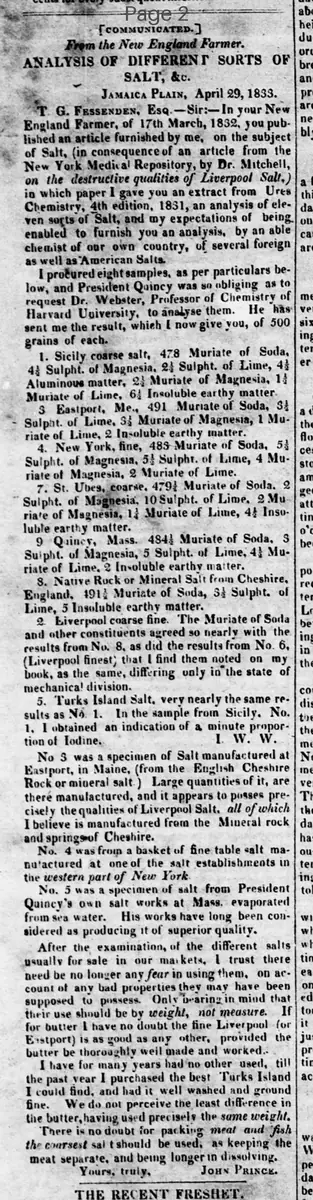
T. G. Fessenden, Esq.—Sir:—In your New England Farmer, of 17th March, 1832, you published an article furnished by me, on the subject of Salt, (in consequence of an article from the New York Medical Repository, by Dr. Mitchell, on the destructive qualities of Liverpool Salt,) in which paper I gave you an extract from Ure’s Chemistry, 4th edition, 1831, an analysis of eleven sorts of Salt, and my expectations of being enabled to furnish you an analysis, by an able chemist of our own country, of several foreign as well as American Salts.
I procured eight samples, as per particulars below, and President Quincy was so obliging as to request Dr. Webster, Professor of Chemistry of Harvard University, to analyse them. He has sent me the result, which I now give you, of 500 grains of each.
1. Sicily coarse salt, 478 Muriate of Soda, 4% Sulph. of Magnesia. 2% Sulph. of Lime, 4 Aluminous matter, 2% Muriate of Magnesia, 1 Muriate of Lime, 6% Insoluble earthy matter
2. Eastport, Me., 491 Muriate of Soda, 8 Sulph. of Lime. 8 Muriate of Magnesia, 1 Muriate of Lime, 2 Insoluble earthy matter.
3. New York, fine, 48s Muriate of Soda, 53 Sulph. of Magnesia, 5 Sulph. of Lime, 4 Muriate of Magnesia, 2 Muriate of Lime.
4. St. Ubes coarse. 479 Muriate of Soda. 2 Sulph. of Magnesia, 10 Sulph. of Lime. 2 Muriate of Magnesia, 1% Muriate of Lime, 4 Insoluble earthy matter.
5. Quincy, Mass. 484 Muriate of Soda, 8 Sulph. of Magnesia, 5 Sulph. of Lime. 4 Muriate of Lime. 2 Insoluble earthy matter.
6. Native Rock or Mineral Salt from Cheshire, England. 191 Muriate of Soda, 8 Sulph. of Lime, 5 Insoluble earthy matter.
7. Liverpool coarse fine. The Muriate of Soda and other constituents agreed so nearly with the results from No. 8. as did the results from No. 6. (Liverpool finest; that I find them noted on my book, as the same, differing only in the state of mechanical division.
8. Turks Island Salt. very nearly the same results as No. 1. In the sample from Sicily. No. 1. I obtained an indication of a minute proportion of Iodine.
I. W. W.
No 3 was a specimen of Salt manufactured at Eastport, in Maine, (from the English Cheshire Rock or mineral salt.) Large quantities of it, are there manufactured, and it appears to possess precisely the qualities of Liverpool Salt. all of which I believe is manufactured from the Mineral rock and springs of Cheshire.
No. 4 was from a basket of fine table salt manufactured at one of the salt establishments in the western part of New York.
No. 5 was a specimen of salt from President Quincy’s own salt works at Mass. evaporated from sea water. His works have long been considered as producing it of superior quality.
After the examination, of the different salts usually for sale in our markets. I trust there need be no longer any fear in using them, on account of any bad properties they may have been supposed to possess. Only bearing in mind that their use should be by weight, not measure. If for butter I have no doubt the fine Liverpool for Eastport) is as good as any other, provided the butter be thoroughly well made and worked.
I have for many years had no other used, till the past year I purchased the best Turks Island I could find, and had it well washed and ground fine. We do not perceive the least difference in the butter, having used precisely the same weight.
There is no doubt for packing meat and fish the coarsest salt should be used. as keeping the meat separate, and being longer in dissolving.
Yours, truly,
John Prince.
From the New England Farmer.
ANALYSIS OF DIFFERENT SORTS OF
SALT, &c.
Jamaica Plain, April 29, 1833.
T. G. Fessenden, Esq.—Sir:—In your New England Farmer, of 17th March, 1832, you published an article furnished by me, on the subject of Salt, (in consequence of an article from the New York Medical Repository, by Dr. Mitchell, on the destructive qualities of Liverpool Salt,) in which paper I gave you an extract from Ure’s Chemistry, 4th edition, 1831, an analysis of eleven sorts of Salt, and my expectations of being enabled to furnish you an analysis, by an able chemist of our own country, of several foreign as well as American Salts.
I procured eight samples, as per particulars below, and President Quincy was so obliging as to request Dr. Webster, Professor of Chemistry of Harvard University, to analyse them. He has sent me the result, which I now give you, of 500 grains of each.
1. Sicily coarse salt, 478 Muriate of Soda, 4% Sulph. of Magnesia. 2% Sulph. of Lime, 4 Aluminous matter, 2% Muriate of Magnesia, 1 Muriate of Lime, 6% Insoluble earthy matter
2. Eastport, Me., 491 Muriate of Soda, 8 Sulph. of Lime. 8 Muriate of Magnesia, 1 Muriate of Lime, 2 Insoluble earthy matter.
3. New York, fine, 48s Muriate of Soda, 53 Sulph. of Magnesia, 5 Sulph. of Lime, 4 Muriate of Magnesia, 2 Muriate of Lime.
4. St. Ubes coarse. 479 Muriate of Soda. 2 Sulph. of Magnesia, 10 Sulph. of Lime. 2 Muriate of Magnesia, 1% Muriate of Lime, 4 Insoluble earthy matter.
5. Quincy, Mass. 484 Muriate of Soda, 8 Sulph. of Magnesia, 5 Sulph. of Lime. 4 Muriate of Lime. 2 Insoluble earthy matter.
6. Native Rock or Mineral Salt from Cheshire, England. 191 Muriate of Soda, 8 Sulph. of Lime, 5 Insoluble earthy matter.
7. Liverpool coarse fine. The Muriate of Soda and other constituents agreed so nearly with the results from No. 8. as did the results from No. 6. (Liverpool finest; that I find them noted on my book, as the same, differing only in the state of mechanical division.
8. Turks Island Salt. very nearly the same results as No. 1. In the sample from Sicily. No. 1. I obtained an indication of a minute proportion of Iodine.
I. W. W.
No 3 was a specimen of Salt manufactured at Eastport, in Maine, (from the English Cheshire Rock or mineral salt.) Large quantities of it, are there manufactured, and it appears to possess precisely the qualities of Liverpool Salt. all of which I believe is manufactured from the Mineral rock and springs of Cheshire.
No. 4 was from a basket of fine table salt manufactured at one of the salt establishments in the western part of New York.
No. 5 was a specimen of salt from President Quincy’s own salt works at Mass. evaporated from sea water. His works have long been considered as producing it of superior quality.
After the examination, of the different salts usually for sale in our markets. I trust there need be no longer any fear in using them, on account of any bad properties they may have been supposed to possess. Only bearing in mind that their use should be by weight, not measure. If for butter I have no doubt the fine Liverpool for Eastport) is as good as any other, provided the butter be thoroughly well made and worked.
I have for many years had no other used, till the past year I purchased the best Turks Island I could find, and had it well washed and ground fine. We do not perceive the least difference in the butter, having used precisely the same weight.
There is no doubt for packing meat and fish the coarsest salt should be used. as keeping the meat separate, and being longer in dissolving.
Yours, truly,
John Prince.
What sub-type of article is it?
Curiosity
What keywords are associated?
Salt Analysis
Chemical Composition
Liverpool Salt
Food Preservation
Harvard University
Butter Making
What entities or persons were involved?
John Prince
T. G. Fessenden
Dr. Webster
President Quincy
Dr. Mitchell
Where did it happen?
Jamaica Plain
Story Details
Key Persons
John Prince
T. G. Fessenden
Dr. Webster
President Quincy
Dr. Mitchell
Location
Jamaica Plain
Event Date
April 29, 1833
Story Details
John Prince submits results of chemical analyses of eight salt varieties by Harvard chemist Dr. Webster, detailing compositions and concluding salts are safe for culinary use, especially in butter and meat preservation, when measured by weight.