Thank you for visiting SNEWPapers!
Sign up free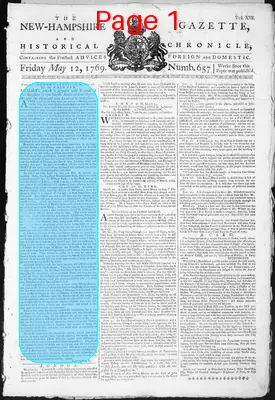
Literary
May 12, 1769
The New Hampshire Gazette And Historical Chronicle
Portsmouth, Greenland, Rockingham County, New Hampshire
What is this article about?
In a satirical vision set in 1944, two North American travelers visit the ruins of London, guided by a poor Briton who laments Britain's fall from imperial glory to decay, attributing it to political corruption, oppression of colonies, and misrule, contrasting with America's rise to empire.
Clipping
OCR Quality
95%
Excellent
Full Text
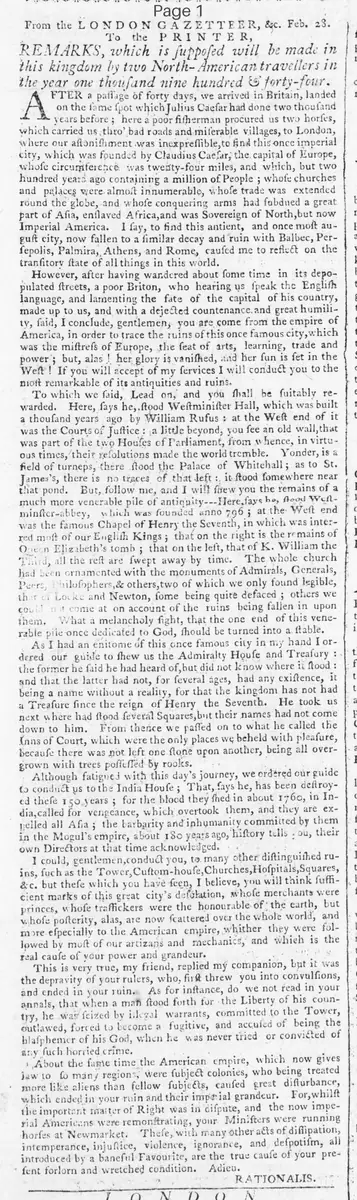
From the LONDON GAZETTEER, &c. Feb. 28.
To the PRINTER,
REMARKS, which is supposed will be made in this kingdom by two North-American travellers in the year one thousand nine hundred & forty-four.
AFTER a passage of forty days, we arrived in Britain, landed on the same spot which Julius Caesar had done two thousand years before; here a poor fisherman procured us two horses, which carried us thro' bad roads and miserable villages, to London, where our astonishment was inexpressible to find this once imperial city, which was founded by Claudius Caesar. the capital of Europe, whose circumference was twenty-four miles, and which, but two hundred years ago containing a million of People; whose churches and palaces were almost innumerable, whose trade was extended round the globe, and whose conquering arms had subdued a great part of Asia, enslaved Africa, and was Sovereign of North, but now Imperial America. I say, to find this antient, and once most august city, now fallen to a similar decay and ruin with Balbec, Persepolis, Palmira, Athens, and Rome, caused me to reflect on the transitory state of all things in this world.
However, after having wandered about some time in its depopulated streets, a poor Briton, who hearing us speak the English language, and lamenting the fate of the capital of his country, made up to us, and with a dejected countenance, and great humility, said, I conclude, gentlemen; you are come from the empire of America, in order to trace the ruins of this once famous city, which was the mistress of Europe, the seat of arts, learning, trade and power; but, alas! her glory is vanished, and her sun is set in the West! If you will accept of my services I will conduct you to the most remarkable of its antiquities and ruins.
To which we said, Lead on. and you shall be suitably rewarded. Here, says he, stood Westminster Hall, which was built a thousand years ago by William Rufus : at the West end of it was the Courts of Justice : a little beyond, you see an old wall, that was part of the two Houses of Parliament, from whence, in virtuous times, their resolutions made the world tremble. Yonder, is a field of turneps, there stood the Palace of Whitehall; as to St. James's, there is no traces of that left : it stood somewhere near that pond. But, follow me, and I wil shew you the remains of a much more venerable pile of antiquity---Here, says he, stood Westminster-abbey, which was founded anno 796 ; at the West end was the famous Chapel of Henry the Seventh, in which was interred most of our English Kings ; that on the right is the remains of Queen Elizabeth's tomb ; that on the left, that of K. William the Third, all the rest are swept away by time. The whole church had seen ornamented with the monuments of Admirals, Generals, Peers, philosophers, & others, two of which we only found legible, those of Locke and Newton, some being quite defaced; others we could not come at on account of the ruins being fallen in upon them. What a melancholy sight, that the one end of this venerable pile once dedicated to God, should be turned into a stable.
As I had an epitome of this once famous city in my hand I ordered our guide to shew us the Admiralty House and Treasury : the former he said he had heard of, but did not know where it stood : and that the latter had not, for several ages, had any existence, it being a name without a reality, for that the kingdom has not had a Treasure since the reign of Henry the Seventh. He took us next where had stood several Squares, but their names had not come down to him. From thence we passed on to what he called the Inns of Court, which were the only places we beheld with pleasure, because there was not left one stone upon another, being all overgrown with trees possessed By rooks.
Although fatigued with this day's journey, we ordered our guide to conduct us to the India House : That, says he, has been destroyed these 150 years ; for the blood they shed in about 1760, in India, called for vengeance, which overtook them, and they are expelled all Asia ; the barbarity and inhumanity committed by them in the Mogul's empire, about 150 years ago, history tells you, their own Directors at that time acknowledged.
I could, gentlemen, conduct you, to many other distinguished ruins, such as the Tower, Custom-house, Churches, Hospitals, Squares, &c. but these which you have seen, I believe, you will think sufficient marks of this great city's desolation, whose merchants were princes, whose traffickers were the honourable of the earth, but whose posterity, alas, are now scattered over the whole world, and more especially to the American empire, whither they were followed by most of our artizans and mechanics, and which is the real cause of your power and grandeur.
This is very true, my friend, replied my companion, but it was the depravity of your rulers, who, first threw you into convulsions, and ended in your ruin. As for instance, do we not read in your annals, that when a man stood forth for the Liberty of his country, he was seized by illegal warrants, committed to the Tower, outlawed, forced to become a fugitive, and accused of being the blasphemer of his God, when he was never tried or convicted of any such horrid crime.
About the same time the American empire, which now gives law to so many regions, were subject colonies, who being treated more like aliens than fellow subjects. caused great disturbance, which ended in your ruin and their imperial grandeur. For, whilst the important matter of Right was in dispute, and the now imperial Americans were remonstrating, your Ministers were running horses at Newmarket. These, with many other acts of dissipation, intemperance, injustice, violence, ignorance, and despotism. all introduced by a baneful Favourite, are the true cause of your present forlorn and wretched condition. Adieu.
RATIONALIS.
To the PRINTER,
REMARKS, which is supposed will be made in this kingdom by two North-American travellers in the year one thousand nine hundred & forty-four.
AFTER a passage of forty days, we arrived in Britain, landed on the same spot which Julius Caesar had done two thousand years before; here a poor fisherman procured us two horses, which carried us thro' bad roads and miserable villages, to London, where our astonishment was inexpressible to find this once imperial city, which was founded by Claudius Caesar. the capital of Europe, whose circumference was twenty-four miles, and which, but two hundred years ago containing a million of People; whose churches and palaces were almost innumerable, whose trade was extended round the globe, and whose conquering arms had subdued a great part of Asia, enslaved Africa, and was Sovereign of North, but now Imperial America. I say, to find this antient, and once most august city, now fallen to a similar decay and ruin with Balbec, Persepolis, Palmira, Athens, and Rome, caused me to reflect on the transitory state of all things in this world.
However, after having wandered about some time in its depopulated streets, a poor Briton, who hearing us speak the English language, and lamenting the fate of the capital of his country, made up to us, and with a dejected countenance, and great humility, said, I conclude, gentlemen; you are come from the empire of America, in order to trace the ruins of this once famous city, which was the mistress of Europe, the seat of arts, learning, trade and power; but, alas! her glory is vanished, and her sun is set in the West! If you will accept of my services I will conduct you to the most remarkable of its antiquities and ruins.
To which we said, Lead on. and you shall be suitably rewarded. Here, says he, stood Westminster Hall, which was built a thousand years ago by William Rufus : at the West end of it was the Courts of Justice : a little beyond, you see an old wall, that was part of the two Houses of Parliament, from whence, in virtuous times, their resolutions made the world tremble. Yonder, is a field of turneps, there stood the Palace of Whitehall; as to St. James's, there is no traces of that left : it stood somewhere near that pond. But, follow me, and I wil shew you the remains of a much more venerable pile of antiquity---Here, says he, stood Westminster-abbey, which was founded anno 796 ; at the West end was the famous Chapel of Henry the Seventh, in which was interred most of our English Kings ; that on the right is the remains of Queen Elizabeth's tomb ; that on the left, that of K. William the Third, all the rest are swept away by time. The whole church had seen ornamented with the monuments of Admirals, Generals, Peers, philosophers, & others, two of which we only found legible, those of Locke and Newton, some being quite defaced; others we could not come at on account of the ruins being fallen in upon them. What a melancholy sight, that the one end of this venerable pile once dedicated to God, should be turned into a stable.
As I had an epitome of this once famous city in my hand I ordered our guide to shew us the Admiralty House and Treasury : the former he said he had heard of, but did not know where it stood : and that the latter had not, for several ages, had any existence, it being a name without a reality, for that the kingdom has not had a Treasure since the reign of Henry the Seventh. He took us next where had stood several Squares, but their names had not come down to him. From thence we passed on to what he called the Inns of Court, which were the only places we beheld with pleasure, because there was not left one stone upon another, being all overgrown with trees possessed By rooks.
Although fatigued with this day's journey, we ordered our guide to conduct us to the India House : That, says he, has been destroyed these 150 years ; for the blood they shed in about 1760, in India, called for vengeance, which overtook them, and they are expelled all Asia ; the barbarity and inhumanity committed by them in the Mogul's empire, about 150 years ago, history tells you, their own Directors at that time acknowledged.
I could, gentlemen, conduct you, to many other distinguished ruins, such as the Tower, Custom-house, Churches, Hospitals, Squares, &c. but these which you have seen, I believe, you will think sufficient marks of this great city's desolation, whose merchants were princes, whose traffickers were the honourable of the earth, but whose posterity, alas, are now scattered over the whole world, and more especially to the American empire, whither they were followed by most of our artizans and mechanics, and which is the real cause of your power and grandeur.
This is very true, my friend, replied my companion, but it was the depravity of your rulers, who, first threw you into convulsions, and ended in your ruin. As for instance, do we not read in your annals, that when a man stood forth for the Liberty of his country, he was seized by illegal warrants, committed to the Tower, outlawed, forced to become a fugitive, and accused of being the blasphemer of his God, when he was never tried or convicted of any such horrid crime.
About the same time the American empire, which now gives law to so many regions, were subject colonies, who being treated more like aliens than fellow subjects. caused great disturbance, which ended in your ruin and their imperial grandeur. For, whilst the important matter of Right was in dispute, and the now imperial Americans were remonstrating, your Ministers were running horses at Newmarket. These, with many other acts of dissipation, intemperance, injustice, violence, ignorance, and despotism. all introduced by a baneful Favourite, are the true cause of your present forlorn and wretched condition. Adieu.
RATIONALIS.
What sub-type of article is it?
Satire
Prose Fiction
Vision Or Dream
What themes does it cover?
Political
Liberty Freedom
Commerce Trade
What keywords are associated?
Britain Decline
London Ruins
American Empire
Imperial Fall
Political Satire
Colonial Oppression
Future Vision
What entities or persons were involved?
Rationalis.
Literary Details
Title
Remarks, Which Is Supposed Will Be Made In This Kingdom By Two North American Travellers In The Year One Thousand Nine Hundred & Forty Four.
Author
Rationalis.
Subject
Imagined Future Reflections On Britain's Imperial Decline And America's Rise.
Form / Style
Satirical Prose Narrative In Dialogue Form Envisioning Future Ruins.
Key Lines
To Find This Antient, And Once Most August City, Now Fallen To A Similar Decay And Ruin With Balbec, Persepolis, Palmira, Athens, And Rome, Caused Me To Reflect On The Transitory State Of All Things In This World.
Her Glory Is Vanished, And Her Sun Is Set In The West!
The Depravity Of Your Rulers, Who, First Threw You Into Convulsions, And Ended In Your Ruin.
The American Empire, Which Now Gives Law To So Many Regions, Were Subject Colonies, Who Being Treated More Like Aliens Than Fellow Subjects.
Acts Of Dissipation, Intemperance, Injustice, Violence, Ignorance, And Despotism... Are The True Cause Of Your Present Forlorn And Wretched Condition.