Thank you for visiting SNEWPapers!
Sign up free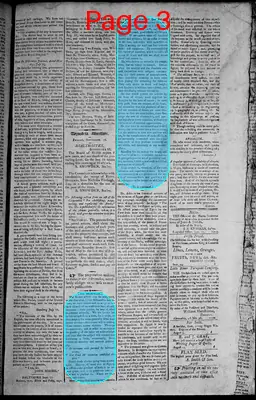
Editorial
September 16, 1803
Alexandria Advertiser And Commercial Intelligencer
Alexandria, Virginia
What is this article about?
Introductory essay in the Alexandria Advertiser titled 'The Moralist,' advocating for moral essays as relief from politics, emphasizing virtue, goodness, and practicing noble deeds for personal and societal benefit, to be continued.
Clipping
OCR Quality
95%
Excellent
Full Text
THE MORALIST
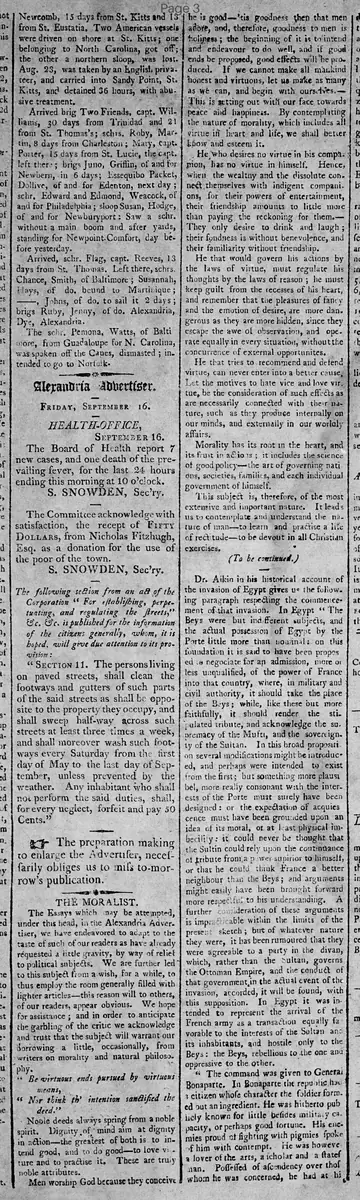
The Essays which may be attempted, under this head, in the Alexandria Advertiser, we have endeavored to adapt to the taste of such of our readers as have already requested a little gravity, by way of relief to political subjects. We are further led to this subject from a wish, for a while, to thus employ the room generally filled with lighter articles--this reason will to others, of our readers, appear obvious. We hope for assistance; and in order to anticipate the garbling of the critic we acknowledge and trust that the subject will warrant our Borrowing--a little, occasionally, from writers on morality and natural philosophy.
"Be virtuous ends pursued by virtuous means,
Nor think th' intention sanctifies the deed?"
Noble deeds always spring from a noble spirit. Dignity of mind aim at dignity in action--the greatest of both is to intend good, and to do good--to love virtue and to practise it. These are truly noble attributes.
Men worship God because they conceive he is good 'tis goodness then that merits our adore, and, therefore, goodness to men is holiness; the beginning of it is to intend and endeavour to do well, and if good ends be proposed, good effects will be produced. If we cannot make all mankind honest and virtuous, let us make as many as we can, and begin with ourselves.--This is setting out with our face towards peace and happiness. By contemplating the nature of morality, which includes all virtue in heart and life, we shall better know and esteem it.
He who desires no virtue in his companion, has no virtue in himself. Hence, when the wealthy and the dissolute connect themselves with indigent companions, or their powers of entertainment, their friendship amounts to little more than paying the reckoning for them.--They only desire to drink and laugh; their fondness is without benevolence, and their familiarity without friendship.
He that would govern his actions by the laws of virtue, must regulate his thoughts by the laws of reason; he must keep guilt from the recesses of his heart, and remember that the pleasures of fancy and the emotion of desire, are more dangerous as they are more hidden, since they escape the awe of observation, and operate equally in every situation, without the concurrence of external opportunities.
He that tries to recommend and defend virtue, can never enter into a better cause Let the motives to hate vice and love virtue, be the consideration of such effects as are necessarily connected with their nature, such as they produce internally on our minds, and externally in our worldly affairs.
Morality has its root in the heart, and its fruit in actions; it includes the science of good policy--the art of governing nations, societies, families, and each individual government of himself.
This subject is, therefore, of the most extensive and important nature. It leads us to contemplate and understand the nature of man--to learn and practise a life of rectitude--to be devout in all Christian exercises.
(To be continued.)
The Essays which may be attempted, under this head, in the Alexandria Advertiser, we have endeavored to adapt to the taste of such of our readers as have already requested a little gravity, by way of relief to political subjects. We are further led to this subject from a wish, for a while, to thus employ the room generally filled with lighter articles--this reason will to others, of our readers, appear obvious. We hope for assistance; and in order to anticipate the garbling of the critic we acknowledge and trust that the subject will warrant our Borrowing--a little, occasionally, from writers on morality and natural philosophy.
"Be virtuous ends pursued by virtuous means,
Nor think th' intention sanctifies the deed?"
Noble deeds always spring from a noble spirit. Dignity of mind aim at dignity in action--the greatest of both is to intend good, and to do good--to love virtue and to practise it. These are truly noble attributes.
Men worship God because they conceive he is good 'tis goodness then that merits our adore, and, therefore, goodness to men is holiness; the beginning of it is to intend and endeavour to do well, and if good ends be proposed, good effects will be produced. If we cannot make all mankind honest and virtuous, let us make as many as we can, and begin with ourselves.--This is setting out with our face towards peace and happiness. By contemplating the nature of morality, which includes all virtue in heart and life, we shall better know and esteem it.
He who desires no virtue in his companion, has no virtue in himself. Hence, when the wealthy and the dissolute connect themselves with indigent companions, or their powers of entertainment, their friendship amounts to little more than paying the reckoning for them.--They only desire to drink and laugh; their fondness is without benevolence, and their familiarity without friendship.
He that would govern his actions by the laws of virtue, must regulate his thoughts by the laws of reason; he must keep guilt from the recesses of his heart, and remember that the pleasures of fancy and the emotion of desire, are more dangerous as they are more hidden, since they escape the awe of observation, and operate equally in every situation, without the concurrence of external opportunities.
He that tries to recommend and defend virtue, can never enter into a better cause Let the motives to hate vice and love virtue, be the consideration of such effects as are necessarily connected with their nature, such as they produce internally on our minds, and externally in our worldly affairs.
Morality has its root in the heart, and its fruit in actions; it includes the science of good policy--the art of governing nations, societies, families, and each individual government of himself.
This subject is, therefore, of the most extensive and important nature. It leads us to contemplate and understand the nature of man--to learn and practise a life of rectitude--to be devout in all Christian exercises.
(To be continued.)
What sub-type of article is it?
Moral Or Religious
Social Reform
What keywords are associated?
Morality
Virtue
Noble Deeds
Goodness
Vice
Reason
Heart
Actions
Christian Exercises
Editorial Details
Primary Topic
Promotion Of Morality And Virtue Through Essays
Stance / Tone
Exhortative Advocacy For Virtuous Living
Key Arguments
Noble Deeds Spring From A Noble Spirit
Intend And Do Good To Love And Practice Virtue
Goodness Merits Adoration And Is Holiness To Men
Begin Making Mankind Virtuous With Oneself For Peace And Happiness
Contemplate Morality To Know And Esteem It
Lack Of Virtue In Companions Reflects One's Own
Wealthy Dissolute Friendships Lack True Benevolence
Govern Actions By Virtue And Thoughts By Reason
Keep Guilt From Heart As Hidden Desires Are Dangerous
Defend Virtue By Considering Its Internal And External Effects
Morality Roots In Heart, Fruits In Actions, Includes Good Policy
Morality Leads To Understanding Man, Rectitude, And Christian Devotion