Thank you for visiting SNEWPapers!
Sign up free
Atlanta Daily World
Atlanta, Fulton County, Georgia
What is this article about?
A Northwestern University study for the US Senate Foreign Relations Committee stresses recognizing African values and nationalism in US policy, addressing colonial issues, racial tensions, and economic development needs in Africa to foster friendly relations.
Merged-components note: Continuation of article across pages based on text content and explicit 'Continued from Page One' indicator.
Clippings
1 of 2
OCR Quality
Full Text
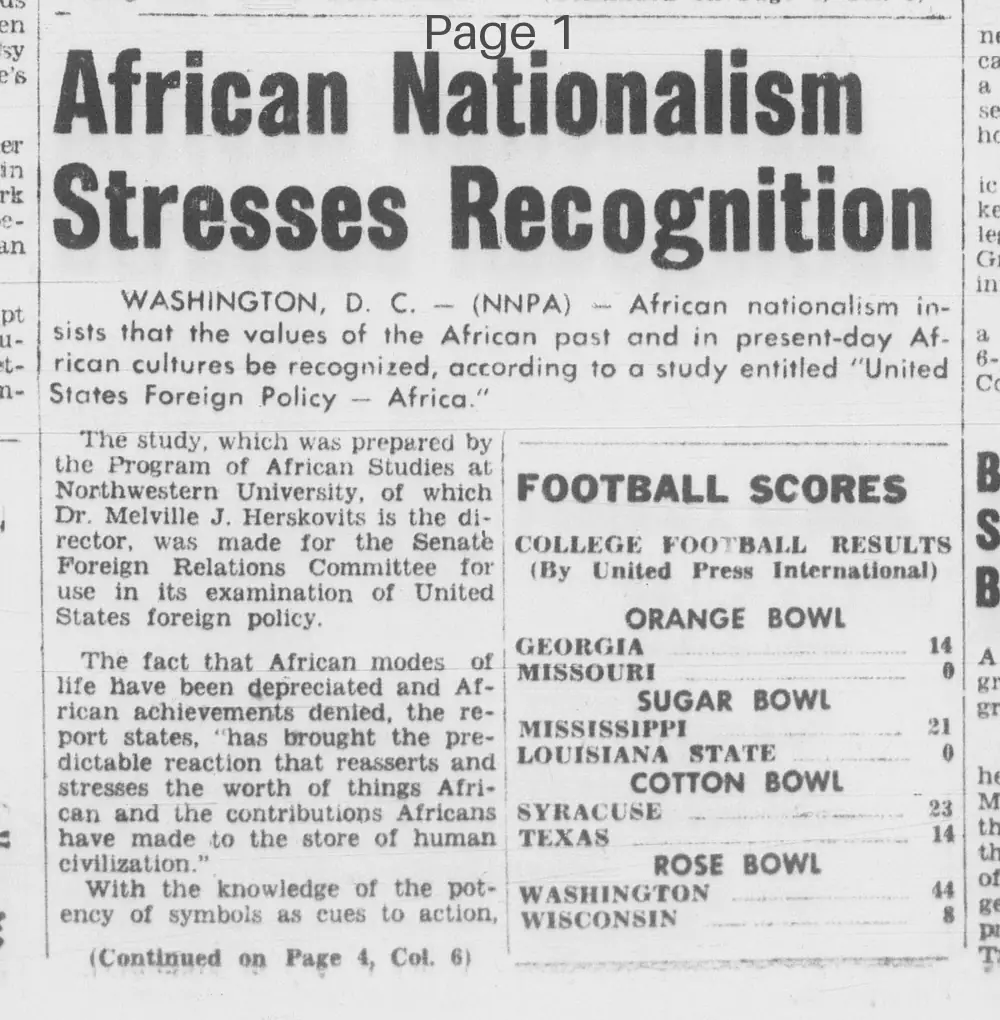
WASHINGTON, D. C. - (NNPA) - African nationalism insists that the values of the African past and in present-day African cultures be recognized, according to a study entitled "United States Foreign Policy - Africa."
The study, which was prepared by the Program of African Studies at Northwestern University, of which Dr. Melville J. Herskovits is the director, was made for the Senate Foreign Relations Committee for use in its examination of United States foreign policy.
The fact that African modes of life have been depreciated and African achievements denied, the report states, has brought the predictable reaction that reasserts and stresses the worth of things African and the contributions Africans have made to the store of human civilization."
With the knowledge of the potency of symbols as cues to action, (Continued on Page 4, Col. 6)
African Nationalism
(Continued from Page One)
the report points out, it is of great importance in American dealings
with African peoples, and in United
States statements bearing
on
Africa and its future, that the United
States recognize the sensibilities
of the Africans as regards their
own ways, and make clear that a
search for alternatives under new
conditions must, in the final analysis, be the task of the Africans
themselves.
There are other important aspects
of the African scene with
which we must deal," the report asserts, adding
Not all the population of Africa
is composed of native Africans. Inevitabilities are by no means actualities, since colonial controls continue in most of the Subsaharan continent.
"Questions of raising standards
of living through aid for economic,
technological and educational development press upon us.
ALERTNESS URGED
"In the present world scene, the
United States is concerned that Africa remain on friendly terms with
the democracies. And because the
factors of race enter so prominently in contemporary Africa, we
must always be alert to the effect
of racial tensions in our own country in shaping attitudes toward us
in Africa.
The report points out that in all
the eastern and southern parts of
the continent where non-African
minorities have permanently settled, the problems of adjustment
follow racial lines.
This is particularly true in the
instance of economic differentials,
especially as regards standards of
living and opportunities for advancement, the report says.
It is frequently pointed out, the
study asserts, that comparable differentials, such as rural and urban
slums, are to be found in even the
most prosperous societies and are
thus no monopoly of these African
countries.
"This reasoning, however logical,
becomes less convincing when the racial factor is taken into account,
the report states, adding
For the class structure of the
multiracial societies is based on
race, with opportunity closely correlated with skin color. This holds
whether average income or comparative salary scales, or expenditures for education, housing or any
other factors be taken as an index of these differentials.
Here the Europeans hold the
most favored position, the Asians
next, the Africans the least."
What sub-type of article is it?
What keywords are associated?
What entities or persons were involved?
Where did it happen?
Foreign News Details
Primary Location
Africa
Key Persons
Event Details
A study entitled 'United States Foreign Policy - Africa' prepared by the Program of African Studies at Northwestern University, directed by Dr. Melville J. Herskovits, for the Senate Foreign Relations Committee, emphasizes that African nationalism insists on recognition of African past values and present cultures. It highlights the reaction to depreciation of African modes of life and denial of achievements, stressing African contributions to civilization. The report urges the United States to recognize African sensitivities in dealings and statements on Africa, allowing Africans to seek alternatives under new conditions. It addresses non-native populations, colonial controls in Subsaharan Africa, economic development needs, and the importance of maintaining friendly relations with democracies amid racial tensions. In eastern and southern Africa, adjustment problems follow racial lines, with economic differentials favoring Europeans over Asians and Africans.