Thank you for visiting SNEWPapers!
Sign up free
Story
August 7, 1847
The North Carolinian
Fayetteville, Cumberland County, North Carolina
What is this article about?
An captured Arab chief named Abou el Marck frees his loyal Arabian horse, which carries him bound and wounded back to his family in the Arabian mountains before collapsing dead from exhaustion, illustrating the breed's strength and attachment.
Clipping
OCR Quality
95%
Excellent
Full Text
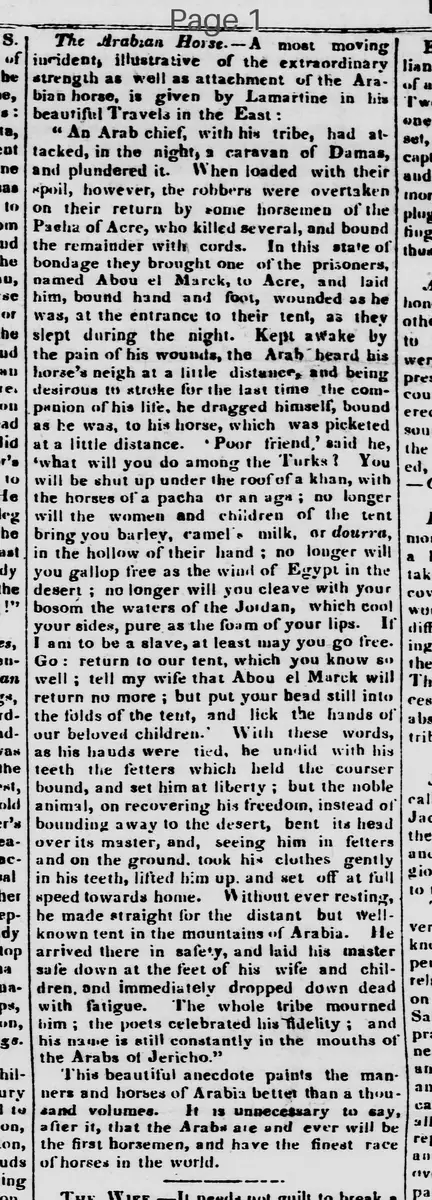
The Arabian Horse.—A most moving incident, illustrative of the extraordinary strength as well as attachment of the Arabian horse, is given by Lamartine in his beautiful Travels in the East:
"An Arab chief, with his tribe, had attacked, in the night, a caravan of Damascus, and plundered it. When loaded with their spoil, however, the robbers were overtaken on their return by some horsemen of the Pasha of Acre, who killed several, and bound the remainder with cords. In this state of bondage they brought one of the prisoners, named Abou el Marck, to Acre, and laid him, bound hand and foot, wounded as he was, at the entrance to their tent, as they slept during the night. Kept awake by the pain of his wounds, the Arab heard his horse's neigh at a little distance, and being desirous to stroke for the last time the companion of his life, he dragged himself, bound as he was, to his horse, which was picketed at a little distance. 'Poor friend,' said he, 'what will you do among the Turks? You will be shut up under the roof of a khan, with the horses of a pacha or an aga; no longer will the women and children of the tent bring you barley, camel's milk, or dourra, in the hollow of their hand; no longer will you gallop free as the wind of Egypt in the desert; no longer will you cleave with your bosom the waters of the Jordan, which cool your sides, pure as the foam of your lips. If I am to be a slave, at least may you go free. Go: return to our tent, which you know so well; tell my wife that Abou el Marck will return no more; but put your head still into the folds of the tent, and lick the hands of our beloved children.' With these words, as his hands were tied, he undid with his teeth the fetters which held the courser bound, and set him at liberty; but the noble animal, on recovering his freedom, instead of bounding away to the desert, bent its head over its master, and, seeing him in fetters and on the ground, took his clothes gently in his teeth, lifted him up, and set off at full speed towards home. Without ever resting he made straight for the distant but well-known tent in the mountains of Arabia. He arrived there in safety, and laid his master safe down at the feet of his wife and children, and immediately dropped down dead with fatigue. The whole tribe mourned him; the poets celebrated his fidelity; and his name is still constantly in the mouths of the Arabs of Jericho."
This beautiful anecdote paints the manners and horses of Arabia better than a thousand volumes. It is unnecessary to say, after it, that the Arabs are and ever will be the first horsemen, and have the finest race of horses in the world.
"An Arab chief, with his tribe, had attacked, in the night, a caravan of Damascus, and plundered it. When loaded with their spoil, however, the robbers were overtaken on their return by some horsemen of the Pasha of Acre, who killed several, and bound the remainder with cords. In this state of bondage they brought one of the prisoners, named Abou el Marck, to Acre, and laid him, bound hand and foot, wounded as he was, at the entrance to their tent, as they slept during the night. Kept awake by the pain of his wounds, the Arab heard his horse's neigh at a little distance, and being desirous to stroke for the last time the companion of his life, he dragged himself, bound as he was, to his horse, which was picketed at a little distance. 'Poor friend,' said he, 'what will you do among the Turks? You will be shut up under the roof of a khan, with the horses of a pacha or an aga; no longer will the women and children of the tent bring you barley, camel's milk, or dourra, in the hollow of their hand; no longer will you gallop free as the wind of Egypt in the desert; no longer will you cleave with your bosom the waters of the Jordan, which cool your sides, pure as the foam of your lips. If I am to be a slave, at least may you go free. Go: return to our tent, which you know so well; tell my wife that Abou el Marck will return no more; but put your head still into the folds of the tent, and lick the hands of our beloved children.' With these words, as his hands were tied, he undid with his teeth the fetters which held the courser bound, and set him at liberty; but the noble animal, on recovering his freedom, instead of bounding away to the desert, bent its head over its master, and, seeing him in fetters and on the ground, took his clothes gently in his teeth, lifted him up, and set off at full speed towards home. Without ever resting he made straight for the distant but well-known tent in the mountains of Arabia. He arrived there in safety, and laid his master safe down at the feet of his wife and children, and immediately dropped down dead with fatigue. The whole tribe mourned him; the poets celebrated his fidelity; and his name is still constantly in the mouths of the Arabs of Jericho."
This beautiful anecdote paints the manners and horses of Arabia better than a thousand volumes. It is unnecessary to say, after it, that the Arabs are and ever will be the first horsemen, and have the finest race of horses in the world.
What sub-type of article is it?
Animal Story
Heroic Act
Extraordinary Event
What themes does it cover?
Bravery Heroism
Moral Virtue
Survival
What keywords are associated?
Arabian Horse
Loyalty
Rescue
Arab Chief
Fidelity
Exhaustion
What entities or persons were involved?
Abou El Marck
Where did it happen?
Arabia, Jericho, Acre
Story Details
Key Persons
Abou El Marck
Location
Arabia, Jericho, Acre
Story Details
Captured and bound Arab chief Abou el Marck frees his horse with his teeth; the loyal animal lifts him onto its back and carries him home to his family in the Arabian mountains before dying of exhaustion.