Thank you for visiting SNEWPapers!
Sign up free
Morning Star
Limerick, York County, Maine
What is this article about?
U.S. Congress proceedings from Jan. 18-23, 1843: Resolution for pension to free Black veteran John Cary; debates on Army pay, old French claims, Tyler-Webster feud; bill restricting Black military enlistments except as servants, with tropical amendment; favorable report on rights of free Black seamen vs. Southern arrests, printing blocked; Florida relief, bankrupt repeal passed.
Clipping
OCR Quality
Full Text
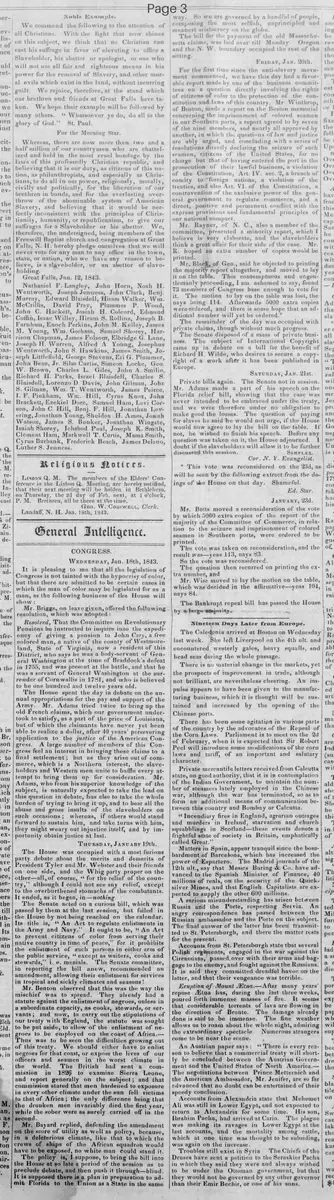
CONGRESS
Wednesday, Jan. 18th, 1843.
It is pleasing to me that all the legislation of Congress is not tainted with the hypocrisy of color, but that there are admitted to be certain cases in which the man of color may be legislated for as a man, as the following business of the House will show:
Mr. Briggs, on leave given, offered the following resolution, which was adopted:
Resolved, That the Committee on Revolutionary Pensions be instructed to inquire into the expediency of giving a pension to John Cary, a free colored man, a native of the county of Westmoreland, State of Virginia, now a resident of this District, who says he was a body-servant of General Washington at the time of Braddock's defeat in 1755, and was present at the battle, and that he was a servant of General Washington at the surrender of Cornwallis in 1781, and who is believed to be one hundred and twelve years old.
The House spent the day in debate on the annual appropriations for the pay and support of the Army. Mr. Adams tried twice to bring up the old French claims, which our government undertook to satisfy, as a part of the price of Louisiana, but of which the claimants have never yet been able to realize a dollar, after 40 years' persevering application to the justice of the American Congress. A large number of members of this Congress feel an interest in bringing these claims to a final settlement; but as they arise out of commerce, which is a Northern interest, the slaveholders and Western men unite to baffle every attempt to bring them up for consideration. Mr. Adams, who from his superior knowledge of the subject, is naturally expected to take the lead on this question in debate, has also to take the whole burden of trying to bring it up, and to bear all the abuse and gross insults of the slaveholders on such occasions; whereas, if others would stand forward to sustain him, and take turns with him, they might weary out injustice itself, and by importunity obtain justice at last.
Thursday, January 19th.
The House was occupied with a most furious party debate about the merits and demerits of President Tyler and Mr. Webster and their friends on one side, and the Whig party proper on the other—all, of course, "for the relief of the country," although I could not see any relief, except to the overburthened stomachs of the combatants. It ended, as it began, in—nothing.
The Senate acted on a curious bill, which was passed by them at the last session, but failed in the House by not being reached on the calendar. Its title is, "An Act to regulate enlistments in the Army and Navy." It ought to be, "An Act to prevent citizens of color from serving their native country in time of peace," for it prohibits the enlistment of such persons in either arm of the public service, "except as waiters, cooks and stewards," i. e. menials. The Senate committee, in reporting the bill anew, recommended an amendment, allowing their enlistment for services in tropical and sickly climates and seasons!
Mr. Benton observed that this was the way the mischief was to spread. They already had a statute against the enlistment of negroes, unless in a subordinate capacity, as cooks, stewards, or servants; and now, to carry out the stipulations of our treaty with England, the statute was sought to be put aside, to allow of the enlistment of negroes to be employed on the coast of Africa.—Thus was to be seen the difficulties growing out of this treaty. We should either have to enlist negroes for that coast, or expose the lives of our officers and seamen in the worst climate in the world. The British had sent a commission in 1826 to examine Sierra Leone, and report generally on the subject; and that commission stated that men hardened to exposure in every other climate under the sun fell victims to that of Africa; the only difference being that the drunken men invariably died the first year, while the sober were as surely carried off in the second.
Mr. Bayard replied, defending the amendment on the score of utility as well as policy, because, in a deleterious climate, like that to which the crews of ships of the African squadron would have to be exposed, no white man could stand it. The policy is, I suppose, to bring the bill into the House at so late a period of the session as to preclude debate, and then push it through—blind. It is supposed there is a plan in preparation to admit Florida to the Union as a State in the same way. So we are governed by a handful of people, composing the most selfish, unprincipled and meanest aristocracy on the globe.
The bill for the payment of the old Massachusetts claims, was laid over till Monday. Oregon and the N. W. boundary occupied the rest of the sitting.
FRIDAY, Jan. 20th.
For the first time since the anti-slavery movement commenced, we have this day had a favorable report made by one of the business committees on a question directly involving the rights of citizens of color to the protection of the constitution and laws of this country. Mr. Winthrop, of Boston, made a report on the Boston memorial concerning the imprisonment of colored seamen in our Southern ports, a report agreed to by seven of the nine members, and nearly all approved by another, in which the questions of law and justice are ably urged, and concluding with a series of resolutions directly declaring the seizure of such seamen, citizens of the United States, for no charge but that of having entered the port in the prosecution of their lawful business, a violation of the Constitution, Art. IV. sec. 2, a breach of comity to foreign nations, a violation of the treaties, and also Art. VI. of the Constitution, a contravention of the exclusive power of the general government to regulate commerce, and a direct, positive and permanent conflict with the express provisions and fundamental principles of our national compact.
Mr. Rayner, of N. C., also a member of the committee, presented a minority report, which I believe is very elaborate, and the slaveholders think a great affair for their side of the case. Mr. R. hoped an extra number of copies would be printed.
Mr. Black, of Geo., said he objected to printing the majority report altogether, and moved to lay it on the table. This contemptuous and ungentlemanly proceeding, I am ashamed to say, found 73 members of Congress base enough to vote for it. The motion to lay on the table was lost, the nays being 114. Afterwards 5000 extra copies were ordered, and there is some hope that an additional number will yet be ordered.*
The remainder of the day was occupied with private claims, though without much progress.
The Senate disposed of a mass of private business. The subject of International Copyright came up in debate on a bill for the benefit of Richard H. Wilde, who desires to secure a copyright of a work after it has been published in Europe.
SATURDAY, Jan. 21st.
Private bills again. The Senate not in session.
Mr. Adams made a part of his speech on the Florida relief bill, showing that the case was never intended to be embraced under the treaty, and we were therefore under no obligation to make good the losses. The question of paying for slaves he said he would not urge, if the House would now agree to lay the bill on the table. If not, he wished to finish his speech. Before any question was taken on it, the House adjourned. I doubt if the slaveholders will allow it to be further discussed this session.
SIMPLEX.
Cor. N. Y. Evangelist.
*This vote was reconsidered on the 23d, as will be seen by the following extract from the doings of the House on that day. Shameful.
Ed. Star.
January, 23d.
Mr. Botts moved a reconsideration of the vote by which 5000 extra copies of the report of the majority of the Committee of Commerce, in relation to the seizure and imprisonment of colored seamen in Southern ports, were ordered to be printed.
The vote was taken on reconsideration, and the result was—yeas 113, nays 83.
So the vote was reconsidered.
The question then recurred on printing the extra number, and
Mr. Wise moved to lay the motion on the table, which was decided in the affirmative—yeas 104, nays 84.
The Bankrupt repeal bill has passed the House by a large majority.
What sub-type of article is it?
What keywords are associated?
What entities or persons were involved?
Where did it happen?
Domestic News Details
Primary Location
Washington
Event Date
January 18 23, 1843
Key Persons
Outcome
resolution for john cary pension inquiry adopted; 5000 copies of seamen report ordered then reconsidered and tabled (yeas 104, nays 84); bankrupt repeal bill passed house by large majority; other bills debated without resolution.
Event Details
Correspondent reports on U.S. Congress sessions: House adopts resolution inquiring into pension for 112-year-old free colored veteran John Cary, servant to Washington; debates Army appropriations and old French claims blocked by slaveholders; partisan debate on Tyler and Webster ends inconclusively; Senate advances bill restricting colored enlistments to menial roles, amends for tropical service per African squadron treaty; favorable majority report on Boston memorial declares Southern imprisonment of free colored seamen unconstitutional, minority report submitted, printing vote later tabled; discussions on Massachusetts claims, Oregon boundary, Florida relief bill, international copyright, private bills; Bankrupt repeal passes House.