Thank you for visiting SNEWPapers!
Sign up free
The Rutland Daily Globe
Rutland, Rutland County, Vermont
What is this article about?
The article compares Arkansas's 1836 admission to the Union via a 'revolutionary' constitution adopted without congressional approval, which was accepted, to the 1874 constitution, legally formed and ratified by voters, yet called revolutionary by President Grant, arguing the latter's legitimacy based on precedents and public consent.
Clipping
OCR Quality
Full Text
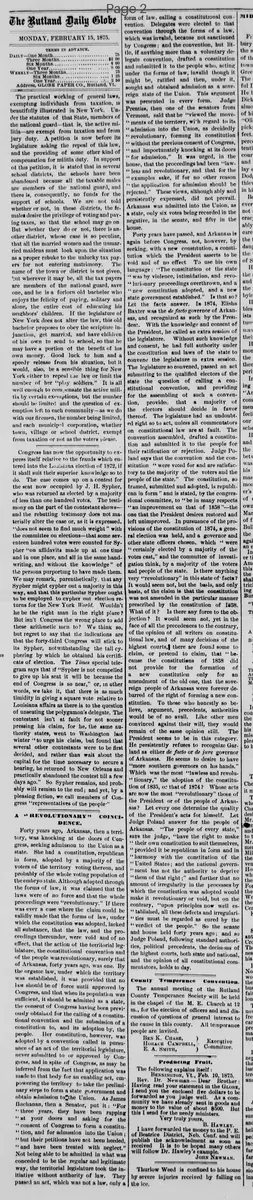
COINCIDENCE.
Forty years ago, Arkansas, then a territory, was knocking at the doors of Congress, seeking admission to the Union as a state. She had a constitution, republican in form, adopted by a majority of the voters of the territory voting thereon, and probably of the whole voting population of the embryo state. Although adopted through the forms of law, it was claimed that the laws were of no force and that the whole proceedings were "revolutionary." If there was ever a case where the claim could be validly made that the forms of law, under which the constitution was adopted, lacked all substance, that the law, and the proceedings thereunder, were void and of no effect, that the action of the territorial legislature, the constitutional convention and of the people was revolutionary, surely that of Arkansas, forty years ago, was one. By the organic law, under which the territory was established, it was provided that no law should be of force until approved by Congress, and that when its population was sufficient, it should be admitted as a state, the consent of Congress having been previously obtained for the calling of a constitutional convention and the submission of a constitution to, and its adoption by, the people. Her constitution, however, was adopted by a convention called in pursuance of an act of the territorial legislature, never submitted to or approved by Congress, and in spite of Congress, as may be inferred from the fact that application was made to that body for an enabling act, empowering the territory to take the preliminary steps to form a state government and obtain admission to the Union. As James Buchanan, then a Senator, put it: "For three years, they have been rapping at your doors and asking for the consent of Congress to form a constitution, and for admission into the Union; but their petitions have not been heeded, and have been treated with neglect."
Not being able to be admitted in what was conceded to be the regular and legitimate way, the territorial legislature took the initiative without authority of law. They passed an act, which was not a law, only a form of law, calling a constitutional convention. Delegates were elected to that convention through the forms of a law, which was invalid, because not sanctioned by Congress; and the convention, but little, if anything more than a voluntary delegate convention, drafted a constitution and submitted it to the people who, acting under the forms of law, invalid though it might be, ratified and then, under it, sought and obtained admission as a sovereign state of the Union. This argument was presented in every form. Judge Prentiss, then one of the senators from Vermont, said that he "viewed the movements of the territory, with regard to its admission into the Union, as decidedly revolutionary, forming its constitution without the previous consent of Congress, and importunately knocking at its doors for admission." It was urged, in the house, that the proceedings had been "lawless and revolutionary, and that for the example's sake, if for no other reason the application for admission should be rejected." These views, although ably and persistently expressed, did not prevail. Arkansas was admitted into the Union, as a state, only six votes being recorded in the negative, in the senate, and fifty in the house.
Forty years have passed, and Arkansas is again before Congress, not, however, by seeking, with a new constitution, a second admission, but by presenting for congressional sanction a constitution which the President asserts to be void and of no effect. To use his own language: The constitution of the state was by violence, intimidation, and revolutionary proceedings overthrown, and a new constitution adopted, and a new state government established. Is that so? Let the facts answer. In 1874, Elisha Baxter was the de facto governor of Arkansas, and recognized as such by the President. With the knowledge and consent of the President, he called an extra session of the legislature. Without such knowledge and consent, he had full authority under the constitution and laws of the state to convene the legislature in extra session. The legislature so convened, passed an act submitting to the qualified electors of the state the question of calling a constitutional convention, and providing for the assembling of such a convention, provided that a majority of the electors should decide in favor thereof. The legislature had an undoubted right so to act, unless all commentators on constitutional law are at fault. The convention assembled, drafted a constitution and submitted it to the people for their ratification or rejection. Judge Poland says that the convention and the constitution were voted for and are satisfactory to the majority of the voters and the people of the state. The constitution, so framed, submitted and adopted, is republican in form and is stated, by the congressional committee, to be in many respects an improvement on that of 1868—the one that the President desires restored and left unimproved. In pursuance of the provisions of the constitution of 1874, a general election was held, and a governor and other state officers chosen, which were certainly elected by a majority of the votes cast, and the committee of investigation think, by a majority of the voters and people of the state. Is there anything very "revolutionary" in this state of facts? It would seem not, but the basis, and only basis, of the claim is that the constitution was not amended in the particular manner prescribed by the constitution of 1868. What of it? Is there any force to the objection? It would seem not, yet in the face of all the precedents to the contrary, of the opinion of all writers on constitutional law, and of many decisions of the highest courts, there are found some to claim, or pretend to claim, that because the constitution of 1868 did not provide for the formation of a new constitution only for an amendment of the old one, that the sovereign people of Arkansas were forever debarred of the right of forming a new constitution. To those who honestly so believe, argument, precedents, authorities would be of no avail. Like other men convinced against their will, they would remain of the same opinion still. The President seems to be in this category. He persistently refuses to recognize Garland as either de facto or de jure governor of Arkansas. He seems to desire to have more southern governors on his hands.
Which was the most "lawless and revolutionary," the adoption of the constitution of 1836, or that of 1874? Whose acts are now the most "revolutionary" those of the President or of the people of Arkansas? Let every one determine the quality of the President's acts for himself. Let Judge Poland answer for the people of Arkansas. "The people of every state," says the judge, "have the right to make their own constitution to suit themselves, provided it be republican in form and in harmony with the constitution of the United States; and the national government has not the authority to deprive them of that right;" and further that no amount of irregularity in the processes by which the constitution was adopted would make it revolutionary or void, but on the contrary, "upon principles now well established, all these defects and irregularities must be regarded as cured by the verdict of the people." So the senate and house held forty years ago; and so Judge Poland, following standard authorities, political precedents, the decisions of the highest courts, both state and national, and the opinion of all constitutional commentators, holds to day.
What sub-type of article is it?
What themes does it cover?
What keywords are associated?
What entities or persons were involved?
Where did it happen?
Story Details
Key Persons
Location
Arkansas, United States Congress
Event Date
1836 And 1874
Story Details
The article argues that Arkansas's 1836 constitution was adopted revolutionarily without congressional consent but admitted to the Union, while the 1874 constitution, formed through legislative and popular processes, is wrongly deemed revolutionary by the President, citing precedents that validate public ratification.