Thank you for visiting SNEWPapers!
Sign up free
Editorial
April 23, 1839
Rutland Herald
Rutland, Rutland County, Vermont
What is this article about?
Editorial in Rutland Herald defends its prior coverage of an Anti-Slavery Society meeting at Middlebury, criticizes the Vermont Telegraph editor for misrepresenting it and mixing extreme abolitionism with politics and religion, warning of societal chaos from such views. Supports Henry Clay for president.
Clipping
OCR Quality
95%
Excellent
Full Text
RUTLAND HERALD.
RUTLAND, VT.
TUESDAY EVENING, APRIL 23, 1839.
Democratic whig Ticket.
For President,
HENRY CLAY
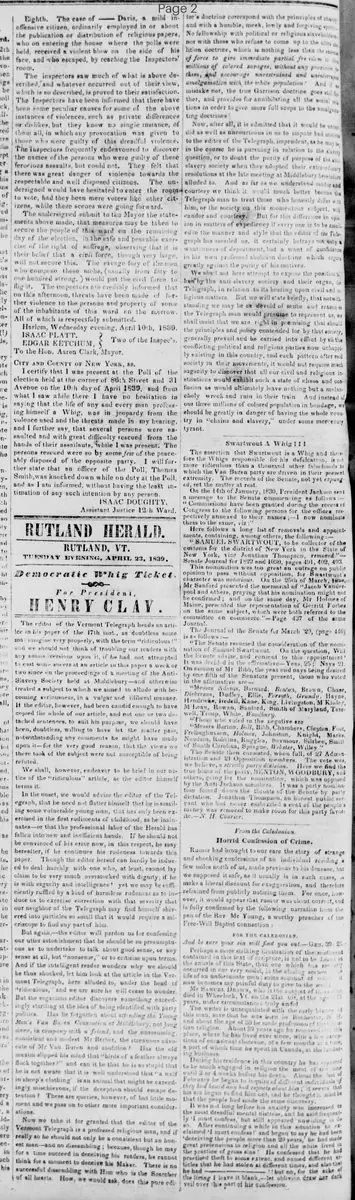
The editor of the Vermont Telegraph heads an article in his paper of the 17th inst., as doubtless some may imagine very properly, with the term "ridiculous!" and we should not think of troubling our readers with any animadversions upon it, if he had not attempted to cast some sneers at an article in this paper a week or two since on the proceedings of a meeting of the Anti-Slavery Society held at Middlebury-and otherwise treated a subject to which we aimed to allude with becoming seriousness, in a vulgar and illiberal manner.
If the editor, however, had been candid enough to have copied the whole of our article, and not one or two detached sentences, to suit his purpose, we should have been, doubtless, willing to have let the matter pass, notwithstanding any comments he might have made upon it-for the very good reason, that the views we there took of the subject were not susceptible of being refuted.
We shall, however, endeavor to be brief in our notice of the "ridiculous" article, as the editor himself terms it.
In the onset, we would advise the editor of the Telegraph, that he need not flatter himself that he is assailing some vulnerable young man, that has only been exercised in the first rudiments of childhood, as he insinuates-or that the professional labor of the Herald has fallen into new and inefficient hands. If he should not be convinced of his error now, in this respect, he may hereafter, if he continues his rudeness towards this paper.
Though the editor hereof can hardly be induced to deal harshly with one who, at least, cannot lay claim to be very much overstocked with dignity, if he is with sagacity and intelligence! yet we may be sufficiently ruffled by a kind of harmless rudeness as to induce us to exercise correction with that severity that our neighbor of the Telegraph may find himself shivered into particles so small that it would require a microscope to find any part of him.
But again,-the editor will pardon us for confessing our utter astonishment that he should be so presumptuous as to undertake to talk about good sense, or any sense at all, but "nonsense," or to criticise upon terms. And if the intelligent reader wonders why we should be thus shocked, let him look at the article in the Vermont Telegraph, here alluded to, under the head of "ridiculous," and we are sure he will cease to wonder.
But the sagacious editor discovers something exceedingly startling at the idea of being identified with party politics. Has he forgotten about attending the Young Men's Van Buren Convention at Middlebury, not long since, in company with a friend, and the unassuming, consistent and modest Mr Barber, the strenuous advocate of Mr Van Buren and abolition? Has the old maxim slipped his mind that "birds of a feather always flock together?" and can it be that he is so stupid that he is not aware that it is well understood that 'a wolf in sheep's clothing' is an animal that might be exceedingly mischievous, if the deception should escape detection?
These are queries, however, of but little moment and we pass on to other more important considerations.
Now we take it for granted that the editor of the Vermont Telegraph is a professed religious man, and if really so he should not only be a consistent but an honest man--and no dissembling; because, though he may for a time succeed in deceiving his readers, he cannot think for a moment to deceive his Maker. There is no successful dissembling with Him who is the Searcher of all hearts.
How, we would ask, does this pure editor's doctrine correspond with the principles of true Christianity and with a humble, meek, lowly and forgiving spirit? No fellowship with political or religious slaveholders nor with those who refuse to come up to the ultra Garrisonian doctrine, which is nothing less than the grossest amalgamation with the white population! And if we mistake not, the true Garrison doctrine goes still further, and provides for annihilating all the social relations in order to give more full scope to the amalgamating doctrines!
Now, after all, it is admitted that it would be unjust as well as uncourteous in us to impute bad motives to the editor of the Telegraph, imprudent, as he may be in the course he is pursuing in relation to the slavery question, or to doubt the purity of purpose of the anti-slavery society when they adopted their extraordinary resolutions at the late meeting at Middlebury heretofore alluded to.
And as far as we understand candor and courtesy we think it would much better become the Telegraph man to treat those who honestly differ with him, or the society on this momentous subject, with candor and courtesy.
But for this difference in opinion in matters of expediency if every one is to be assailed in the manner and style that the editor of the Telegraph has assailed us, it certainly betrays not only wantonness of deportment, but a want of confidence in his own professed abolition doctrine which argues greatly against the purity of his motives.
We shall not here attempt to expose the position taken by the anti-slavery society and their organ, Telegraph, in relation to its bearing upon civil and religious matters. But we will state briefly, that notwithstanding we may be as devoid of sense and reason as the Telegraph man would presume to represent us, we shall insist that we are right in premising that should the principles and policy contended for by that society, generally prevail and be carried into effect by all the conflicting political and religious parties now unhappily existing in this country, and each patterning after said society in their movements, it would not require much sagacity to discover that all our civil and religious institutions would exhibit such a state of chaos and confusion as would ultimately leave nothing but a melancholy wreck and ruin in their train.
And instead of our three millions of colored population in bondage, we should be greatly in danger of having the whole country in "chains and slavery," under some mercenary tyrant.
RUTLAND, VT.
TUESDAY EVENING, APRIL 23, 1839.
Democratic whig Ticket.
For President,
HENRY CLAY
The editor of the Vermont Telegraph heads an article in his paper of the 17th inst., as doubtless some may imagine very properly, with the term "ridiculous!" and we should not think of troubling our readers with any animadversions upon it, if he had not attempted to cast some sneers at an article in this paper a week or two since on the proceedings of a meeting of the Anti-Slavery Society held at Middlebury-and otherwise treated a subject to which we aimed to allude with becoming seriousness, in a vulgar and illiberal manner.
If the editor, however, had been candid enough to have copied the whole of our article, and not one or two detached sentences, to suit his purpose, we should have been, doubtless, willing to have let the matter pass, notwithstanding any comments he might have made upon it-for the very good reason, that the views we there took of the subject were not susceptible of being refuted.
We shall, however, endeavor to be brief in our notice of the "ridiculous" article, as the editor himself terms it.
In the onset, we would advise the editor of the Telegraph, that he need not flatter himself that he is assailing some vulnerable young man, that has only been exercised in the first rudiments of childhood, as he insinuates-or that the professional labor of the Herald has fallen into new and inefficient hands. If he should not be convinced of his error now, in this respect, he may hereafter, if he continues his rudeness towards this paper.
Though the editor hereof can hardly be induced to deal harshly with one who, at least, cannot lay claim to be very much overstocked with dignity, if he is with sagacity and intelligence! yet we may be sufficiently ruffled by a kind of harmless rudeness as to induce us to exercise correction with that severity that our neighbor of the Telegraph may find himself shivered into particles so small that it would require a microscope to find any part of him.
But again,-the editor will pardon us for confessing our utter astonishment that he should be so presumptuous as to undertake to talk about good sense, or any sense at all, but "nonsense," or to criticise upon terms. And if the intelligent reader wonders why we should be thus shocked, let him look at the article in the Vermont Telegraph, here alluded to, under the head of "ridiculous," and we are sure he will cease to wonder.
But the sagacious editor discovers something exceedingly startling at the idea of being identified with party politics. Has he forgotten about attending the Young Men's Van Buren Convention at Middlebury, not long since, in company with a friend, and the unassuming, consistent and modest Mr Barber, the strenuous advocate of Mr Van Buren and abolition? Has the old maxim slipped his mind that "birds of a feather always flock together?" and can it be that he is so stupid that he is not aware that it is well understood that 'a wolf in sheep's clothing' is an animal that might be exceedingly mischievous, if the deception should escape detection?
These are queries, however, of but little moment and we pass on to other more important considerations.
Now we take it for granted that the editor of the Vermont Telegraph is a professed religious man, and if really so he should not only be a consistent but an honest man--and no dissembling; because, though he may for a time succeed in deceiving his readers, he cannot think for a moment to deceive his Maker. There is no successful dissembling with Him who is the Searcher of all hearts.
How, we would ask, does this pure editor's doctrine correspond with the principles of true Christianity and with a humble, meek, lowly and forgiving spirit? No fellowship with political or religious slaveholders nor with those who refuse to come up to the ultra Garrisonian doctrine, which is nothing less than the grossest amalgamation with the white population! And if we mistake not, the true Garrison doctrine goes still further, and provides for annihilating all the social relations in order to give more full scope to the amalgamating doctrines!
Now, after all, it is admitted that it would be unjust as well as uncourteous in us to impute bad motives to the editor of the Telegraph, imprudent, as he may be in the course he is pursuing in relation to the slavery question, or to doubt the purity of purpose of the anti-slavery society when they adopted their extraordinary resolutions at the late meeting at Middlebury heretofore alluded to.
And as far as we understand candor and courtesy we think it would much better become the Telegraph man to treat those who honestly differ with him, or the society on this momentous subject, with candor and courtesy.
But for this difference in opinion in matters of expediency if every one is to be assailed in the manner and style that the editor of the Telegraph has assailed us, it certainly betrays not only wantonness of deportment, but a want of confidence in his own professed abolition doctrine which argues greatly against the purity of his motives.
We shall not here attempt to expose the position taken by the anti-slavery society and their organ, Telegraph, in relation to its bearing upon civil and religious matters. But we will state briefly, that notwithstanding we may be as devoid of sense and reason as the Telegraph man would presume to represent us, we shall insist that we are right in premising that should the principles and policy contended for by that society, generally prevail and be carried into effect by all the conflicting political and religious parties now unhappily existing in this country, and each patterning after said society in their movements, it would not require much sagacity to discover that all our civil and religious institutions would exhibit such a state of chaos and confusion as would ultimately leave nothing but a melancholy wreck and ruin in their train.
And instead of our three millions of colored population in bondage, we should be greatly in danger of having the whole country in "chains and slavery," under some mercenary tyrant.
What sub-type of article is it?
Slavery Abolition
Partisan Politics
Moral Or Religious
What keywords are associated?
Anti Slavery Society
Vermont Telegraph
Garrisonian Doctrine
Political Abolitionism
Middlebury Meeting
Henry Clay
Van Buren Convention
What entities or persons were involved?
Vermont Telegraph Editor
Anti Slavery Society
Middlebury Meeting
Mr. Barber
Van Buren
Garrison
Henry Clay
Editorial Details
Primary Topic
Critique Of Vermont Telegraph's Handling Of Anti Slavery Society And Political Involvement
Stance / Tone
Defensive Criticism Of Extreme Abolitionism And Hypocrisy
Key Figures
Vermont Telegraph Editor
Anti Slavery Society
Middlebury Meeting
Mr. Barber
Van Buren
Garrison
Henry Clay
Key Arguments
Telegraph Misrepresented Herald's Article On Anti Slavery Society Meeting
Editor Shows Hypocrisy By Attending Van Buren Convention While Decrying Politics
Extreme Garrisonian Doctrines Contradict Christian Principles And Promote Social Chaos
Anti Slavery Society's Positions Risk National Ruin If Adopted Broadly
Calls For Candor And Courtesy In Debates On Slavery