Thank you for visiting SNEWPapers!
Sign up free
Editorial
December 29, 1804
The Enquirer
Richmond, Henrico County, Virginia
What is this article about?
An anonymous editorial for the Enquirer critiques electioneering corruption, argues against universal suffrage due to voters' ignorance and moral failings, advocates property-based qualifications for voting, and stresses that representative government must align with societal moral and intellectual conditions to endure.
Clipping
OCR Quality
98%
Excellent
Full Text
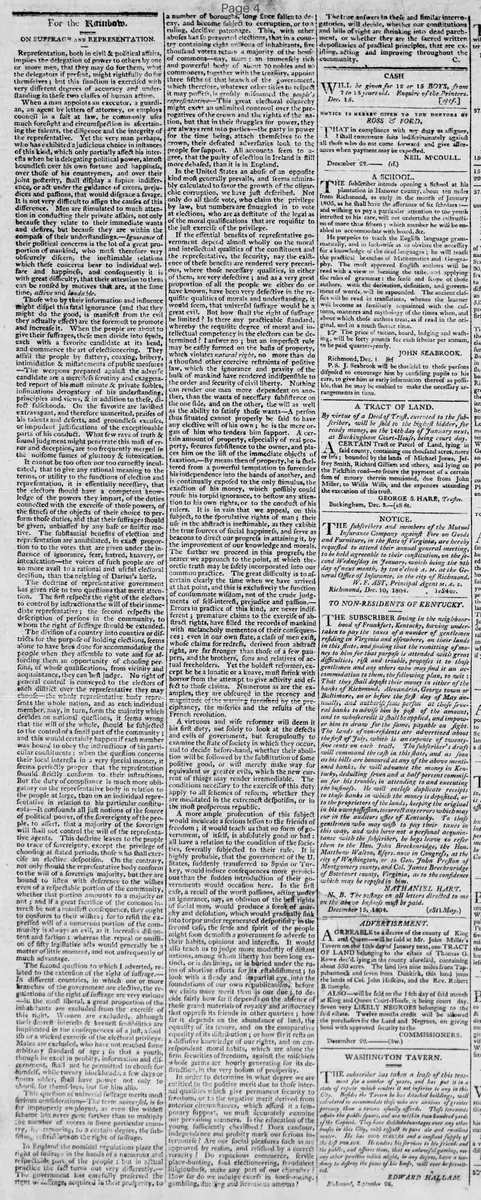
For the Enquirer.
ON SUFFRAGE AND REPRESENTATION.
Representation, both in civil & political affairs, implies the delegation of power to others by one or more men, that they may do for them, what the delegators if present, might rightfully do for themselves: but this function is exercised with very different degrees of accuracy and understanding in these two classes of human action.
When a man appoints an executor, a guardian, an agent by letters of attorney, or employs council in a suit at law, he commonly uses much foresight and circumspection in ascertaining the talents, the diligence and the integrity of the representative. Yet the very man perhaps, who has exhibited a judicious choice in instances of this kind, which only partially affect his interests when he is delegating political power, almost boundless over his own fortune and happiness, over those of his countrymen, and over their joint posterity, shall display a supine indifference, or act under the guidance of errors, prejudices and passions, that would disgrace a savage.
It is not very difficult to assign the causes of this difference. Men are stimulated to much attention in conducting their private affairs, not only because they relate to their immediate wants and desires, but because they are within the compass of their understandings.--Ignorance of their political concerns is the lot of a great proportion of mankind, who must therefore very obscurely discern, the inestimable relations which these concerns bear to individual welfare and happiness, and consequently it is with great difficulty, that their attention to them can be roused by motives that are, at the same time, active and laudable.
Those who by their information and influence might dispel this fatal ignorance (and that they might do the good, is manifest from the evil they actually effect) are the foremost to promote and increase it. When the people are about to give their suffrages, these men divide into squads, each with a favorite candidate at its head, and commence the art of electioneering. They assail the people by flattery, coaxing, bribery, intimidation & misstatements of public measures --The weapons prepared against the adverse candidate are a merciless scrutiny and exaggerated report of his most minute & private foibles, insinuations derogatory of his understanding, principles and views, & in addition to these, direst falsehoods. On the favorite are lavished extravagant, and therefore unmerited, praises of his talents and deserts, and groundless excuses. or impudent justifications of the exceptionable parts of his conduct. What few rays of truth & sound judgment might penetrate this mist of error and deception, are too frequently merged in the noisome fumes of gluttony & intoxication.
It cannot be too often nor too earnestly inculcated, that to give any rational meaning to the terms, or utility to the functions of election and representation, it is essentially necessary, that the electors should have a competent knowledge of the powers they impart, of the duties connected with the exercise of those powers, of the fitness of the objects of their choice to perform those duties, and that their suffrages should be given, unbiased by any base or sinister motive. The substantial benefits of election and representation are annihilated, in exact proportion to the votes that are given under the influence of ignorance, fear, hatred, knavery, or intoxication the voices of such people are of no more avail to a rational and useful electoral decision, than the neighing of Darius's horse.
The doctrine of representative government has given rise to two questions that merit attention. The first respects the right of the electors to control by instructions the will of their immediate representative: the second respects the description of persons in the community, to whom the right of suffrage should be extended.
The division of a country into counties or districts for the purpose of holding elections, seems alone to have been done for accommodating the people when they assemble to vote and for affording them an opportunity of choosing persons, of whose qualifications, from vicinity and acquaintance, they can best judge. No right of general control is conveyed to the electors of each district over the representative they may choose-the whole representative body represents the whole nation, and as each individual member, may, in turn, form the majority which decides on national questions, it seems wrong that the will of the whole, should be subjected to the control of a small part of the community ; and this would certainly happen if each member was bound to obey the instruction of his particular constituents : when the question concerns their local interests in a very special manner, it seems perfectly proper that the representation should strictly conform to their instructions.
But the duty of compliance is much more obligatory on the representative body in relation to the people at large, than on an individual representative in relation to his particular constituents--It confounds all just notions of the source of political power, of the sovereignty of the people, to assert, that a majority of the sovereign will shall not control the will of the representative agents. This doctrine leaves to the people no trace of sovereignty, except the privilege of choosing at stated periods, those who shall exercise an elective despotism. On the contrary, not only should the representative body conform to the will of a sovereign majority, but they are bound to listen with deference to the wishes even of a respectable portion of the community, whether that portion amounts to a majority or not ; and if a great sacrifice of the common interest be not a manifest consequence, they ought to conform to their wishes; for to rein the expressed will of a numerous portion of the community is always an evil, as it increases discontent and faction : whereas the repeal or omission of fifty legislative acts would generally be a matter of little moment, and not unfrequently of much advantage.
The second question to which I adverted, related to the extension of the right of suffrage.- In different countries, in which one or more branches of the government are elective, the regulations of the right of suffrage are very various --in the most liberal, a great proportion of the inhabitants are excluded from the exercise of this right. Women are excluded, although their dearest interests & keenest sensibilities are implicated in the consequences of a just, a foolish or a wicked exercise of the electoral privilege Males are excluded, who have not reached some arbitrary standard of age ; so that a youth, though he excel in probity, information and discernment, shall not be permitted to choose for himself, while twenty blockheads, a few days or hours older, shall have power not only to choose for themselves. but for him also.
This question of universal suffrage merits most serious consideration-The term universal, is so far improperly employed, as even the wildest schemer has never gone farther than to multiply the number of voters in some particular country, i.e. removing, to a certain degree, the sub- stitute restrictions on the right of suffrage.
In England the nominal regulations place the right of suffrage in the hands of a numerous and respectable part of the people : but in actual practice the fact turns out very differently.- The government has carefully preserved the right of suffrage, acquired in their property, to a number of boroughs, long since fallen to decay, and become subject to corruption. or to a ruling, decisive patronage. This, with other abuses has so perverted elections, that in a country containing eight millions of inhabitants, five thousand voters return a majority of the house of commons--nay, more: an immensely rich and powerful body of about 70 nobles and 90 commoners, together with the treasury, appoint three fifths of that branch of the government, which therefore, whatever other titles to respect it may possess, is grossly misnamed the people's representative-This great electoral oligarchy might exert an unlimited controul over the prerogatives of the crown and the rights of the nation, but that in their struggles for power, they are always rent into parties--the party in power for the time being, attach themselves to the crown, their defeated adversaries look to the people for support. All accounts seem to agree, that the purity of election in Ireland is still more debased, than it is in England.
In the United States an abuse of an opposite kind most generally prevails, and seems admirably calculated to favor the growth of the oligarchic corruption, we have just described. Not only do all those vote, who claim the privilege by law. but numbers are smuggled in to vote at elections, who are as destitute of the legal as of the moral qualifications that are requisite to the just exercise of the privilege.
If the essential benefits of representative government depend almost wholly on the moral and intellectual qualities of the constituent and the representative, the security, nay the existence of these benefits are rendered very precarious, where those necessary qualities, in either of them, are very defective ; and as a very great proportion of all the people we either do or have known, have been very defective in these requisite qualities of morals and understanding, it would seem, that universal suffrage would be a great evil. But how shall the right of suffrage be limited? Is there any practicable standard, whereby the requisite degree of moral and intellectual competency in the electors can be determined? I answer no : but an imperfect rule may be easily formed on the basis of property, which violates natural right, no more than do a thousand other coercive restraints of positive law, which the ignorance and pravity of the bulk of mankind have rendered indispensable to the order and security of civil liberty. Nothing can render one man more dependent on another, than the wants of necessary subsistence on the one side, and on the other. the will as well as the ability to satisfy those wants-A person thus situated cannot properly be said to have any elective will of his own; he is the mere organ of him who tenders him support. A certain amount of property, especially of real property, secures subsistence to the owner, and places him on the list of the immediate objects of taxation.-By means then of property, he is sheltered from a powerful temptation to surrender his independence into the hands of another, and is continually exposed to the only stimulus, the exaction of his money, which possibly could rouse his torpid ignorance, to bestow any attention to his own rights, or to the conduct of his rulers. It is in vain that we appeal, on this subject, to the speculative rights of man ; their use in the abstract is inestimable, as they exhibit the true sources of social happiness, and serve as beacons to direct our progress in attaining it, by the improvement of our knowledge and morals.
The farther we proceed in this progress, the nearer we approach to the point, at which theoretic truth may be safely incorporated into our common practice. The great difficulty is to ascertain clearly the time when we have arrived at that point, and this is exclusively the function of consummate wisdom, not of the crude judgments of self-interest, prejudice and passion.-- Errors in practice of this kind, are never indifferent : premature claims to the exercise of abstract rights, have filled the records of mankind with melancholy mementos of their consequences; even in our own state, a class of men exist whose claims for redress, derived from abstract right, are far stronger than those of a few paupers, and the brothers, sons and relatives of actual freeholders. Yet the boldest reformer, except he be a lunatic or a knave, must shrink with horror from the attempt to give activity and effect to those claims. Numerous as are the examples, they are obscured in the recency and magnitude of the warning furnished by the precipitancy, the miseries and the results of the French revolution.
A virtuous and wise reformer will deem it his first duty, not solely to look at the defects and evils of government, but scrupulously to examine the state of society in which they occur, and to decide before-hand, whether their abolition will be followed by the substitution of some positive good, or will merely make way for equivalent or greater evils, which the new current of things may render irremediable. The conditions necessary to the exercise of this duty apply to all schemes of reform, whether they are meditated in the extremest despotism, or in the most prosperous republic.
A more ample prosecution of this subject would inculcate a serious lesson to the friends of freedom : it would teach us that no form of government, of itself, is absolutely good or bad : all have a relation to the condition of the societies, severally subjected to their rule. It is highly probable, that the government of the U. States, suddenly transferred to Spain or Turkey, would induce consequences more pernicious than the sudden introduction of their governments would occasion here. In the first case, a recoil of the worst passions, acting under an ignorance, nay, an oblivion of the best rights of social man, would produce a scene of anarchy and desolation, which would gradually sink into torpor under regenerated despotism; in the second case, the energy and spirit of the people might soon demolish a government so adverse to their habits, opinions and interests. It would also teach us to judge more modestly of distant nations, among whom liberty has been long extinct, or is declining, or is buried under the ruins of abortive efforts for its establishment ; to look with a steady and impartial eye into the foundations of our own republicanism, before we claim more merit than is our due; to decide fairly how far it depends on the absence of those grand materials of royalty and aristocracy that oppress its friends in other quarters; how far it depends on the abundance of land, the equality of its tenure, and on the comparative equality of its distribution; or how far it rests on a diffusive knowledge of our rights, and on correspondent moral habits, which are alone the firm securities of freedom, against the mischiefs whose germs are hourly generating for its destruction, in the very bosom of prosperity.
In order to determine in what degree we are entitled to the positive merit due to those internal qualities which give permanent security to freedom, or to the negative merit derived from anterior circumstances, which afford it a temporary support, we must accurately examine our prevailing manners. Is the education of the young sufficiently cherished? Does candour, independence and probity mark our serious intercourse? Are our social pleasures such as are approved by reason, and relished by a correct vivacity ? Do rapacious commerce, servile place-hunting, foul electioneering, fraudulent litigiousness, make any part of our character How far do we indulge excess in horse-racing, gambling, duelling and licentious amours?
The true answers to these and similar interrogatories, will decide, whether our constitutions and bills of right are shrinking into dead parchment, or whether they are the sacred written depositories of practical principles, that are existing, acting and improving throughout the community.
ON SUFFRAGE AND REPRESENTATION.
Representation, both in civil & political affairs, implies the delegation of power to others by one or more men, that they may do for them, what the delegators if present, might rightfully do for themselves: but this function is exercised with very different degrees of accuracy and understanding in these two classes of human action.
When a man appoints an executor, a guardian, an agent by letters of attorney, or employs council in a suit at law, he commonly uses much foresight and circumspection in ascertaining the talents, the diligence and the integrity of the representative. Yet the very man perhaps, who has exhibited a judicious choice in instances of this kind, which only partially affect his interests when he is delegating political power, almost boundless over his own fortune and happiness, over those of his countrymen, and over their joint posterity, shall display a supine indifference, or act under the guidance of errors, prejudices and passions, that would disgrace a savage.
It is not very difficult to assign the causes of this difference. Men are stimulated to much attention in conducting their private affairs, not only because they relate to their immediate wants and desires, but because they are within the compass of their understandings.--Ignorance of their political concerns is the lot of a great proportion of mankind, who must therefore very obscurely discern, the inestimable relations which these concerns bear to individual welfare and happiness, and consequently it is with great difficulty, that their attention to them can be roused by motives that are, at the same time, active and laudable.
Those who by their information and influence might dispel this fatal ignorance (and that they might do the good, is manifest from the evil they actually effect) are the foremost to promote and increase it. When the people are about to give their suffrages, these men divide into squads, each with a favorite candidate at its head, and commence the art of electioneering. They assail the people by flattery, coaxing, bribery, intimidation & misstatements of public measures --The weapons prepared against the adverse candidate are a merciless scrutiny and exaggerated report of his most minute & private foibles, insinuations derogatory of his understanding, principles and views, & in addition to these, direst falsehoods. On the favorite are lavished extravagant, and therefore unmerited, praises of his talents and deserts, and groundless excuses. or impudent justifications of the exceptionable parts of his conduct. What few rays of truth & sound judgment might penetrate this mist of error and deception, are too frequently merged in the noisome fumes of gluttony & intoxication.
It cannot be too often nor too earnestly inculcated, that to give any rational meaning to the terms, or utility to the functions of election and representation, it is essentially necessary, that the electors should have a competent knowledge of the powers they impart, of the duties connected with the exercise of those powers, of the fitness of the objects of their choice to perform those duties, and that their suffrages should be given, unbiased by any base or sinister motive. The substantial benefits of election and representation are annihilated, in exact proportion to the votes that are given under the influence of ignorance, fear, hatred, knavery, or intoxication the voices of such people are of no more avail to a rational and useful electoral decision, than the neighing of Darius's horse.
The doctrine of representative government has given rise to two questions that merit attention. The first respects the right of the electors to control by instructions the will of their immediate representative: the second respects the description of persons in the community, to whom the right of suffrage should be extended.
The division of a country into counties or districts for the purpose of holding elections, seems alone to have been done for accommodating the people when they assemble to vote and for affording them an opportunity of choosing persons, of whose qualifications, from vicinity and acquaintance, they can best judge. No right of general control is conveyed to the electors of each district over the representative they may choose-the whole representative body represents the whole nation, and as each individual member, may, in turn, form the majority which decides on national questions, it seems wrong that the will of the whole, should be subjected to the control of a small part of the community ; and this would certainly happen if each member was bound to obey the instruction of his particular constituents : when the question concerns their local interests in a very special manner, it seems perfectly proper that the representation should strictly conform to their instructions.
But the duty of compliance is much more obligatory on the representative body in relation to the people at large, than on an individual representative in relation to his particular constituents--It confounds all just notions of the source of political power, of the sovereignty of the people, to assert, that a majority of the sovereign will shall not control the will of the representative agents. This doctrine leaves to the people no trace of sovereignty, except the privilege of choosing at stated periods, those who shall exercise an elective despotism. On the contrary, not only should the representative body conform to the will of a sovereign majority, but they are bound to listen with deference to the wishes even of a respectable portion of the community, whether that portion amounts to a majority or not ; and if a great sacrifice of the common interest be not a manifest consequence, they ought to conform to their wishes; for to rein the expressed will of a numerous portion of the community is always an evil, as it increases discontent and faction : whereas the repeal or omission of fifty legislative acts would generally be a matter of little moment, and not unfrequently of much advantage.
The second question to which I adverted, related to the extension of the right of suffrage.- In different countries, in which one or more branches of the government are elective, the regulations of the right of suffrage are very various --in the most liberal, a great proportion of the inhabitants are excluded from the exercise of this right. Women are excluded, although their dearest interests & keenest sensibilities are implicated in the consequences of a just, a foolish or a wicked exercise of the electoral privilege Males are excluded, who have not reached some arbitrary standard of age ; so that a youth, though he excel in probity, information and discernment, shall not be permitted to choose for himself, while twenty blockheads, a few days or hours older, shall have power not only to choose for themselves. but for him also.
This question of universal suffrage merits most serious consideration-The term universal, is so far improperly employed, as even the wildest schemer has never gone farther than to multiply the number of voters in some particular country, i.e. removing, to a certain degree, the sub- stitute restrictions on the right of suffrage.
In England the nominal regulations place the right of suffrage in the hands of a numerous and respectable part of the people : but in actual practice the fact turns out very differently.- The government has carefully preserved the right of suffrage, acquired in their property, to a number of boroughs, long since fallen to decay, and become subject to corruption. or to a ruling, decisive patronage. This, with other abuses has so perverted elections, that in a country containing eight millions of inhabitants, five thousand voters return a majority of the house of commons--nay, more: an immensely rich and powerful body of about 70 nobles and 90 commoners, together with the treasury, appoint three fifths of that branch of the government, which therefore, whatever other titles to respect it may possess, is grossly misnamed the people's representative-This great electoral oligarchy might exert an unlimited controul over the prerogatives of the crown and the rights of the nation, but that in their struggles for power, they are always rent into parties--the party in power for the time being, attach themselves to the crown, their defeated adversaries look to the people for support. All accounts seem to agree, that the purity of election in Ireland is still more debased, than it is in England.
In the United States an abuse of an opposite kind most generally prevails, and seems admirably calculated to favor the growth of the oligarchic corruption, we have just described. Not only do all those vote, who claim the privilege by law. but numbers are smuggled in to vote at elections, who are as destitute of the legal as of the moral qualifications that are requisite to the just exercise of the privilege.
If the essential benefits of representative government depend almost wholly on the moral and intellectual qualities of the constituent and the representative, the security, nay the existence of these benefits are rendered very precarious, where those necessary qualities, in either of them, are very defective ; and as a very great proportion of all the people we either do or have known, have been very defective in these requisite qualities of morals and understanding, it would seem, that universal suffrage would be a great evil. But how shall the right of suffrage be limited? Is there any practicable standard, whereby the requisite degree of moral and intellectual competency in the electors can be determined? I answer no : but an imperfect rule may be easily formed on the basis of property, which violates natural right, no more than do a thousand other coercive restraints of positive law, which the ignorance and pravity of the bulk of mankind have rendered indispensable to the order and security of civil liberty. Nothing can render one man more dependent on another, than the wants of necessary subsistence on the one side, and on the other. the will as well as the ability to satisfy those wants-A person thus situated cannot properly be said to have any elective will of his own; he is the mere organ of him who tenders him support. A certain amount of property, especially of real property, secures subsistence to the owner, and places him on the list of the immediate objects of taxation.-By means then of property, he is sheltered from a powerful temptation to surrender his independence into the hands of another, and is continually exposed to the only stimulus, the exaction of his money, which possibly could rouse his torpid ignorance, to bestow any attention to his own rights, or to the conduct of his rulers. It is in vain that we appeal, on this subject, to the speculative rights of man ; their use in the abstract is inestimable, as they exhibit the true sources of social happiness, and serve as beacons to direct our progress in attaining it, by the improvement of our knowledge and morals.
The farther we proceed in this progress, the nearer we approach to the point, at which theoretic truth may be safely incorporated into our common practice. The great difficulty is to ascertain clearly the time when we have arrived at that point, and this is exclusively the function of consummate wisdom, not of the crude judgments of self-interest, prejudice and passion.-- Errors in practice of this kind, are never indifferent : premature claims to the exercise of abstract rights, have filled the records of mankind with melancholy mementos of their consequences; even in our own state, a class of men exist whose claims for redress, derived from abstract right, are far stronger than those of a few paupers, and the brothers, sons and relatives of actual freeholders. Yet the boldest reformer, except he be a lunatic or a knave, must shrink with horror from the attempt to give activity and effect to those claims. Numerous as are the examples, they are obscured in the recency and magnitude of the warning furnished by the precipitancy, the miseries and the results of the French revolution.
A virtuous and wise reformer will deem it his first duty, not solely to look at the defects and evils of government, but scrupulously to examine the state of society in which they occur, and to decide before-hand, whether their abolition will be followed by the substitution of some positive good, or will merely make way for equivalent or greater evils, which the new current of things may render irremediable. The conditions necessary to the exercise of this duty apply to all schemes of reform, whether they are meditated in the extremest despotism, or in the most prosperous republic.
A more ample prosecution of this subject would inculcate a serious lesson to the friends of freedom : it would teach us that no form of government, of itself, is absolutely good or bad : all have a relation to the condition of the societies, severally subjected to their rule. It is highly probable, that the government of the U. States, suddenly transferred to Spain or Turkey, would induce consequences more pernicious than the sudden introduction of their governments would occasion here. In the first case, a recoil of the worst passions, acting under an ignorance, nay, an oblivion of the best rights of social man, would produce a scene of anarchy and desolation, which would gradually sink into torpor under regenerated despotism; in the second case, the energy and spirit of the people might soon demolish a government so adverse to their habits, opinions and interests. It would also teach us to judge more modestly of distant nations, among whom liberty has been long extinct, or is declining, or is buried under the ruins of abortive efforts for its establishment ; to look with a steady and impartial eye into the foundations of our own republicanism, before we claim more merit than is our due; to decide fairly how far it depends on the absence of those grand materials of royalty and aristocracy that oppress its friends in other quarters; how far it depends on the abundance of land, the equality of its tenure, and on the comparative equality of its distribution; or how far it rests on a diffusive knowledge of our rights, and on correspondent moral habits, which are alone the firm securities of freedom, against the mischiefs whose germs are hourly generating for its destruction, in the very bosom of prosperity.
In order to determine in what degree we are entitled to the positive merit due to those internal qualities which give permanent security to freedom, or to the negative merit derived from anterior circumstances, which afford it a temporary support, we must accurately examine our prevailing manners. Is the education of the young sufficiently cherished? Does candour, independence and probity mark our serious intercourse? Are our social pleasures such as are approved by reason, and relished by a correct vivacity ? Do rapacious commerce, servile place-hunting, foul electioneering, fraudulent litigiousness, make any part of our character How far do we indulge excess in horse-racing, gambling, duelling and licentious amours?
The true answers to these and similar interrogatories, will decide, whether our constitutions and bills of right are shrinking into dead parchment, or whether they are the sacred written depositories of practical principles, that are existing, acting and improving throughout the community.
What sub-type of article is it?
Suffrage
Constitutional
Partisan Politics
What keywords are associated?
Suffrage
Representation
Electioneering
Universal Suffrage
Property Qualification
Electoral Corruption
Representative Government
Moral Qualifications
What entities or persons were involved?
Electors
Representatives
English House Of Commons
United States Government
French Revolution
Editorial Details
Primary Topic
Suffrage And Representation In Government
Stance / Tone
Critical Of Universal Suffrage And Electoral Corruption; Advocates Property Qualifications And Moral/Intellectual Fitness
Key Figures
Electors
Representatives
English House Of Commons
United States Government
French Revolution
Key Arguments
Political Representation Requires Careful Delegation Unlike Private Affairs Due To Ignorance
Electioneering Uses Flattery, Bribery, And Falsehoods To Manipulate Voters
Electors Need Knowledge Of Powers, Duties, And Candidates Without Bias
Representatives Should Follow Majority Will But Not Strict Local Instructions Except For Local Issues
Universal Suffrage Is Flawed As Most Lack Moral And Intellectual Qualifications
Property Ownership Provides A Practical Basis For Limiting Suffrage To Ensure Independence
Reform Must Consider Societal Conditions To Avoid Greater Evils Like In French Revolution
Government Forms Succeed Based On Societal Morals And Knowledge, Not Inherently