Thank you for visiting SNEWPapers!
Sign up free
Martinsburg Gazette And Public Advertiser
Martinsburg, Berkeley County, West Virginia
What is this article about?
Article reports excitement and superstition among Philadelphia's uninformed classes about expected comets in 1832, republishes scientific info from Time's Telescope to dispel fears. Discusses comets of Encke and Biela, their orbits crossing Earth's, historical predictions, and low probability of collision despite dire hypothetical effects.
Clipping
OCR Quality
Full Text
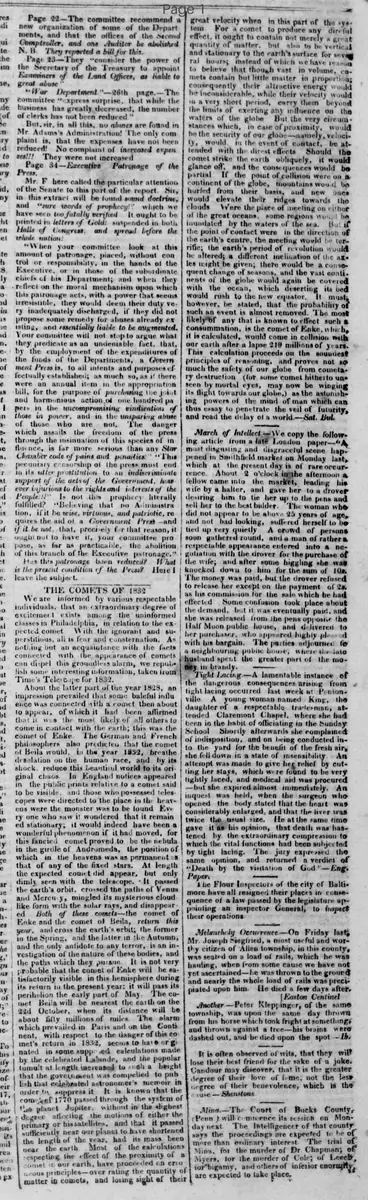
We are informed by various respectable individuals, that an extraordinary degree of excitement exists among the uninformed classes in Philadelphia, in relation to the expected comet. With the ignorant and superstitious, all is fear and consternation. As nothing but an acquaintance with the facts connected with the appearance of comets can dispel this groundless alarm, we republish some interesting information, taken from Time's Telescope for 1832.
About the latter part of the year 1825, an impression prevailed that some baleful influence was connected with a comet then about to appear, of which it had been affirmed that it was the most likely of all others to come in contact with the earth; this was the comet of Encke. The German and French philosophers also predicted that the comet of Biela would, in the year 1832, breathe desolation on the human race, and by its shock, reduce this beautiful world to its original chaos. In England notices appeared in the public prints relative to a comet said to be visible, and those who possessed telescopes were directed to the place in the heavens where the monster was to be found. Every one who saw it wondered that it remained stationary; it would indeed have been a wonderful phenomenon if it had moved, for this fancied comet proved to be the nebula in the girdle of Andromeda, the position of which in the heavens was as permanent as that of any of the fixed stars. At length the expected comet did appear, but only dimly seen with the telescope.—It passed the earth's orbit, crossed the paths of Venus and Mercury, mingled its mysterious cloud-like form with the solar rays, and disappeared. Both of these comets—the comet of Encke and the comet of Biela, return this year, and cross the earth's orbit; the former in the Spring, and the latter in the Autumn, and the only antidote to any terror, is an investigation of the nature of these bodies, and the paths which they pursue. It is not very probable that the comet of Encke will be satisfactorily visible in this hemisphere during its return in the present year: it will pass its perihelion the early part of May. The comet Biela will be nearest the earth on the 22d October, when its distance will be about fifty millions of miles. The alarm which prevailed in Paris and on the Continent, with respect to the danger of this comet's return in 1832, seems to have originated in some supposed calculations made by the celebrated La Place, and the popular tumult at length increased to such a height that the government was compelled to publish that celebrated astronomer's memoir in order to suppress it. It is known that the comet of 1770 passed through the system of the planet Jupiter, without in the slightest degree affecting the motions of either the primary or his satellites, and that it passed sufficiently near our planet to have shortened the length of the year, had its mass been considerable. Most of the calculations respecting the effect of the proximity of a comet to our earth, have proceeded on erroneous principles—over rating the quantity of matter in comets, and losing sight of their great velocity when in this part of the system. For a comet to produce any direful effect, it ought to contain not merely a great quantity of matter, but also to be vertical and stationary to the earth's surface or several hours; instead of which we have reason to believe that though vast in volume, comets contain but little matter in proportion; consequently their attractive energy would be inconsiderable, while their velocity would in a very short period, carry them beyond the limits of exerting any influence on the waters of the globe. But the very circumstances which, in case of proximity, would be the security of our globe—namely, velocity, would, in the event of contact, be attended with the direst effects. Should the comet strike the earth obliquely, it would glance off, and the consequences would be partial. If the point of collision were on a continent of the globe, mountains would be hurled from their basis, and new ones would elevate their ridges towards the clouds. Were the place of meeting on either of the great oceans, some regions would be inundated by the waters of the sea. But if the point of contact were in the direction of the earth's centre, the meeting would be terrific; the earth's period of revolution would be altered; a different inclination of the axis might be given: there would be a consequent change of seasons, and the vast continents of the globe would again be covered with the ocean, which deserting its bed would rush to the new equator. It must, however, be stated, that the probability of such an event is almost removed. The most likely of any that is known to effect such a consummation, is the comet of Encke, which it is calculated, would come in collision with our earth after a lapse of 219 millions of years. This calculation proceeds on the soundest principles of reasoning, and proves not so much the safety of our globe from comet-ary destruction (for some comet hitherto unseen by mortal eyes, may now be winging its flight towards our globe,) as the astonishing powers of the mind of man which can thus essay to penetrate the veil of futurity, and read the doom of a world.—Sat. Bul.
What sub-type of article is it?
What themes does it cover?
What keywords are associated?
What entities or persons were involved?
Where did it happen?
Story Details
Key Persons
Location
Philadelphia
Event Date
1832
Story Details
Public in Philadelphia fears comets of Encke and Biela in 1832 due to superstitions of collision and destruction; article explains their orbits, past appearances, scientific improbability of impact, and hypothetical catastrophic effects if collision occurred, emphasizing human intellect's predictive power.