Thank you for visiting SNEWPapers!
Sign up free
Vermont Telegraph
Brandon, Rutland County, Vermont
What is this article about?
Extracts from Baptist missionary letters in Sadiya, Asam (1838): Discussion on challenges of printing Shyan language in Burmese vs. Roman scripts due to inadequacies; Appeal by Brown and Cutter for 12 more missionaries to expand work among Shyans, Singphos, Nagas, Miris, Asamese, and others in Brahmaputra Valley, highlighting opportunities and needs.
Merged-components note: Continuation of missionary report and letters from Asam across pages; relabeled to foreign_news as it pertains to international missionary work.
Clippings
1 of 2
OCR Quality
Full Text
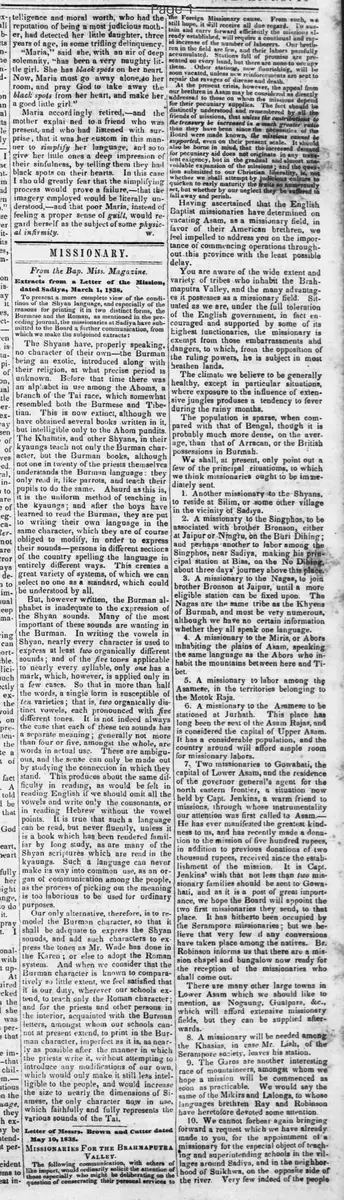
From the Bap. Miss. Magazine.
Extracts from a Letter of the Mission, dated Sadiya, March 1, 1838.
To present a more complete view of the condition of the Shyan language, and especially of the reasons for printing it in two distinct forms, the Burmese and the Roman, as mentioned in the preceding journal, the missionaries at Sadiya have submitted to the Board a further communication, from which we make the subjoined extracts:
The Shyans have, properly speaking, no character of their own—the Burman being an exotic, introduced along with their religion, at what precise period is unknown. Before that time there was an alphabet in use among the Ahoms, a branch of the Tai race, which somewhat resembled both the Burmese and Tibetan. This is now extinct, although we have obtained several books written in it, but intelligible only to the Ahom pundits.
The Khamtis, and other Shyans, in their kyaungs teach not only the Burman character, but the Burman books, although not one in twenty of the priests themselves understands the Burman language: they only read it, like parrots, and teach their pupils to do the same. Absurd as this is, it is the uniform method of teaching in the kyaungs; and after the boys have learned to read the Burman, they are put to writing their own language in the same character, which they are of course obliged to modify, in order to express their sounds—persons in different sections of the country spelling the language in entirely different ways.
This creates a great variety of systems, of which we can select no one as a standard, which could be understood by all.
But, however written, the Burman alphabet is inadequate to the expression of the Shyan sounds. Many of the most important of these sounds are wanting in the Burman. In writing the vowels in Shyan, nearly every character is used to express at least two organically different sounds; and of the five tones applicable to nearly every syllable, only one has a mark, which, however, is applied only in a few cases. So that in more than half the words, a single form is susceptible of ten varieties; that is, two organically distinct vowels, each pronounced with five different tones. It is not indeed always the case that each of these ten sounds has a separate meaning; generally not more than four or five, amongst the whole, are words in actual use. These are ambiguous, and the sense can only be made out by studying the connection in which they stand. This produces about the same difficulty in reading, as would be felt in reading English if we should omit all the vowels and write only the consonants, or in reading Hebrew without the vowel points. It is true that such a language can be read, but never fluently, unless it is a book which has been rendered familiar by long study, as are many of the Shyan scriptures which are read in the kyaungs. Such a language can never make its way into common use, as an organ of communication among the people, as the process of picking out the meaning is too laborious to be used for ordinary purposes.
Our only alternative, therefore, is to remodel the Burman character, so that it shall be adequate to express the Shyan sounds, and add such characters to express the tones as Mr. Wade has done in the Karen; or else to adopt the Roman system. And when we consider that the Burman character is known to comparatively so little extent, we feel satisfied that it is our duty, wherever our schools extend, to teach only the Roman character: and for the priests and other persons in the interior, acquainted with the Burman letters, amongst whom our schools cannot at present extend, to print in the Burman character, imperfect as it is, as nearly as possible after the manner in which the priests write it, without attempting to introduce any modifications of our own, which would only make it still less intelligible to the people, and would increase the size to nearly the dimensions of Siamese, the only character now in use, which faithfully and fully represents the various sounds of the Tai.
Letter of Messrs. Brown and Cutter dated May 10, 1838.
Missionaries For The Brahmaputra VALLEY.
The following communication, with others of like import, would ordinarily solicit the attention of those especially who might be deliberating on the question of consecrating their personal services to the Foreign Missionary cause. From such, we still hope, it will receive all due regard. To sustain and carry forward efficiently the missions already established, will require a continual and rapid increase of the number of laborers. Our brethren in the field are few, and their labors painfully accumulated. Stations full of promise are presented on every hand, but there are none to occupy them. Other stations, now flourishing, will be soon vacated, unless new reinforcements are sent to repair the ravages of disease and death.
At the present crisis, however, the appeal from our brethren in Asam may be considered as directly addressed to those on whom the missions depend for their pecuniary supplies. The act should be distinctly understood and remembered by all the friends of missions, that unless the contributions to the treasury be increased in a much greater ratio than they have been since the necessities of the Board were made known, the missions cannot be supported, even on their present scale. It should also be borne in mind, that the increased demand for pecuniary aid does not originate in any transient exigency, but in the gradual and almost unavoidable expansion of the missions; and the question submitted to our Christian liberality, is, not whether we shall attempt by judicious culture to quicken to early maturity the fruits so numerously set, but whether by our neglect they be suffered to fall away and perish.
Having ascertained that the English Baptist missionaries have determined on vacating Asam, as a missionary field, in favor of their American brethren, we feel impelled to address you on the importance of commencing operations throughout this province with the least possible delay.
You are aware of the wide extent and variety of tribes who inhabit the Brahmaputra Valley, and the many advantages it possesses as a missionary field. Situated as we are, under the full toleration of the English government, in fact encouraged and supported by some of its highest functionaries, the missionary is exempt from those embarrassments and dangers, to which, from the opposition of the ruling powers, he is subject in most heathen lands.
The climate we believe to be generally healthy, except in particular situations, where exposure to the influence of extensive jungles produces a tendency to fever during the rainy months.
The population is sparse, when compared with that of Bengal, though it is probably much more dense, on the average, than that of Arracan, or the British possessions in Burmah.
We shall, at present, only point out a few of the principal situations, to which we think missionaries ought to be immediately sent.
1. Another missionary to the Shyans, to reside at Silim, or some other village in the vicinity of Sadiya.
2. A missionary to the Singphos, to be associated with brother Bronson, either at Jaipur or Ningtu, on the Buri Dihing; and perhaps another to labor among the Singphos, near Sadiya, making his principal station at Bisa, on the No Dihing, about three days' journey above this place.
3. A missionary to the Nagas, to join brother Bronson at Jaipur, 'until a more eligible station can be fixed upon. The Nagas are the same tribe as the Khyens of Burmah, and must be very numerous, although we have no certain information whether they all speak one language.
4. A missionary to the Miris, or Abors inhabiting the plains of Asam, speaking the same language as the Abors who inhabit the mountains between here and Tibet.
5. A missionary to labor among the Asamese, in the territories belonging to the Motok Raja.
6. A missionary to the Asamese to be stationed at Jorhat. This place has long been the seat of the Asam Rajas, and is considered the capital of Upper Asam. It has a considerable population, and the country around will afford ample room for missionary labors.
7. Two missionaries to Gowahati, the capital of Lower Asam, and the residence of the governor general's agent for the north eastern frontier, a situation now held by Capt. Jenkins, a warm friend to missions, through whose instrumentality our attention was first called to Asam. He has ever manifested the greatest kindness to us, and has recently made a donation to the mission of five hundred rupees, in addition to previous donations of two thousand rupees, received since the establishment of the mission. It is Capt. Jenkins' wish that not less than two missionary families should be sent to Gowahati, and as it is a post of great importance, we hope the Board will appoint the two first missionaries they send, to that place. It has hitherto been occupied by the Serampore missionaries; but we believe that very few if any conversions have taken place among the natives. Br. Robinson informs us that there are a mission chapel and bungalow now ready for the reception of the missionaries who shall come out.
There are many other large towns in Lower Asam which we should like to mention, as Nowgong, Goalpara, &c., which will afford extensive missionary fields, but they can be supplied afterwards.
8. A missionary will be needed among the Khasias, in case Mr. Lish, of the Serampore society, leaves his station.
9. The Garos are another interesting race of mountaineers, amongst whom we hope a mission will be commenced as soon as practicable. We would say the same of the Mikirs and Lalungs, to whose languages brethren Ray and Robinson have heretofore devoted some attention.
10. We cannot forbear again bringing forward a request which we have already made to you, for the appointment of a missionary for the especial object of teaching and superintending schools in the villages around Sadiya, and in the neighborhood of Suikhwa, on the opposite side of the river. Very few indeed of the people
can read, and there is no prospect that any schools will be established among them, except such as are taught by missionaries, for many years to come.
In view of the wants of the different tribes we have mentioned, we think that twelve additional missionaries is the least number that could with propriety be sent to commence operations in so wide a field.
In the midst of such varied obstacles and discouragements as we have to contend with in a country like this, it is in the highest degree desirable that there should be concentration of effort, and that all missionaries in the same field should be of one denomination, and acting under the instructions of one Board. In this way only can we hope for that combined, harmonious, and systematic action of all engaged in the work, which is so necessary to success. We would, therefore, dear brethren, earnestly suggest the propriety of an immediate concentration of your efforts upon this extended field, which God in his providence has now given into your hands. We know no more inviting field in the missionary world—no field where we could with so much satisfaction labor and die in this precious cause. But the solitary efforts of the few now on the ground, are but a drop in the ocean—they are swallowed up and lost amid the wide-spread desolation and darkness; and unless the field is speedily supplied with more laborers, we fear the cause will languish, while heathenism continues to spread and strengthen itself, for years to come. May God in mercy look upon us, and send us help, and bring salvation to this benighted and long neglected land.
What sub-type of article is it?
What keywords are associated?
What entities or persons were involved?
Where did it happen?
Foreign News Details
Primary Location
Sadiya, Asam
Event Date
March 1, 1838; May 10, 1838
Key Persons
Outcome
appeal for 12 additional missionaries; english baptists vacating asam for american brethren; capt. jenkins donations of 2500 rupees total; need for roman script in schools and modified burmese for priests.
Event Details
Missionaries discuss inadequacies of Burmese script for Shyan language, advocating Roman alphabet for schools and modified Burmese printing for priests. Brown and Cutter urge rapid reinforcement of missions in Brahmaputra Valley among Shyans, Singphos, Nagas, Miris, Asamese, Khasias, Garos, Mikirs, Lalungs; list specific stations like Silim, Jaipur, Jorhat, Gowahati; emphasize English government support and healthy climate.