Thank you for visiting SNEWPapers!
Sign up free
The Enquirer
Richmond, Henrico County, Virginia
What is this article about?
In this second letter to the Morning Chronicle, Veritas defends the United States against accusations of French influence, explaining that the French decree of November 1806 did not harm American commerce due to official assurances and interpretations, and argues that the US acted prudently by not aggressively opposing it, contrasting it with British actions.
Clipping
OCR Quality
Full Text
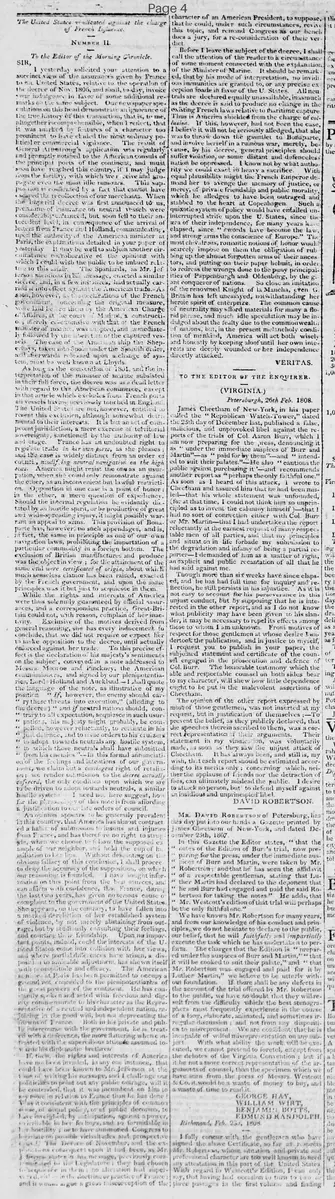
NUMBER II.
To the Editor of the Morning Chronicle.
SIR,
I yesterday solicited your attention to a succinct view of the assurances given by France to the United States, relative to the operation of the decree of Nov. 1806, and shall, to-day, invoke your indulgence in favor of some additional remarks on the same subject. Our newspaper speculations on this head demonstrate an ignorance of the true history of this transaction, that is altogether incomprehensible, when I reflect that it was marked by features of a character too prominent to have eluded the most ordinary political or commercial vigilance. The result of General Armstrong's application was regularly and promptly notified to the American consuls of the principal ports of the continent, and must soon have reached this country, if I may judge from the facility with which we receive and propagate even the most idle rumours. This supposition is confirmed by a fact that cannot have escaped the recollection of our merchants. When the imperial decree was first announced to us, premiums of insurance on neutral vessels were considerably advanced, but soon fell to their antecedent level, in consequence of the arrival of letters from France and Holland, communicating, upon the authority of the American minister at Paris, the explanations detailed in your paper of yesterday. It may be well to subjoin another circumstance corroborative of the opinions with which I could wish the public to be imbued relative to this affair. The Spaniards, as Mr. Jefferson mentions in his message, enacted a similar decree, and, in a few instances, had actually carried it into effect against the American trade. As soon, however, as the declarations of the French government concerning the original measure were laid before them by the American Charge d'Affaires, at the court of Madrid, a construction, perfectly co-extensive with that of the French minister of marine, was adopted, and immediately followed by the restoration of the captured vessels. The case of the American ship the Shepherdess, taken into Spain under the Spanish order, and afterwards released upon a change of system, must be well known at Lloyd's.
As long as the convention of 1800, and the interpretation of the minister of marine subsisted in their full force, the decree was as a dead letter with regard to the American commerce, except in that article which excludes from French ports all vessels having previously touched in England. The United States are not, however, entitled to resent this exclusion, although somewhat detrimental to their interests. It is but an act of competent jurisdiction, a mere exercise of territorial sovereignty, sanctioned by the authority of law and usage.
France has an undoubted right to regulate trade in her own ports, as she pleases; and the case is widely distinct from an order of council, modifying neutral navigation on the high seas. America might resist the one as an usurpation, when she could only remonstrate against the other, as an inconvenient but lawful restriction. Opposition in one case is a point of honor: in the other, a mere question of expediency.
Should the internal regulation be evidently dictated by an hostile spirit, or be productive of great and wide-spreading injury, it might possibly warrant an appeal to arms. This provision of Bonaparte has, however, no such appendages, and is, in fact, the same in principle as one of our own navigation laws, prohibiting the importation of a particular commodity in a foreign bottom. The exclusion of British manufactures and produce was the object in view; for the attainment of the same end were certificates of origin, about which much senseless clamor has been raised, exacted by the French government, and upon the same principles was it but just to acquiesce in them.
While the rights and interests of America were thus solemnly guaranteed by official assurances, and a correspondent practice, Great Britain could not, with reason, complain of her inactivity. Exclusive of the motives derived from general reasoning, she has every inducement to conclude, that we did not require or expect her to make opposition to the decree, until actually enforced against her trade. To this precise effect is the declaration of his majesty's sentiments on the subject, conveyed in a note addressed to Messrs. Monroe and Pinckney, the American commissioners, and signed by our plenipotentiaries, Lords Holland and Auckland. I shall quote the language of the note, as illustrative of my position: "If, however, the enemy should carry these threats into execution," (alluding to the decree) "and if neutral nations should, contrary to all expectation, acquiesce in such usurpations, his majesty might probably be compelled, however reluctantly, to retaliate in his just defence, and to issue orders to his cruisers to adopt towards neutrals any hostile system, to which those neutrals shall have submitted from their enemies." In this formal annunciation of the feelings and intentions of our government, we claim but a contingent right of retaliation: we render submission to the decree actually enforced, the only condition upon which we are to be driven to adopt towards neutrals, a similar hostile system. I need not here suggest, how far the phraseology of this note is from affording a justification to our late orders of council.
An opinion appears to be generally prevalent in this country, that America has almost contracted a habit of submission to insults and injuries from France, and has therefore no right to struggle, when we choose to follow the supposed example of our neighbor, and hold the cup of humiliation to her lips. Without descanting on the obvious fallacy of this conclusion, I shall proceed to deny the accuracy of the supposition, on which our reasoning is founded. I have sought information on this point from the best sources, and can affirm with confidence, that France, during the last two years, has given no serious cause of complaint to the government of the United States. She appears, on the contrary, to have fallen into a marked dereliction of her established system of violence, by not merely abstaining from outrage, but by studiously consulting their feelings, and courting their friendship. Upon no important points, indeed, could the interests of the United States come into collision with her views, and where partial differences have arisen, a disposition to amicable adjustment has shown itself with promptitude and efficacy. The American minister at Paris has been permitted to occupy a ground not conceded to the plenipotentiaries of the great powers of the continent. He has constantly spoken and acted with freedom and dignity commensurate to his character as the Representative of a neutral and independent nation, reposing in the good will, but not deprecating the frowns of France. Both in his private and public intercourse with the government, he is treated with a deference, the more flattering when contrasted with the supercilious attitude assumed towards his diplomatic brethren.
If, then, the rights and interests of America have not been invaded, in any one instance, that could have been known to Mr. Jefferson at the time of writing his message, and I challenge our journalists to point out any public outrage, will it be contended, that it was incumbent on him to say more in relation to France than he has done? Was it consistent with the principles of common sense, of sound policy, or of public decorum, to have inveighed, by anticipation, against a power, so irritable in her feelings, and so formidable in her hostility; or to have summoned Congress to legislate on possible vicissitudes and prospective contingencies? The Decree of November, and the exactions consequent upon it had been, as Mr. Jefferson states in his message, previously communicated to the Legislature. They had chosen to requiesce in them. No allegation had supervened, either in doctrine or practice of France: and it would argue a gross misconception of the character of an American President, to suppose, that he could, under such circumstances, revive this topic, and remand Congress, as our bench does a jury, for a re-consideration of their verdict.
Before I leave the subject of the decree, I shall call the attention of the reader to a circumstance of some moment connected with the explanation of the Minister of Marine. It should be remarked, that by his mode of interpretation, no invidious immunities are granted to, or any precise exception made in favor of the U. States. All neutrals are declared equally unassailable, inasmuch as the decree is said to produce no change in the existing French laws relative to maritime capture. Thus is America shielded from the charge of collusion. If this, however, had not been the case, I believe it will not be seriously alleged, that she was to throw down the gauntlet to Bonaparte, and involve herself in a ruinous war, merely, because, by his decree, general principles should suffer violation, or some distant and defenceless nation be oppressed. I know not by what authority we could exact so heavy a sacrifice. With equal plausibility might the French Emperor demand her to avenge the memory of justice, or mercy, of private friendship and public morality, which he alleges to have been outraged and stabbed to the heart at Copenhagen. Such a quixotic system of policy would have entailed uninterrupted strife upon the U. States, since the era of their independence, for many years have elapsed, since "swords have become the law, and strong arms the conscience of Europe." The most chivalrous, romantic notions of honor would scarcely impose on them the obligation of rubbing up the almost forgotten arms of their ancestors, and putting on their paper helmet, in order to redress the wrongs done to the puny principalities of Pappenburgh and Oldenburg, by the giant conqueror of nations.
So close an imitation of the renowned Knight of la Mancha, even Great Britain has left unessayed, notwithstanding her heroic spirit of enterprize. The common cause of neutrality may afford materials for many a florid phrase, and much idle speculation may be indulged about the fealty due to the commonwealth of nations, but, in the present melancholy condition of mankind, America will act both wisely and honestly by keeping aloof until her own interests are deeply wounded or her independence directly attacked.
VERITAS.
What sub-type of article is it?
What themes does it cover?
What keywords are associated?
What entities or persons were involved?
Letter to Editor Details
Author
Veritas
Recipient
Editor Of The Morning Chronicle
Main Argument
the united states has not submitted to french influence regarding the november 1806 decree, as official french assurances ensured it did not affect american commerce, and the us prudently chose remonstration over resistance, unlike britain's high-seas actions; jefferson's message reflected this reality without need for further alarm.
Notable Details