Thank you for visiting SNEWPapers!
Sign up free
The Daily Phoenix
Columbia, Richland County, South Carolina
What is this article about?
Citizens of New York write to President Andrew Johnson on June 24, requesting permission to present his name as a candidate for the Presidency at the Democratic Convention. Johnson replies on July 2, expressing reluctance unless there is strong public endorsement, while defending his constitutional stance against congressional opposition.
Clipping
OCR Quality
Full Text
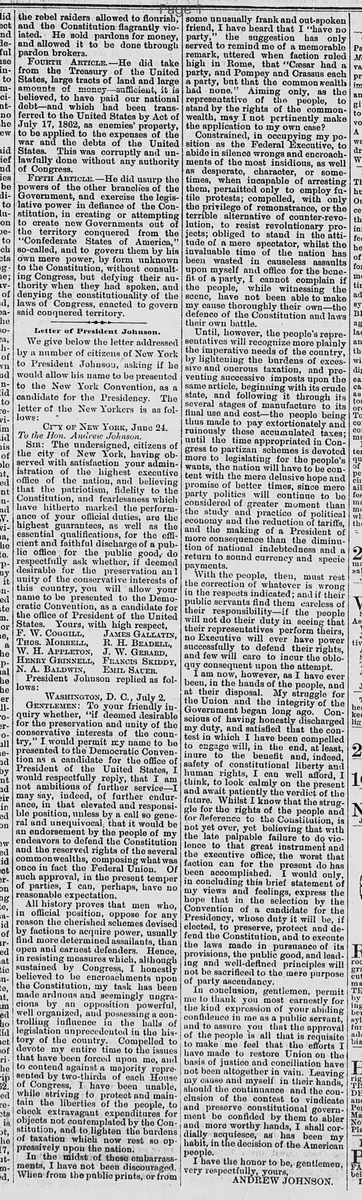
We give below the letter addressed by a number of citizens of New York to President Johnson, asking if he would allow his name to be presented to the New York Convention, as a candidate for the Presidency. The letter of the New Yorkers is as follows:
City of New York, June 24.
To the Hon. Andrew Johnson.
SIR: The undersigned, citizens of the city of New York, having observed with satisfaction your administration of the highest executive office of the nation, and believing that the patriotism, fidelity to the Constitution, and fearlessness which have hitherto marked the performance of your official duties, are the highest guarantees, as well as the essential qualifications, for the efficient and faithful discharge of a public office: for the public good, do respectfully ask whether, if deemed desirable for the preservation and unity of the conservative interests of this country, you will allow your name to be presented to the Democratic Convention, as a candidate for the office of President of the United States. Yours, with high respect,
F. W. COGGILL,
JAMES GALLATIN,
THOS. MORRELL,
R. H. BEADELL,
W. H. APPLETON,
J. W. GERARD,
HENRY GRINNELL,
FRANCIS SKIDDY,
N. A. BALDWIN,
EMIL SAUER.
President Johnson replied as follows:
WASHINGTON, D. C., July 2.
GENTLEMEN: To your friendly inquiry whether, "if deemed desirable for the preservation and unity of the conservative interests of the country," I would permit my name to be presented to the Democratic Convention as a candidate for the office of President of the United States, I would respectfully reply, that I am not ambitious of further service--I may say, indeed, of further endurance, in that elevated and responsible position, unless by a call so general and unequivocal, that it would be an endorsement by the people of my endeavors to defend the Constitution and the reserved rights of the several commonwealths, composing what was once in fact the Federal Union. Of such approval, in the present temper of parties, I can, perhaps, have no reasonable expectation.
All history proves that men who, in official position, oppose for any reason the cherished schemes devised by factions to acquire power, usually find more determined assailants, than open and earnest defenders. Hence, in resisting measures which, although sustained by Congress, I honestly believed to be encroachments upon the Constitution, my task has been made arduous and seemingly ungracious by an opposition powerful, well organized, and possessing a controlling influence in the halls of legislation unprecedented in the history of the country. Compelled to devote my entire time to the issues that have been forced upon me, and to contend against a majority represented by two-thirds of each House of Congress, I have been unable, while striving to protect and maintain the liberties of the people, to check extravagant expenditures for objects not contemplated by the Constitution, and to lighten the burdens of taxation which now rest so oppressively upon the nation.
In the midst of these embarrassments, I have not been discouraged. When from the public prints, or from some unusually frank and out-spoken friend, I have heard that I "have no party," the suggestion has only served to remind me of a memorable remark, uttered when faction ruled high in Rome, that "Cæsar had a party, and Pompey and Crassus each a party, but that the common wealth had none." Aiming only, as the representative of the people, to stand by the rights of the commonwealth, may I not pertinently make the application to my own case?
Constrained, in occupying my position as the Federal Executive, to abide in silence wrongs and encroachments of the most insidious, as well as desperate, character, or sometimes, when incapable of arresting them, permitted only to employ futile protests; compelled, with only the privilege of remonstrance, or the terrible alternative of counter-revolution, to resist revolutionary projects; obliged to stand in the attitude of a mere spectator, whilst the invaluable time of the nation has been wasted in causeless assaults upon myself and office for the benefit of a party, I cannot complain if the people, while witnessing the scene, have not been able to make my cause thoroughly their own--the defence of the Constitution and laws their own battle.
Until, however, the people's representatives will recognize more plainly the imperative needs of the country, by lightening the burdens of excessive and onerous taxation, and preventing successive imposts upon the same article, beginning with its crude state, and following it through its several stages of manufacture to its final use and cost--the people being thus made to pay extortionately and ruinously these accumulated taxes; until the time appropriated in Congress to partizan schemes is devoted more to legislating for the people's wants, the nation will have to be content with the mere delusive hope and promise of better times, since mere party politics will continue to be considered of greater moment than the study and practice of political economy and the reduction of tariffs, and the making of a President of more consequence than the diminution of national indebtedness and a return to sound currency and specie payments.
With the people, then, must rest the correction of whatever is wrong in the respects indicated; and if their public servants find them careless of their responsibility--if the people will not do their duty in seeing that their representatives perform theirs, no Executive will ever have power successfully to defend their rights, and few will care to incur the obloquy consequent upon the attempt.
I am now, however, as I have ever been, in the hands of the people, and at their disposal. My struggle for the Union and the integrity of the Government began long ago. Conscious of having honestly discharged my duty, and satisfied that the contest in which I have been compelled to engage will, in the end, at least, inure to the benefit and, indeed, safety of constitutional liberty and human rights, I can well afford, I think, to look calmly on the present and await patiently the verdict of the future. Whilst I know that the struggle for the rights of the people and for deference to the Constitution, is not yet over, yet believing that with the late palpable failure to do violence to that great instrument and the executive office: the worst that faction can for the present do has been accomplished. I would only, in concluding this brief statement of my views and feelings, express the hope that in the selection by the Convention of a candidate for the Presidency, whose duty it will be, if elected, to preserve, protect and defend the Constitution, and to execute the laws made in pursuance of its provisions, the public good, and leading and well-defined principles will not be sacrificed to the mere purpose of party ascendancy.
In conclusion, gentlemen, permit me to thank you most earnestly for the kind expression of your abiding confidence in me as a public servant, and to assure you that the approval of the people is all that is requisite to make me feel that the efforts I have made to restore Union on the basis of justice and conciliation have not been altogether in vain. Leaving my cause and myself in their hands, should the continuance and the conclusion of the contest to vindicate and preserve constitutional government be confided by them to abler and more worthy hands, I shall cordially acquiesce, as has been my habit, in the decision of the American people.
I have the honor to be, gentlemen,
very respectfully, yours,
ANDREW JOHNSON.
What sub-type of article is it?
What themes does it cover?
What keywords are associated?
What entities or persons were involved?
Where did it happen?
Story Details
Key Persons
Location
City Of New York; Washington, D. C.
Event Date
June 24; July 2
Story Details
New York citizens request President Johnson to allow his name for Democratic presidential candidacy; he replies he would only if there is unequivocal public support, detailing his struggles defending the Constitution against congressional opposition and party factions.