Thank you for visiting SNEWPapers!
Sign up free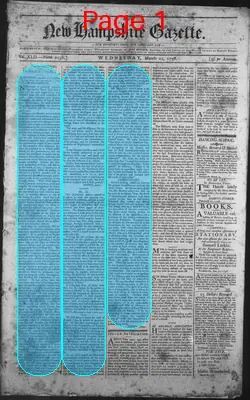
Editorial
March 21, 1798
The New Hampshire Gazette
Portsmouth, Rockingham County, New Hampshire
What is this article about?
Editorial by 'Scipio, junior' in The Sentinel critiques James Munroe's conduct as US minister to France, using his own letters to expose inconsistencies, infidelity to Washington, and ties between US opposition and French Jacobins, defending the administration's recall of him.
Merged-components note: Direct continuation of the same editorial series 'The Felo de Se' by SCIPIO, junior, with sequential reading order and matching topic on Munroe's conduct.
Clipping
OCR Quality
95%
Excellent
Full Text
The SENTINEL
The Felo de Se. No. I
Or. MUNROE convicted of inconsistency, infidelity, and ingratitude; from his own DOCUMENTS.
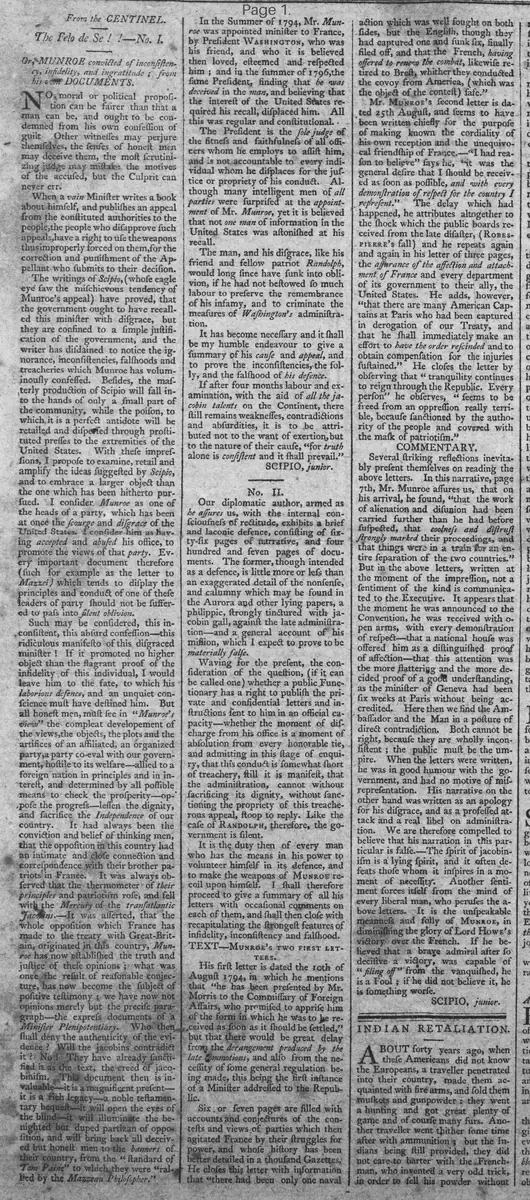
No moral or political proposition can be fairer than that a man can be, and ought to be condemned from his own confession of guilt. Other witnesses may perjure themselves, the senses of honest men may deceive them, the most scrutinizing judge may mistake the motives of the accused, but the Culprit can never err.
When a vain Minister writes a book about himself, and publishes an appeal from the constituted authorities to the people, the people who disapprove such appeals, have a right to use the weapons thus improperly forced on them, for the correction and punishment of the Appellant who submits to their decision.
The writings of Scipio, (whose eagle eye saw the mischievous tendency of Munroe's appeal) have proved, that the government ought to have recalled this minister with disgrace, but they are confined to a simple justification of the government, and the writer has disdained to notice the ignorance, inconsistencies, falsehoods and treacheries which Munroe has voluminously confessed. Besides, the masterly production of Scipio will fall into the hands of only a small part of the community, while the poison, to which it is a perfect antidote will be retailed and dispersed through prostitute presses to the extremities of the United States. With these impressions, I propose to examine, retail and amplify the ideas suggested by Scipio, and to embrace a larger object than the one which has been hitherto pursued. I consider Munroe as one of the heads of a party, which has been at once the scourge and disgrace of the United States. I consider him as having accepted and abused his office, to promote the views of that party. Every important document therefore (such for example as the letter to Mazzei) which tends to display the principles and conduct of one of these leaders of party should not be suffered to pass into silent oblivion.
Such may be considered, this inconsistent, this absurd confession--this ridiculous manifesto of this disgraced minister! If it promoted no higher object than the flagrant proof of the infidelity of this individual, I would leave him to the fate, to which his laborious defence, and an unquiet conscience must have destined him. But all honest men, must see in "Munroe's View" the complete development of the views, the objects, the plots and the artifices of an affiliated, an organized party, a party co-eval with our government, hostile to its welfare--allied to a foreign nation in principles and in interest, and determined by all possible means to check the prosperity--oppose the progress--lessen the dignity, and sacrifice the Independence of our country. It had always been the conviction and belief of thinking men, that the opposition in this country had an intimate and close connection and correspondence with their brother patriots in France. It was always observed that the thermometer of their principles and patriotism rose and fell with the Mercury of the transatlantic Jacobins.--It was asserted, that the whole opposition which France has made to the treaty with Great-Britain, originated in this country, Munroe has now established the truth and justice of these opinions; what was once the result of reasonable conjecture, has now become the subject of positive testimony; we have now not opinions merely but the precise paragraph--the express documents of a Minister Plenipotentiary. Who then shall deny the authenticity of the evidence? Will the jacobins contradict it? No! They have already sanctified it as the text, the creed of jacobinsim. This document then is invaluable it is a magnificent present-- it is a rich legacy--a noble testamentary bequest it will open the eyes of the blind it will illuminate the benighted but duped partizan of opposition, and will bring back all deceived but honest men to the banners of their country, from the " standard of Tom Paine" to which they were "rallied by the Mazzeau Philosopher."
In the Summer of 1794, Mr. Munroe was appointed minister to France, by President Washington, who was his friend, and who it is believed then loved, esteemed and respected him; and in the summer of 1796, the same President, finding that he was deceived in the man, and believing that the interest of the United States required his recall, displaced him. All this was regular and constitutional.
The President is the sole judge of the fitness and faithfulness of all officers whom he employs to assist him, and is not accountable to every individual whom he displaces for the justice or propriety of his conduct. Although many intelligent men of all parties were surprised at the appointment of Mr. Munroe, yet it is believed that not one man of information in the United States was astonished at his recall.
The man, and his disgrace, like his friend and fellow patriot Randolph, would long since have sunk into oblivion, if he had not bestowed so much labour to preserve the remembrance of his infamy, and to criminate the measures of Washington's administration.
It has become necessary and it shall be my humble endeavour to give a summary of his cause and appeal, and to prove the inconsistencies,--the folly, and the falsehood of his defence. If after four months labour and examination, with the aid of all the jacobin talents on the Continent, there still remains weaknesses, contradictions and absurdities, it is to be attributed not to the want of exertion, but to the nature of their cause, "for truth alone is consistent and it shall prevail."
SCIPIO, junior.
No. II.
Our diplomatic author, armed as he assures us, with the internal consciousness of rectitude, exhibits a brief and laconic defence, consisting of sixty-six pages of narrative, and four hundred and seven pages of documents. The former, though intended as a defence, is little more or less than an exaggerated detail of the nonsense, and calumny which may be found in the Aurora and other lying papers, a philippic, strongly tinctured with jacobin gall, against the late administration--and a general account of his mission, which I expect to prove to be materially false.
Waving for the present, the consideration of the question, (if it can be called one) whether a public Functionary has a right to publish the private and confidential letters and instructions sent to him in an official capacity--whether the moment of discharge from his office is a moment of absolution from every honorable tie, and admitting in this stage of enquiry, that this conduct is somewhat short of treachery, still it is manifest, that the administration, cannot without sacrificing its dignity,, without aneaning the propriety of this treacherous appeal, stoop to reply. Like the case of RanDolph, therefore, the government is silent.
It is the duty then of every man who has the means in his power to volunteer himself in its defence, and to make the weapons of MuNroe recoil upon himself. I shall therefore proceed to give a summary of all his letters with occasional comments on each of them, and shall then close with recapitulating the strongest features of infidelity, inconsistency and falsehood.
TEXT -MuNROE'S TWO FIRST LETTERS.
His first letter is dated the 10th of August 1794, in which he mentions that "he has been presented by Mr. Morris to the Minister of Foreign Affairs, who promised to apprise him of the form in which he was to be received as soon as it should be settled," but that there would be great delay from the derangement produced by the late commotions, and also from the necessity of some general regulation being made, this being the first instance of a Minister addressed to the Republic.
Six or seven pages are filled with accounts and conjectures of the contests and views of parties which then agitated France by their Struggles for power, and whose history has been better detailed in a thousand Gazettes.
He closes this letter with information that "there had been only one naval
action which was well fought on both sides,--but the English, though they had captured one and sunk six, finally filed off, and that the French, having offered to renew the combat, likewise retired to Brest, whither they conducted the convoy from America, (which was the object of the contest) safe."
Mr. Munroe's second letter is dated 25th August, and seems to have been written chiefly for the purpose of making known the cordiality of his own reception and the unequivocal friendship of France.--"I had reason to believe" says he, it was the general desire that I should be received as soon as possible, and with every demonstration of respect for the country I represent." The delay which had happened, he attributes altogether to the shock which the public boards received from the late disaster, (RoBES-PIERRe's fall)and he repeats again and again in his letter of three pages, the assurance of the affection and attachment of France and every department of its government to their ally, the United States. He adds, however, "that there are many American Captains at Paris who had been captured in derogation of our Treaty, and that he shall immediately make an effort to have the order rescinded and to obtain compensation for the injuries sustained." He closes the letter by observing that " tranquility continues to reign through the Republic. Every person" he observes, " seems to be freed from an oppression really terrible, because sanctioned by the authority of the people and covered with the mask of patriotism."
COMMENTARY.
Several striking reflections inevitably present themselves on reading the above letters. In this narrative, page 7th, Mr. Munroe assures us, that on his arrival, he found, "that the work of alienation and disunion had been carried further than he had before suspected, that coolness and distrust strongly marked their proceedings, and that things were in a train for an entire separation of the two countries."
But in the above letters, written at the moment of the impression, not a sentiment of the kind is communicated to the Executive. It appears that the moment he was announced to the Convention, he was received with open arms, with every demonstration of respect--that a national house was offered him as a distinguished proof of affection--that this attention was the more flattering and the more decided proof of a good understanding, as the minister of Geneva had been six weeks at Paris without being accredited, Here then we find the Ambassador and the Man in a posture of direct contradiction. Both cannot be right, because they are wholly inconsistent ; the public must be the umpire. When the letters were written, he was in good humour with the government, and had no motive of misrepresentation. His narrative on the other hand was written as an apology for his disgrace, and as a professed attack and a real libel on administration. We are therefore compelled to believe that his narration in this particular is false.--The spirit of jacobinsim is a lying spirit, and it often defeats those whom it inspires in a moment of necessity. Another sentiment forces itself from the mind of every liberal man, who peruses the above letters. It is the unspeakable meanness and folly of, Munroe, in diminishing the glory of Lord Howe's victory over the French. If he believed that a brave admiral after so decisive a victory, was capable of " filing off" from the vanquished, he is a Fool ; if he did not believe it, he is something worse.
SCIPIO, junior.
The Felo de Se. No. I
Or. MUNROE convicted of inconsistency, infidelity, and ingratitude; from his own DOCUMENTS.
No moral or political proposition can be fairer than that a man can be, and ought to be condemned from his own confession of guilt. Other witnesses may perjure themselves, the senses of honest men may deceive them, the most scrutinizing judge may mistake the motives of the accused, but the Culprit can never err.
When a vain Minister writes a book about himself, and publishes an appeal from the constituted authorities to the people, the people who disapprove such appeals, have a right to use the weapons thus improperly forced on them, for the correction and punishment of the Appellant who submits to their decision.
The writings of Scipio, (whose eagle eye saw the mischievous tendency of Munroe's appeal) have proved, that the government ought to have recalled this minister with disgrace, but they are confined to a simple justification of the government, and the writer has disdained to notice the ignorance, inconsistencies, falsehoods and treacheries which Munroe has voluminously confessed. Besides, the masterly production of Scipio will fall into the hands of only a small part of the community, while the poison, to which it is a perfect antidote will be retailed and dispersed through prostitute presses to the extremities of the United States. With these impressions, I propose to examine, retail and amplify the ideas suggested by Scipio, and to embrace a larger object than the one which has been hitherto pursued. I consider Munroe as one of the heads of a party, which has been at once the scourge and disgrace of the United States. I consider him as having accepted and abused his office, to promote the views of that party. Every important document therefore (such for example as the letter to Mazzei) which tends to display the principles and conduct of one of these leaders of party should not be suffered to pass into silent oblivion.
Such may be considered, this inconsistent, this absurd confession--this ridiculous manifesto of this disgraced minister! If it promoted no higher object than the flagrant proof of the infidelity of this individual, I would leave him to the fate, to which his laborious defence, and an unquiet conscience must have destined him. But all honest men, must see in "Munroe's View" the complete development of the views, the objects, the plots and the artifices of an affiliated, an organized party, a party co-eval with our government, hostile to its welfare--allied to a foreign nation in principles and in interest, and determined by all possible means to check the prosperity--oppose the progress--lessen the dignity, and sacrifice the Independence of our country. It had always been the conviction and belief of thinking men, that the opposition in this country had an intimate and close connection and correspondence with their brother patriots in France. It was always observed that the thermometer of their principles and patriotism rose and fell with the Mercury of the transatlantic Jacobins.--It was asserted, that the whole opposition which France has made to the treaty with Great-Britain, originated in this country, Munroe has now established the truth and justice of these opinions; what was once the result of reasonable conjecture, has now become the subject of positive testimony; we have now not opinions merely but the precise paragraph--the express documents of a Minister Plenipotentiary. Who then shall deny the authenticity of the evidence? Will the jacobins contradict it? No! They have already sanctified it as the text, the creed of jacobinsim. This document then is invaluable it is a magnificent present-- it is a rich legacy--a noble testamentary bequest it will open the eyes of the blind it will illuminate the benighted but duped partizan of opposition, and will bring back all deceived but honest men to the banners of their country, from the " standard of Tom Paine" to which they were "rallied by the Mazzeau Philosopher."
In the Summer of 1794, Mr. Munroe was appointed minister to France, by President Washington, who was his friend, and who it is believed then loved, esteemed and respected him; and in the summer of 1796, the same President, finding that he was deceived in the man, and believing that the interest of the United States required his recall, displaced him. All this was regular and constitutional.
The President is the sole judge of the fitness and faithfulness of all officers whom he employs to assist him, and is not accountable to every individual whom he displaces for the justice or propriety of his conduct. Although many intelligent men of all parties were surprised at the appointment of Mr. Munroe, yet it is believed that not one man of information in the United States was astonished at his recall.
The man, and his disgrace, like his friend and fellow patriot Randolph, would long since have sunk into oblivion, if he had not bestowed so much labour to preserve the remembrance of his infamy, and to criminate the measures of Washington's administration.
It has become necessary and it shall be my humble endeavour to give a summary of his cause and appeal, and to prove the inconsistencies,--the folly, and the falsehood of his defence. If after four months labour and examination, with the aid of all the jacobin talents on the Continent, there still remains weaknesses, contradictions and absurdities, it is to be attributed not to the want of exertion, but to the nature of their cause, "for truth alone is consistent and it shall prevail."
SCIPIO, junior.
No. II.
Our diplomatic author, armed as he assures us, with the internal consciousness of rectitude, exhibits a brief and laconic defence, consisting of sixty-six pages of narrative, and four hundred and seven pages of documents. The former, though intended as a defence, is little more or less than an exaggerated detail of the nonsense, and calumny which may be found in the Aurora and other lying papers, a philippic, strongly tinctured with jacobin gall, against the late administration--and a general account of his mission, which I expect to prove to be materially false.
Waving for the present, the consideration of the question, (if it can be called one) whether a public Functionary has a right to publish the private and confidential letters and instructions sent to him in an official capacity--whether the moment of discharge from his office is a moment of absolution from every honorable tie, and admitting in this stage of enquiry, that this conduct is somewhat short of treachery, still it is manifest, that the administration, cannot without sacrificing its dignity,, without aneaning the propriety of this treacherous appeal, stoop to reply. Like the case of RanDolph, therefore, the government is silent.
It is the duty then of every man who has the means in his power to volunteer himself in its defence, and to make the weapons of MuNroe recoil upon himself. I shall therefore proceed to give a summary of all his letters with occasional comments on each of them, and shall then close with recapitulating the strongest features of infidelity, inconsistency and falsehood.
TEXT -MuNROE'S TWO FIRST LETTERS.
His first letter is dated the 10th of August 1794, in which he mentions that "he has been presented by Mr. Morris to the Minister of Foreign Affairs, who promised to apprise him of the form in which he was to be received as soon as it should be settled," but that there would be great delay from the derangement produced by the late commotions, and also from the necessity of some general regulation being made, this being the first instance of a Minister addressed to the Republic.
Six or seven pages are filled with accounts and conjectures of the contests and views of parties which then agitated France by their Struggles for power, and whose history has been better detailed in a thousand Gazettes.
He closes this letter with information that "there had been only one naval
action which was well fought on both sides,--but the English, though they had captured one and sunk six, finally filed off, and that the French, having offered to renew the combat, likewise retired to Brest, whither they conducted the convoy from America, (which was the object of the contest) safe."
Mr. Munroe's second letter is dated 25th August, and seems to have been written chiefly for the purpose of making known the cordiality of his own reception and the unequivocal friendship of France.--"I had reason to believe" says he, it was the general desire that I should be received as soon as possible, and with every demonstration of respect for the country I represent." The delay which had happened, he attributes altogether to the shock which the public boards received from the late disaster, (RoBES-PIERRe's fall)and he repeats again and again in his letter of three pages, the assurance of the affection and attachment of France and every department of its government to their ally, the United States. He adds, however, "that there are many American Captains at Paris who had been captured in derogation of our Treaty, and that he shall immediately make an effort to have the order rescinded and to obtain compensation for the injuries sustained." He closes the letter by observing that " tranquility continues to reign through the Republic. Every person" he observes, " seems to be freed from an oppression really terrible, because sanctioned by the authority of the people and covered with the mask of patriotism."
COMMENTARY.
Several striking reflections inevitably present themselves on reading the above letters. In this narrative, page 7th, Mr. Munroe assures us, that on his arrival, he found, "that the work of alienation and disunion had been carried further than he had before suspected, that coolness and distrust strongly marked their proceedings, and that things were in a train for an entire separation of the two countries."
But in the above letters, written at the moment of the impression, not a sentiment of the kind is communicated to the Executive. It appears that the moment he was announced to the Convention, he was received with open arms, with every demonstration of respect--that a national house was offered him as a distinguished proof of affection--that this attention was the more flattering and the more decided proof of a good understanding, as the minister of Geneva had been six weeks at Paris without being accredited, Here then we find the Ambassador and the Man in a posture of direct contradiction. Both cannot be right, because they are wholly inconsistent ; the public must be the umpire. When the letters were written, he was in good humour with the government, and had no motive of misrepresentation. His narrative on the other hand was written as an apology for his disgrace, and as a professed attack and a real libel on administration. We are therefore compelled to believe that his narration in this particular is false.--The spirit of jacobinsim is a lying spirit, and it often defeats those whom it inspires in a moment of necessity. Another sentiment forces itself from the mind of every liberal man, who peruses the above letters. It is the unspeakable meanness and folly of, Munroe, in diminishing the glory of Lord Howe's victory over the French. If he believed that a brave admiral after so decisive a victory, was capable of " filing off" from the vanquished, he is a Fool ; if he did not believe it, he is something worse.
SCIPIO, junior.
What sub-type of article is it?
Partisan Politics
Foreign Affairs
What keywords are associated?
Munroe Critique
French Alliance
Jacobin Opposition
Washington Administration
Diplomatic Recall
Partisan Infidelity
What entities or persons were involved?
James Munroe
President Washington
Scipio
French Jacobins
Tom Paine
Mazzei
Editorial Details
Primary Topic
Critique Of James Munroe's Inconsistencies And Ties To French Jacobins
Stance / Tone
Strongly Critical And Accusatory
Key Figures
James Munroe
President Washington
Scipio
French Jacobins
Tom Paine
Mazzei
Key Arguments
Munroe's Own Documents Convict Him Of Inconsistency And Infidelity
Us Opposition Party Allied With French Jacobins Hostile To American Interests
Washington's Recall Of Munroe Was Justified And Constitutional
Munroe's Narrative Contradicts His Contemporaneous Letters
Publication Of Confidential Documents Is Treacherous
Munroe Diminishes British Naval Victory, Showing Folly