Thank you for visiting SNEWPapers!
Sign up free
Editorial
June 5, 1816
Richmond Enquirer
Richmond, Richmond County, Virginia
What is this article about?
The New-York newspaper republishes part of William Cobbett's 'Introductory Address' from his Weekly Political Register (New York edition, Jan. 6, 1816), praising it as a champion of political truth. Cobbett denounces the British government as tyrannical, deceptive, and hypocritical, aiming to reveal its true nature to Americans and counter lingering admiration for it.
Clipping
OCR Quality
85%
Good
Full Text
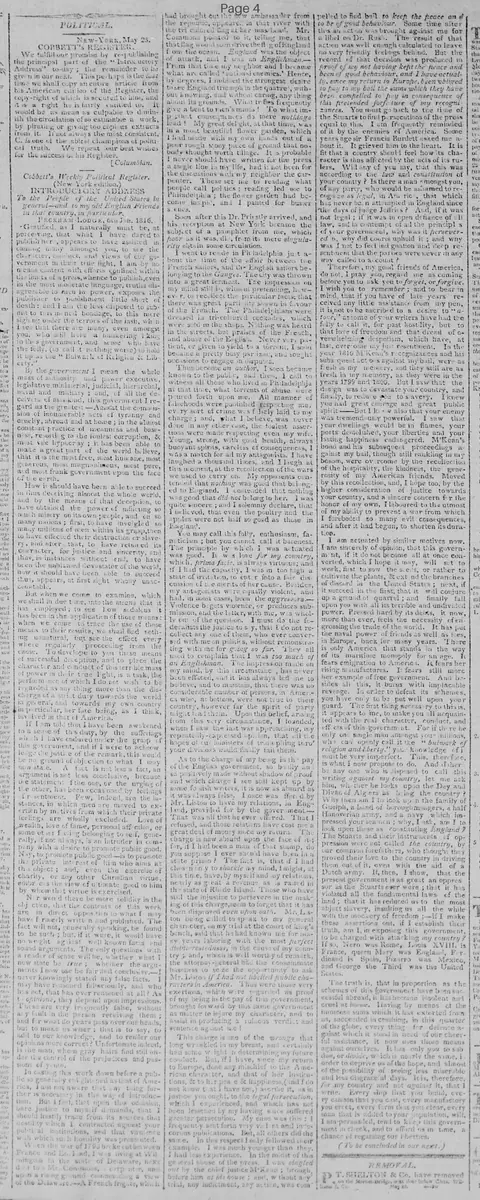
POLITICAL.
New-York, May 25.
CORBETT'S REGISTER.
We fulfill our promise by re-publishing the principal part of the "Introductory Address" to-day; the remainder to be given in our next. This perhaps is the last time we shall copy an entire article from his American edition of the Register, the copy-right of which is secured to him, and it is a right he is fairly entitled to. It would be as mean as culpable to diminish the circulation of so estimable a work, by pirating or giving too copious extracts from it. If not always the most consistent, C. is one of the ablest champions of political truth. We repeat our best wishes for the success of his Register.
[Columbian.
Cobbett's Weekly Political Register.
(New York edition.)
INTRODUCTORY ADDRESS
To the People of the United States in general—and to my old English Friends in that country, in particular.
PECKHAM-LODGE, 6th Jan. 1816.
Gratified, as I naturally must be, at perceiving, that what I have dared to publish here, appears to have assisted in causing many amongst you, to see the character, conduct, and views of our government in their true light, I am by no means content with efforts confined within the limits of a press, whence to publish, even in the most moderate language, truths disagreeable to men in power, exposes the publisher to punishment little short of death: and I am the less disposed to submit to this mended bondage, to this meanness under the terrors of the lash, when I see that there are many, even amongst you, who still have a hankering liking to this government, and some who have the folly, (to call it nothing worse) to hold it up as the "Bulwark of Religion & Liberty."
By the government I mean the whole mass of authority and power executive, legislative ministerial, judicial, hierachol, naval and military; and, of all the deceivers of mankind, this government I regard as the greatest—Amidst the Commission of innumerable acts of tyranny and cruelty, abroad and at home; in the almost constant practice of meanness and baseness, resorting to the foulest corruption, & most vile hypocrisy; it has been able to make a great part of the world believe, that it is the most free, most humane, most generous, most magnanimous, most pure, and most frank government upon the face of the earth.
How it should have been able to succeed in this deceiving almost the whole world, and by the means of that deception, to have obtained the power of inflicting so much misery on its own people, and on so many nations; first, to have inveigled so many millions of men within its grasp, then to have effected their destruction or slavery, and after that, to have retained its character, for justice and sincerity, and thus, in instances without end, to have been the unabashed devastator of the world, how it should have been able to succeed thus, appears, at first sight wholly unaccountable.
But when we come to examine, which we shall in due time, into the means that it has employed; to see how sedulous it has been in the application of those means: when we come to trace the use of those means to their results, we shall find nothing unnatural, but see the effect every where regularly proceeding from the cause. To develope to you these means of successful deception, and to place the character and conduct of this terrible mass of power in their true light, is a task, the performance of which I do not wish to be regarded as any thing more than the discharge of strict duty towards the world in general, and towards my own country in particular, her fate being, as I think, involved in that of America.
If I am told that I have been awakened to a sense of this duty, by the sufferings which I have endured under the grasp of this government, and if I were to acknowledge the justice of the remark, this would be no ground of objection to what I may now state. A fact is not less a fact, an argument is not less conclusive, because the statement of the one, or the urging of the other, has been occasioned by feelings or sentiment. Few, indeed, are the instances, in which men are moved to exertion by motives from which their private feelings are wholly excluded. Love of wealth, love of fame, personal affection, or some other feeling belonging to self, generally, if not always, is an intruder in company with a desire to promote public good. Nay, to promote public good—is to promote the private interest of him who aims at this object; and, even the exercise of charity, or any other Christian virtue, embraces the view of ultimate good to him by whom that virtue is exercised.
Nor would there be more solidity in the objection, that the contents of this work are in direct opposition to what I may have formerly written and published. The fact will not, generally speaking, be found to be such; but, if it were, it would have no weight against well known facts and sound arguments. The only questions with a reader of sense will be, whether what I now state be true; whether the arguments I now use be fair and conclusive.—I never knowingly stated any false facts. I may have reasoned fallaciously, and who has not, that has ever reasoned at all? As to chimeras, they depend upon impressions. These are very frequently false, without any fault in the person receiving them; and for what do years pass over our heads, but to make us wiser; that is to say, to add to our knowledge, and to render our opinions more correct? Unfortunate indeed, is the man, whom gray hairs find still under the control of the prejudices and passions of youth.
In casting this work down before a public so generally enlightened as that of America, I am not aware that any thing further is necessary in the way of introduction. But I feel, that upon this occasion, bare justice to myself demands, that I should hastily trace from its source that hostility which I contracted against your political institutions, and that violence with which such hostility was presented. When the war of 1793 broke out between France and England, I was living at Wilmington in the state of Delaware, next door to Mr. (now commons, crp at r, apd undarangg nndCormn Giga vew ofthe Dciaw it.-A French frigate, which
New-York, May 25.
CORBETT'S REGISTER.
We fulfill our promise by re-publishing the principal part of the "Introductory Address" to-day; the remainder to be given in our next. This perhaps is the last time we shall copy an entire article from his American edition of the Register, the copy-right of which is secured to him, and it is a right he is fairly entitled to. It would be as mean as culpable to diminish the circulation of so estimable a work, by pirating or giving too copious extracts from it. If not always the most consistent, C. is one of the ablest champions of political truth. We repeat our best wishes for the success of his Register.
[Columbian.
Cobbett's Weekly Political Register.
(New York edition.)
INTRODUCTORY ADDRESS
To the People of the United States in general—and to my old English Friends in that country, in particular.
PECKHAM-LODGE, 6th Jan. 1816.
Gratified, as I naturally must be, at perceiving, that what I have dared to publish here, appears to have assisted in causing many amongst you, to see the character, conduct, and views of our government in their true light, I am by no means content with efforts confined within the limits of a press, whence to publish, even in the most moderate language, truths disagreeable to men in power, exposes the publisher to punishment little short of death: and I am the less disposed to submit to this mended bondage, to this meanness under the terrors of the lash, when I see that there are many, even amongst you, who still have a hankering liking to this government, and some who have the folly, (to call it nothing worse) to hold it up as the "Bulwark of Religion & Liberty."
By the government I mean the whole mass of authority and power executive, legislative ministerial, judicial, hierachol, naval and military; and, of all the deceivers of mankind, this government I regard as the greatest—Amidst the Commission of innumerable acts of tyranny and cruelty, abroad and at home; in the almost constant practice of meanness and baseness, resorting to the foulest corruption, & most vile hypocrisy; it has been able to make a great part of the world believe, that it is the most free, most humane, most generous, most magnanimous, most pure, and most frank government upon the face of the earth.
How it should have been able to succeed in this deceiving almost the whole world, and by the means of that deception, to have obtained the power of inflicting so much misery on its own people, and on so many nations; first, to have inveigled so many millions of men within its grasp, then to have effected their destruction or slavery, and after that, to have retained its character, for justice and sincerity, and thus, in instances without end, to have been the unabashed devastator of the world, how it should have been able to succeed thus, appears, at first sight wholly unaccountable.
But when we come to examine, which we shall in due time, into the means that it has employed; to see how sedulous it has been in the application of those means: when we come to trace the use of those means to their results, we shall find nothing unnatural, but see the effect every where regularly proceeding from the cause. To develope to you these means of successful deception, and to place the character and conduct of this terrible mass of power in their true light, is a task, the performance of which I do not wish to be regarded as any thing more than the discharge of strict duty towards the world in general, and towards my own country in particular, her fate being, as I think, involved in that of America.
If I am told that I have been awakened to a sense of this duty, by the sufferings which I have endured under the grasp of this government, and if I were to acknowledge the justice of the remark, this would be no ground of objection to what I may now state. A fact is not less a fact, an argument is not less conclusive, because the statement of the one, or the urging of the other, has been occasioned by feelings or sentiment. Few, indeed, are the instances, in which men are moved to exertion by motives from which their private feelings are wholly excluded. Love of wealth, love of fame, personal affection, or some other feeling belonging to self, generally, if not always, is an intruder in company with a desire to promote public good. Nay, to promote public good—is to promote the private interest of him who aims at this object; and, even the exercise of charity, or any other Christian virtue, embraces the view of ultimate good to him by whom that virtue is exercised.
Nor would there be more solidity in the objection, that the contents of this work are in direct opposition to what I may have formerly written and published. The fact will not, generally speaking, be found to be such; but, if it were, it would have no weight against well known facts and sound arguments. The only questions with a reader of sense will be, whether what I now state be true; whether the arguments I now use be fair and conclusive.—I never knowingly stated any false facts. I may have reasoned fallaciously, and who has not, that has ever reasoned at all? As to chimeras, they depend upon impressions. These are very frequently false, without any fault in the person receiving them; and for what do years pass over our heads, but to make us wiser; that is to say, to add to our knowledge, and to render our opinions more correct? Unfortunate indeed, is the man, whom gray hairs find still under the control of the prejudices and passions of youth.
In casting this work down before a public so generally enlightened as that of America, I am not aware that any thing further is necessary in the way of introduction. But I feel, that upon this occasion, bare justice to myself demands, that I should hastily trace from its source that hostility which I contracted against your political institutions, and that violence with which such hostility was presented. When the war of 1793 broke out between France and England, I was living at Wilmington in the state of Delaware, next door to Mr. (now commons, crp at r, apd undarangg nndCormn Giga vew ofthe Dciaw it.-A French frigate, which
What sub-type of article is it?
Foreign Affairs
Partisan Politics
Press Freedom
What keywords are associated?
British Government
Deception
Tyranny
Political Register
Cobbett
American Edition
Press Freedom
Political Truth
What entities or persons were involved?
British Government
William Cobbett
Editorial Details
Primary Topic
Criticism Of The British Government
Stance / Tone
Strongly Anti British Government
Key Figures
British Government
William Cobbett
Key Arguments
British Government Is The Greatest Deceiver Of Mankind Through Tyranny, Cruelty, Corruption, And Hypocrisy
It Has Deceived The World Into Believing It Is Free And Humane While Inflicting Misery
Cobbett's Duty To Reveal These Deceptions To Americans And The World
Personal Sufferings Under The Government Motivate But Do Not Invalidate His Arguments
Past Writings May Differ, But Truth And Sound Arguments Prevail Over Consistency