Thank you for visiting SNEWPapers!
Sign up free
Palladium Of Virginia And The Pacific Monitor
Lewisburg, Greenbrier County, West Virginia
What is this article about?
In a dream inspired by Burns' poetry, the author imagines a conversation between the Methodist and Presbyterian churches arguing over doctrine, interrupted by the Court House urging unity, charity, and less sectarian rivalry to avoid harming religion.
Merged-components note: This is a single letter to the editor split across two components due to parsing boundaries.
Clipping
OCR Quality
Full Text
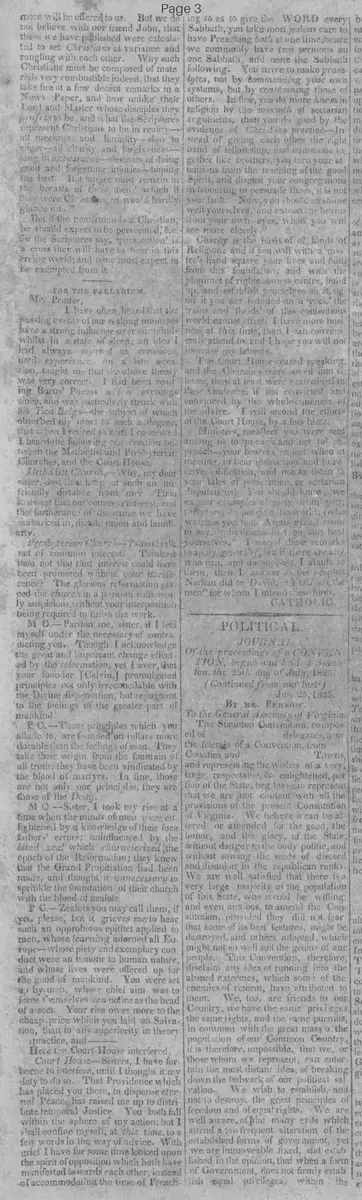
Mr. Printer,
I have often heard that the passing events of our waking moments have a strong influence over our minds whilst in a state of sleep; an idea I had always rejected as erroneous, until experience, on a late occasion, taught me that the above theory was very correct. I had been reading Burns' Poems a few evenings since, and was particularly struck with his 'Twa Brigs'--the subject of which absorbed my ideas to such a degree, that when I retired to rest, I conceived I heard the following conversation between the Methodist and Presbyterian Churches, and the Court House.
Methodist Church,--Why, my dear sister, dost thou keep at such an unfriendly distance from me? Thou knowest that our common interest, and the furtherance of the cause we have embarked in, dictate union and familiarity.
Presbyterian Church--Pshaw! talk not of common interest. Thinkest thou not that that interest could have been promoted without your interference? The glorious reformation placed the church in a position sufficiently auspicious, without your interposition being required to finish the work.
M. C.--Pardon me, sister, if I feel myself under the necessity of contradicting you. Though I acknowledge the great and important change effected by the reformation, yet I aver, that your founder [Calvin] promulgated principles not only irreconcilable with the Divine dispensation, but repugnant to the feelings of the greater part of mankind.
P. C.--Those principles which you allude to, are founded on pillars more durable than the feelings of men. They take their origin from the fountain of all truth; they have been vindicated by the blood of martyrs. In fine, those are not only our principles, they are those of the Deity.
M. C.--Sister, I took my rise at a time when the minds of men were enlightened by a knowledge of their forefathers' errors; and influenced by the blind zeal which characterized the epoch of the Reformation; they knew that the Grand Propitiation had been made, and thought it unnecessary to sprinkle the foundation of their church with the blood of zealots.
P. C.--Zealots you may call them, if you please, but it grieves me to hear such an opprobrious epithet applied to men, whose learning adorned all Europe--whose piety and exemplary conduct were an honour to human nature, and whose lives were offered up for the good of mankind. You were set up by men, whose chief aim was to force themselves into notice as the head of a sect. Your rise owes more to the cheap price which you laid on Salvation, than to any superiority in theory or practice, and--
Here the Court House interfered,
Court House--Sisters, I have forborne to interfere, until I thought it my duty to do so. That Providence which has placed you there, to dispense eternal Peace, has raised me up to distribute temporal Justice. You both fall within the sphere of my action; but I shall confine myself, at this time, to a few words in the way of advice. With grief I have for some time looked upon the spirit of opposition which both have manifested towards each other; instead of accommodating the time of Preaching so as to give the WORD every Sabbath, you take most jealous care to have Preaching both at one time; hence we commonly have two sermons on one Sabbath, and none the Sabbath following. You strive to make proselytes, not by commending your own systems, but by condemning those of others. In fine, you do more harm in religion by the warmth of sectarian arguments, than you do good by the evidence of Christian practice--Instead of giving each other the right hand of fellowship, and coming together like brothers, you turn your attentions from the teaching of the good Spirit, and disgust your congregations in labouring to persuade them, it is not your fault. Now, you should examine well yourselves, "and extract the beam from your own eyes, when you will see more clearly."
Charity is the basis of all kinds of Religion: and if you will with a master's hand square your lives and faith from this foundation, and with the plummet of righteousness centre, build up, and establish yourselves on it, then you are founded on a rock' the rains and floods' of this contentious world cannot affect. I have more business at this time, than I can conveniently attend to, and I hope you will not increase my labours.
The Court House ceased speaking, and the Churches were awed into silence, they at least were restrained in their virulence, if not convicted and convinced by the wholesomeness of the advice. I will second the efforts of the Court House, by a few hints: Ministers, recollect you were sent among us to preach and not to re-preach--your hearers expect when at meeting, to hear instruction and to receive edification, and not to listen to your tales of persecution, or sectarian disputations! you should know, we expect examples of piety from you; therefore, do not give the world, (who watches you with Argus eyes) room to say, "physicians heal yourselves." I intend these remarks to apply generally, but if there are any who can, and do suppose I allude to them, then I am even as the prophet Nathan did to David, "You are the men" for whom I intend these hints.
What sub-type of article is it?
What themes does it cover?
What keywords are associated?
What entities or persons were involved?
Letter to Editor Details
Recipient
Mr. Printer
Main Argument
the letter satirizes sectarian rivalry between methodist and presbyterian churches through a dream conversation, with the court house advising unity, charity, and focus on christian practice over disputes to benefit religion and congregations.
Notable Details