Thank you for visiting SNEWPapers!
Sign up free
Editorial
April 22, 1789
Gazette Of The United States
New York, New York County, New York
What is this article about?
In 'The Tablet' No. III, the author recounts a conversation with two foreigners explaining why U.S. citizens engage in speculative debates: the free nature of government allowing participation in legislation and religion, plus historical circumstances fostering altercation, which ultimately preserves liberty through reflection and toleration.
Clipping
OCR Quality
98%
Excellent
Full Text
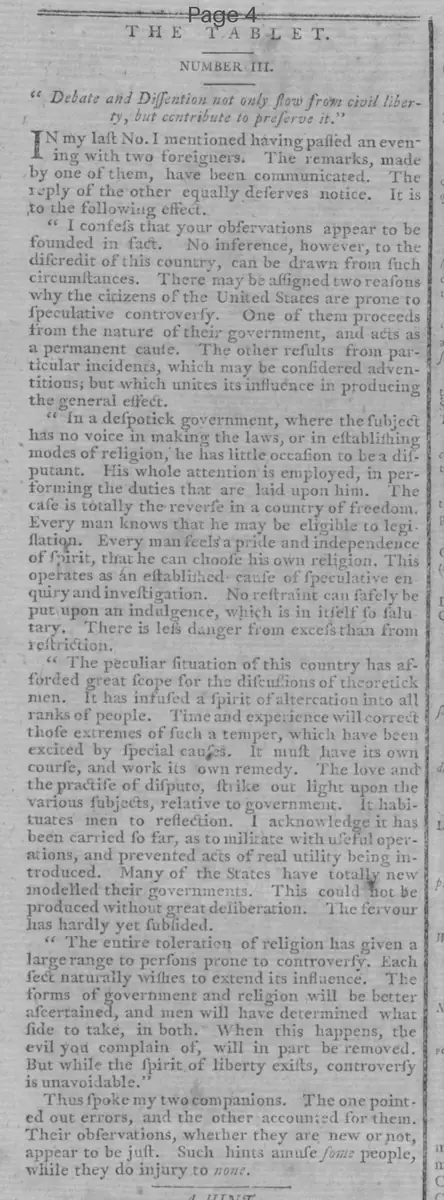
THE TABLET.
NUMBER III.
"The Debate and Dissension not only flow from civil liberty, but contribute to preserve it."
IN my last No. I mentioned having passed an evening with two foreigners. The remarks, made by one of them, have been communicated. The reply of the other equally deserves notice. It is to the following effect.
"I confess that your observations appear to be founded in fact. No inference, however, to the discredit of this country, can be drawn from such circumstances. There may be assigned two reasons why the citizens of the United States are prone to speculative controversy. One of them proceeds from the nature of their government, and acts as a permanent cause. The other results from particular incidents, which may be considered adventitious; but which unites its influence in producing the general effect.
"In a despotick government, where the subject has no voice in making the laws, or in establishing modes of religion, he has little occasion to be a disputant. His whole attention is employed, in performing the duties that are laid upon him. The case is totally the reverse in a country of freedom. Every man knows that he may be eligible to legislation. Every man feels a pride and independence of spirit, that he can choose his own religion. This operates as an established cause of speculative enquiry and investigation. No restraint can safely be put upon an indulgence, which is in itself so salutary. There is less danger from excess than from restriction.
"The peculiar situation of this country has afforded great scope for the discussions of theoretick men. It has infused a spirit of altercation into all ranks of people. Time and experience will correct those extremes of such a temper, which have been excited by special causes. It must have its own course, and work its own remedy. The love and the practice of dispute, strike out light upon the various subjects, relative to government. It habituates men to reflection. I acknowledge it has been carried too far, as to militate with useful operations, and prevented acts of real utility being introduced. Many of the States have totally new modelled their governments. This could not be produced without great deliberation. The fervour has hardly yet subsided.
"The entire toleration of religion has given a large range to persons prone to controversy. Each sect naturally wishes to extend its influence. The forms of government and religion will be better ascertained, and men will have determined what side to take, in both. When this happens, the evil you complain of, will in part be removed. But while the spirit of liberty exists, controversy is unavoidable."
Thus spoke my two companions. The one pointed out errors, and the other accounted for them. Their observations, whether they are new or not, appear to be just. Such hints amuse some people, while they do injury to none.
NUMBER III.
"The Debate and Dissension not only flow from civil liberty, but contribute to preserve it."
IN my last No. I mentioned having passed an evening with two foreigners. The remarks, made by one of them, have been communicated. The reply of the other equally deserves notice. It is to the following effect.
"I confess that your observations appear to be founded in fact. No inference, however, to the discredit of this country, can be drawn from such circumstances. There may be assigned two reasons why the citizens of the United States are prone to speculative controversy. One of them proceeds from the nature of their government, and acts as a permanent cause. The other results from particular incidents, which may be considered adventitious; but which unites its influence in producing the general effect.
"In a despotick government, where the subject has no voice in making the laws, or in establishing modes of religion, he has little occasion to be a disputant. His whole attention is employed, in performing the duties that are laid upon him. The case is totally the reverse in a country of freedom. Every man knows that he may be eligible to legislation. Every man feels a pride and independence of spirit, that he can choose his own religion. This operates as an established cause of speculative enquiry and investigation. No restraint can safely be put upon an indulgence, which is in itself so salutary. There is less danger from excess than from restriction.
"The peculiar situation of this country has afforded great scope for the discussions of theoretick men. It has infused a spirit of altercation into all ranks of people. Time and experience will correct those extremes of such a temper, which have been excited by special causes. It must have its own course, and work its own remedy. The love and the practice of dispute, strike out light upon the various subjects, relative to government. It habituates men to reflection. I acknowledge it has been carried too far, as to militate with useful operations, and prevented acts of real utility being introduced. Many of the States have totally new modelled their governments. This could not be produced without great deliberation. The fervour has hardly yet subsided.
"The entire toleration of religion has given a large range to persons prone to controversy. Each sect naturally wishes to extend its influence. The forms of government and religion will be better ascertained, and men will have determined what side to take, in both. When this happens, the evil you complain of, will in part be removed. But while the spirit of liberty exists, controversy is unavoidable."
Thus spoke my two companions. The one pointed out errors, and the other accounted for them. Their observations, whether they are new or not, appear to be just. Such hints amuse some people, while they do injury to none.
What sub-type of article is it?
Constitutional
Moral Or Religious
What keywords are associated?
Civil Liberty
Speculative Controversy
Free Government
Religious Toleration
Debate
Dissension
United States
What entities or persons were involved?
Citizens Of The United States
Two Foreigners
Editorial Details
Primary Topic
Debate And Dissension In A Free Society
Stance / Tone
Explanatory And Justificatory
Key Figures
Citizens Of The United States
Two Foreigners
Key Arguments
Debate Stems From Free Government Where Citizens Can Participate In Legislation And Choose Religion
Contrast With Despotic Governments Where Subjects Have No Voice
Peculiar U.S. Situation Infuses Spirit Of Altercation, But Time Will Correct Extremes
Dispute Fosters Reflection And Light On Government Subjects
Religious Toleration Expands Controversy But Will Stabilize With Determination Of Sides
Controversy Is Unavoidable While Spirit Of Liberty Exists