Thank you for visiting SNEWPapers!
Sign up free
The Bismarck Tribune
Bismarck, Mandan, Burleigh County, Morton County, North Dakota
What is this article about?
President Hoover is leaning against extending the tariff bill debate into the regular Congress session due to indifference over the Senate's version lacking flexible provisions, making it unlikely the special session will enact the bill.
Clipping
OCR Quality
Full Text
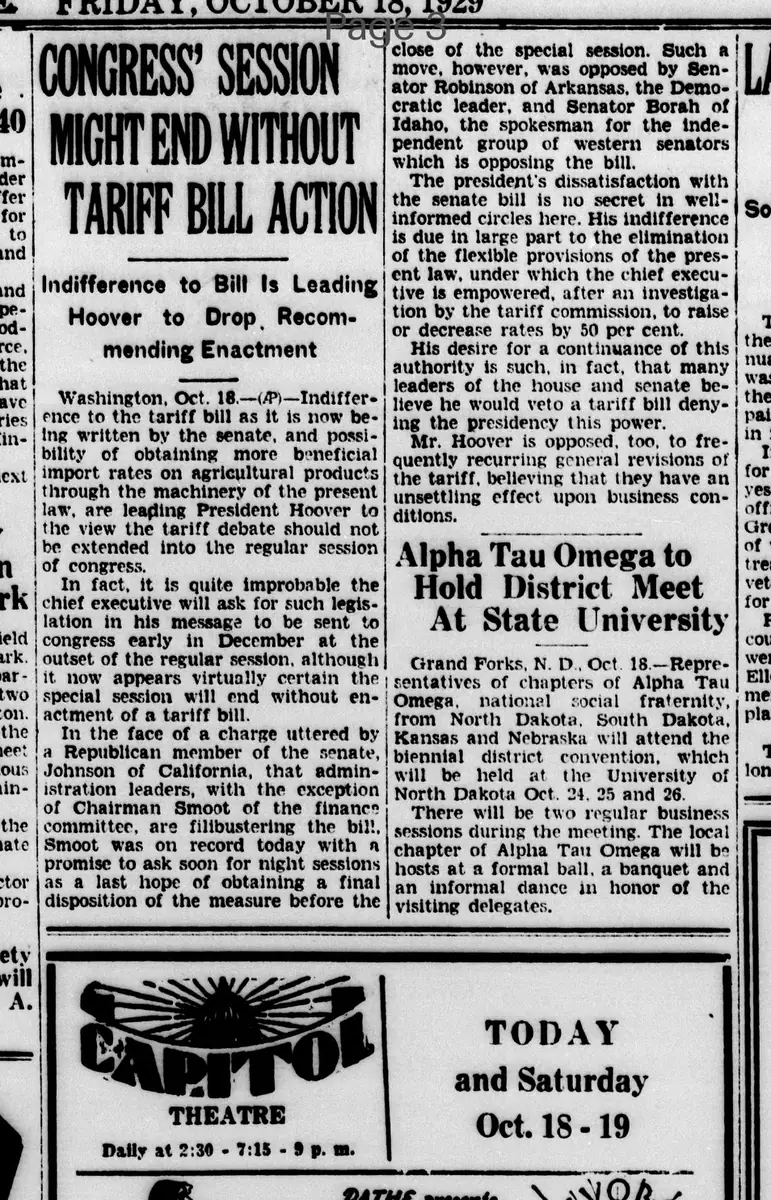
Indifference to Bill Is Leading Hoover to Drop, Recommending Enactment
Washington, Oct. 18.--(AP)-Indifference to the tariff bill as it is now being written by the senate, and possibility of obtaining more beneficial import rates on agricultural products through the machinery of the present law, are leading President Hoover to the view the tariff debate should not be extended into the regular session of congress.
In fact, it is quite improbable the chief executive will ask for such legislation in his message to be sent to congress early in December at the outset of the regular session, although it now appears virtually certain the special session will end without enactment of a tariff bill.
In the face of a charge uttered by a Republican member of the senate, Johnson of California, that administration leaders, with the exception of Chairman Smoot of the finance committee, are filibustering the bill, Smoot was on record today with a promise to ask soon for night sessions as a last hope of obtaining a final disposition of the measure before the close of the special session. Such a move, however, was opposed by Senator Robinson of Arkansas, the Democratic leader, and Senator Borah of Idaho, the spokesman for the independent group of western senators which is opposing the bill.
The president's dissatisfaction with the senate bill is no secret in well-informed circles here. His indifference is due in large part to the elimination of the flexible provisions of the present law, under which the chief executive is empowered, after an investigation by the tariff commission, to raise or decrease rates by 50 per cent.
His desire for a continuance of this authority is such, in fact, that many leaders of the house and senate believe he would veto a tariff bill denying the presidency this power.
Mr. Hoover is opposed, too, to frequently recurring general revisions of the tariff, believing that they have an unsettling effect upon business conditions.
What sub-type of article is it?
What keywords are associated?
What entities or persons were involved?
Where did it happen?
Domestic News Details
Primary Location
Washington
Event Date
Oct. 18
Key Persons
Outcome
special session likely to end without tariff bill enactment; hoover may not request it in december message and could veto a bill without flexible provisions.
Event Details
Indifference to the Senate's tariff bill, lacking flexible rate adjustment provisions, leads President Hoover to view that the debate should not extend into the regular Congress session. Smoot promises night sessions to push for passage before special session ends, opposed by Robinson and Borah. Hoover opposes frequent tariff revisions for business stability.