Thank you for visiting SNEWPapers!
Sign up free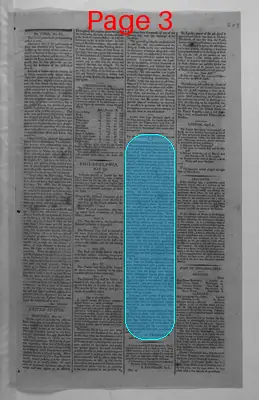
Gazette Of The United States & Evening Advertiser
Philadelphia, Philadelphia County, Pennsylvania
What is this article about?
Anecdote of Anacharsis Cloots, a Prussian philosopher who became prominent in the French Revolution for his eccentric patriotism, addressed the National Convention with foreign delegates, destroyed a Prussian medal, served as a representative alongside Thomas Paine, but was later executed for conspiracy.
Clipping
OCR Quality
Full Text
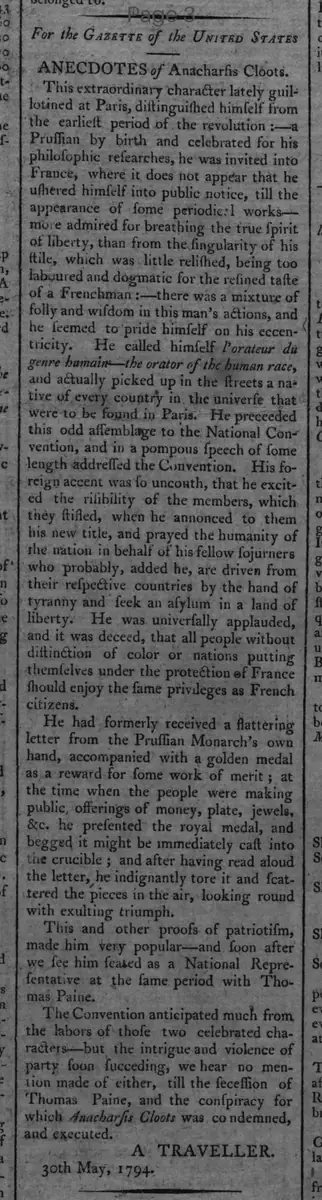
ANECDOTES of Anacharsis Cloots.
This extraordinary character lately guillotined at Paris, distinguished himself from the earliest period of the revolution: a Prussian by birth and celebrated for his philosophic researches, he was invited into France, where it does not appear that he ushered himself into public notice, till the appearance of some periodical works—more admired for breathing the true spirit of liberty, than from the singularity of his style, which was little relished, being too laboured and dogmatic for the refined taste of a Frenchman:—there was a mixture of folly and wisdom in this man's actions, and he seemed to pride himself on his eccentricity. He called himself l'orateur du genre humain the orator of the human race, and actually picked up in the streets a native of every country in the universe that were to be found in Paris. He preceded this odd assemblage to the National Convention, and in a pompous speech of some length addressed the Convention. His foreign accent was so uncouth, that he excited the risibility of the members, which they stifled, when he announced to them his new title, and prayed the humanity of the nation in behalf of his fellow sojourners who probably, added he, are driven from their respective countries by the hand of tyranny and seek an asylum in a land of liberty. He was universally applauded, and it was decreed, that all people without distinction of color or nations putting themselves under the protection of France should enjoy the same privileges as French citizens.
He had formerly received a flattering letter from the Prussian Monarch's own hand, accompanied with a golden medal as a reward for some work of merit; at the time when the people were making public, offerings of money, plate, jewels, &c. he presented the royal medal, and begged it might be immediately cast into the crucible; and after having read aloud the letter, he indignantly tore it and scattered the pieces in the air, looking round with exulting triumph.
This and other proofs of patriotism made him very popular—and soon after we see him seated as a National Representative at the same period with Thomas Paine.
The Convention anticipated much from the labors of those two celebrated characters—but the intrigue and violence of party soon succeeding, we hear no mention made of either, till the secession of Thomas Paine, and the conspiracy for which Anacharsis Cloots was condemned, and executed.
A TRAVELLER.
30th May, 1794.
What sub-type of article is it?
What themes does it cover?
What keywords are associated?
What entities or persons were involved?
Where did it happen?
Story Details
Key Persons
Location
Paris, France
Event Date
From The Earliest Period Of The Revolution
Story Details
Anacharsis Cloots, Prussian philosopher, gained notice in France for liberty writings, styled himself orator of humanity, led foreign delegates to Convention seeking asylum, destroyed Prussian medal in patriotic act, became popular representative with Paine, but later executed for conspiracy.