Thank you for visiting SNEWPapers!
Sign up free
Gazette Of The United States, & Philadelphia Daily Advertiser
Philadelphia, Philadelphia County, Pennsylvania
What is this article about?
A letter from Richmond warns of a faction in Virginia's legislature, led by John Taylor, pushing for separation from the union by declaring the Alien and Sedition Acts unconstitutional. It encloses an address from the General Assembly to the people, criticizing the acts as encroachments on state sovereignty and urging vigilance against federal overreach.
Merged-components note: The letter extract references and introduces the enclosed address from the Virginia General Assembly, forming a cohesive news component on state politics regarding federal laws.
Clipping
OCR Quality
Full Text
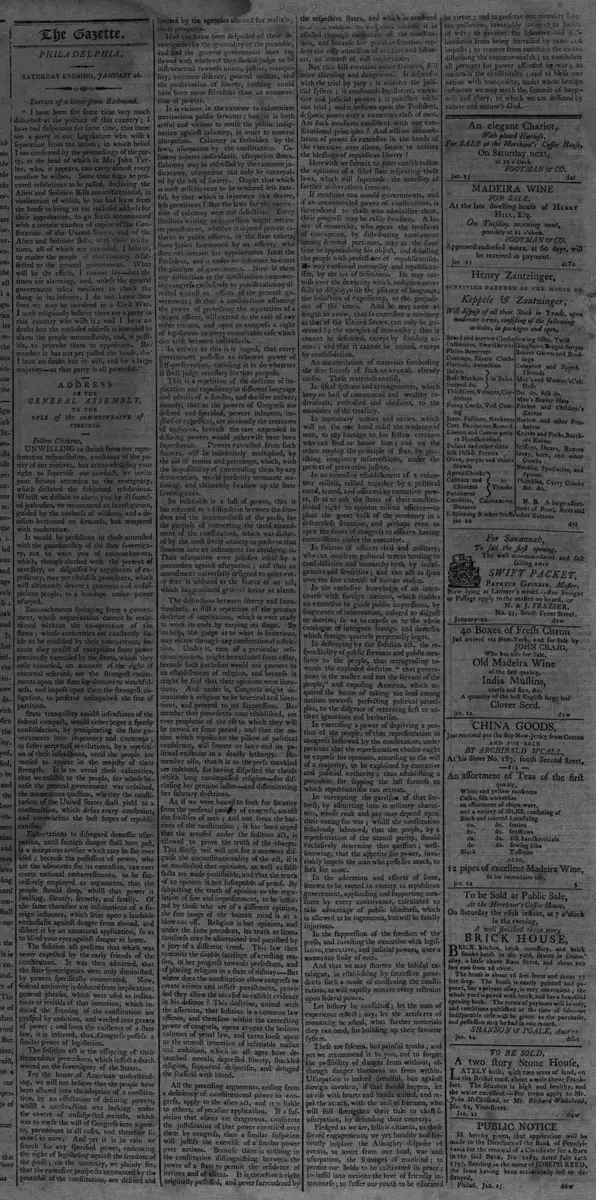
"I have been for some time very much disturbed at the politics of this country; I have had suspicions for some time, that there are a party in our Legislature who wish a separation from the union; in which belief I am confirmed by the proceedings of the party, at the head of which is Mr. John Taylor, who, it appears, can carry almost every measure he wishes. Some time since he procured resolutions to be passed, declaring the Alien and Sedition Bills unconstitutional, in vindication of which, he has had leave from the house to bring in the enclosed address for their approbation, to go forth accompanied with a certain number of copies of the Constitution of the United States, and of the Alien and Sedition Bills, with their resolutions, all of which are intended, I believe, to render the people of this country disaffected to the general government. What will be the effect, I cannot say—but the times are alarming, and, unless the general government takes measures to check the thing in its infancy, I do not know how soon we may be involved in a Civil War. I most religiously believe there are a party in this country who wish it; and I have no doubt but the enclosed address is intended to alarm the people unnecessarily, and, if possible, to provoke them to opposition. Remember it has not yet passed the house, tho' I have no doubt but it will, and by a large majority—as that party is all powerful."
ADDRESS
OF THE
GENERAL ASSEMBLY,
TO THE
PEOPLE of the COMMONWEALTH of
VIRGINIA.
Fellow Citizens,
UNWILLING to shrink from our representative responsibility, conscious of the purity of our motives, but acknowledging your right to supervise our conduct, we invite your serious attention to the emergency, which dictated the subjoined resolutions.
Whilst we disdain to alarm you by ill founded jealousies, we recommend an investigation, guided by the coolness of wisdom, and a decision bottomed on firmness, but tempered with moderation.
It would be perfidious in those entrusted with the guardianship of the state sovereignty, not to warn you of encroachments, which, though clothed with the pretext of necessity, or disguised by arguments of expediency, may yet establish precedents, which will ultimately devote a generous and unsuspicious people, to a bondage under power usurped.
Encroachments springing from a government, whose organization cannot be maintained without the co-operation of the states; whose authorities are constantly liable to be modified by their concurrence, because they consist of exceptions from power previously exercised by the states, which they only conceded, on account of the right of controul reserved, are the strongest excitements upon the state legislatures to watchfulness, and impose upon them the strongest obligation, to preserve unimpaired the line of partition.
State tranquility amidst infractions of the federal compact, would either beget a speedy consolidation, by precipitating the state governments into impotency and contempt; or foster perpetual revolutions, by a repetition of these infractions, until the people are roused to appear in the majesty of their strength. It is to avoid these calamities, that we exhibit to the people, for whose benefit the general government was ordained, the momentous question, whether the constitution of the United States shall yield to a construction, which defies every contraint, and overwhelms the best hopes of republicanism.
Exhortations to disregard domestic usurpation, until foreign danger shall have past, is a deceptious artifice which may be for ever used; because the possessors of power, who are the advocates for its extension, can ever create national embarrasments, to be successively employed as arguments, that the people should sleep, whilst that power is swelling, silently, secretly, and fatally. Of the same character are insinuations of a foreign influence, which seize upon a laudable enthusiasm against danger from abroad, and divert it by an unnatural application, so as to blind your eyes against danger at home.
The sedition act presents that which was never expected by the early friends of the constitution. It was then admitted, that the state sovereignties were only diminished, by powers specifically enumerated. Now, federal authority is deduced from implication; general phrases, which were used as indications or recitals of that intention, which induced the framing of the constitution are grasped by ambition, and wrested into grants of power; and from the existence of a state law, it is inferred, that Congress possesses a similar power of legislation.
The sedition act is the offspring of these tremendous pretensions, which inflict a death wound on the sovereignty of the States.
For the honor of American understanding, we will not believe that the people have been allured into the adoption of a constitution, by an affectation of designing powers, whilst a construction was lurking under the covert of unsuspected recitals, which was to erect the will of Congress into a power, paramount in all cases, and therefore limited in none. And yet it is in vain we search for any specified power, embracing the right of legislating against the freedom of the press; on the contrary, we plainly see, that the extensive prospects announced by the preamble of the constitution, are defined and limited by the agencies allowed for realizing those prospects.
Had the states been despoiled of their sovereignties by the generality of the preamble, and had the general government been endowed with whatever they should judge to be instrumental towards union, justice, tranquility, common defence, general welfare, and the preservation of liberty, nothing could have been more frivolous than an enumeration of powers.
It is vicious in the extreme to calumniate meritorious public servants; but it is both artful and vicious to rouse the public indignation against calumny, in order to conceal usurpation. Calumny is forbidden by the laws, usurpation by the constitution. Calumny injures individuals, usurpation states. Calumny may be redressed by the common judicatures, usurpation can only be controuled by the act of society. Ought that which is most mischievous to be rendered less hateful, by that which is injurious in a degree, less pernicious? But the laws for the correction of calumny were not defective. Every libellous writing or expression might receive its punishment, whether it injured private citizens or public officers, in the state courts, from juries summoned by an officer, who does not receive his appointment from the President, and is under no influence to court the pleasure of government. Now is there any distinction in the constitution empowering congress exclusively to punish calumny directed against an officer of the general government; so that a construction assuming the power of protecting the reputation of a citizen officer, will extend to the case of any other citizen, and open to congress a right of legislation in every conceivable case which can arise between individuals.
In answer to this it is urged, that every government possesses an inherent power of self-preservation, entitling it to do whatever it shall judge necessary for that purpose. This is a repetition of the doctrine of implication and expediency in different language and admits of a similar, and decisive answer, namely, that as the powers of Congress are designed and specified, powers inherent, implied or expedient, are obviously the creatures of ambition, because the care expended in defining powers would otherwise have been superfluous. Powers extracted from such sources, will be indefinitely multiplied, by the aid of armies and patronage, which, with the impossibility of controuling them by any demarcation, would presently terminate reasoning, and ultimately swallow up the state sovereignties.
So insatiate is a lust of power, that it has resorted to a distinction between the freedom and the licentiousness of the press, for the purpose of converting the third amendment of the constitution, which was dictated by the most lively anxiety to preserve that freedom into an instrument for abridging it. Thus usurpation even justifies itself by a precaution against usurpation; and thus an amendment universally designed to quiet every fear is adduced as the source of an act, which has produced general terror or alarm.
The distinction between liberty and licentiousness, is still a repetition of the protean doctrine of implication, which is ever ready to work its ends by varying its shape. By its help, the judge as to what is licentious, may escape through any constitutional restriction. Under it, men of a particular religious opinion, might be excluded from office, because such exclusion would not amount to an establishment of religion, and because it might be said that their opinions were licentious. And under it, Congress might denominate a religion to be heretical and licentious, and proceed to its suppression. Remember that precedents once established, are ever prophetic of the use to which they will be turned at some period; and that the nation which reposes on the pillow of political confidence, will sooner or later end its political existence in a deadly lethargy. Remember also, that it is to the press mankind are indebted, for having dispelled the clouds which long encompassed religion for disclosing her genuine lustre -and disseminating her salutary doctrines.
As if we were bound to look for security from the personal probity of congress, amidst the frailties of man; and not from the barriers of the constitution; it has been urged that the accused under the sedition act, is allowed to prove the truth of the charge. This slimy veil will not for a moment disguise the unconstitutionality of the act, if it be recollected that opinions, as well as false facts are made punishable, and that the truth of an opinion is not susceptible of proof. By subjecting the truth of opinion to the regulation of fine and imprisonment, to be inflicted by those who are of a different opinion, the free range of the human mind is at a blow cut off. Religion is but opinion, and under the same precedent, its truth or licentiousness may be ascertained and punished by a jury of a different creed. This law then commits the double sacrilege of arresting reason, in her progress towards perfection, and of placing religion in a state of disiny. But where does the constitution allow congress to create crimes and inflict punishment, provided they allow the accused to exhibit evidence in his defence? This doctrine, united with the assertion, that sedition is a common law offence, and therefore within the correcting power of congress, opens at once the hedious volumes of penal law, and turns loose upon us the utmost invention of insatiate malice and ambition, which in all ages have debauched morals, depressed liberty, shackled religion, supported despotism, and deluged the scaffold with blood.
All the preceding arguments, arising from a deficiency of constitutional power in congress, apply to the alien act, and it is liable to others, of peculiar application. If a suspicion that aliens are dangerous, constitute the justification of that power exercised over them by congress, then a similar suspicion will justify the exercise of a similar power over natives. Because there is nothing in the constitution distinguishing between the power of a state to permit the residence of natives and of aliens. It is therefore a right originally possessed, and never surrendered by the respective states, and which is rendered sacred and valuable to Virginia, because it is assailed through the bosom of the constitution, and because her peculiar situation renders the easy admission of artizans and laborers, an interest of vast importance.
But this bill contains other features, still more alarming and dangerous. It dispenses with the trial by jury: it violates the judicial system; it confounds legislative, executive and judicial powers; it punishes without trial; and it bestows upon the President, despotic power over a numerous class of men.
Are such measures consistent with our constitutional principles? And will an accumulation of power so extensive in the hands of the executive over aliens, secure to natives the blessings of republican liberty?
Herewith we submit to your consideration the opinions of a sister state respecting these laws, which will supercede the necessity of farther observations from us.
If measures can mould governments, and if an uncontrouled power of construction, is surrendered to those who administer them, their progress may be easily foreseen. A lover of monarchy, who opens the treasures of corruption, by distributing emolument among devoted partizans, may at the same time be approaching his object, and deluding the people with professions of republicanism. He may confound monarchy and republicanism, by the art of definition. He may varnish over the dexterity which ambition never fails to display, with the pliancy of language, the seduction of expediency, or the prejudices of the times. And he may come at length to avow, that so extensive a territory as that of the United States, can only be governed by the energies of monarchy; that it cannot be defended, except by standing armies; and that it cannot be united, except by consolidation.
An accumulation of materials foreboding the dire success of such an avowal, already exists. These materials consist,
In fiscal systems and arrangements, which keep an host of commercial and wealthy individuals, embodied and obedient, to the mandates of the treasury.
In mercenary armies and navies, which will on the one hand enlist the tendency of man, to pay homage to his fellow creature who can feed or honor him; and on the other employ the principle of fear, by punishing imaginary insurrections, under the pretext of preventive justice.
In an extensive establishment of a volunteer militia, rallied together by a political creed, armed, and officered by executive power, so as to rob the states of their constitutional right to appoint militia officers-to place the great bulk of the yeomanry in a defenceless situation, and perhaps even to open the doors of congress to officers having commissions under the executive.
In swarms of officers civil and military, who can inculcate political tenets tending to consolidation and monarchy both by indulgencies and severities; and can act as spies over the free exercise of human reason.
In the exclusive knowledge of an intercourse with foreign nations, which enables an executive to guide public impressions, by fragments of information, colored to disgust or deceive, so as to expose us to the whole catalogue of intrigues foreign and domestic which foreign quarrels perpetually beget.
In destroying by the sedition act, the responsibility of public servants and public measures to the people, thus retrograding towards the exploded doctrine "that government is the master and not the servant of the people," and exposing America, which acquired the honor of taking the lead among nations towards perfecting political principles, to the disgrace of returning first to ancient ignorance and barbarism.
In exercising a power of depriving a portion of the people, of that representation in congress bestowed by the constitution, under pretence that the representative chosen ought to express his opinions, according to the will of a majority, to be explained by executive and judicial authority; thus establishing a precedent for sapping the last fortress to which republicanism can retreat.
In corrupting the garrison of that fortress, by admitting into it military characters, whose rank and pay may depend upon their voting for war; whilst the constitution sedulously laboured, that the people, by a representation of the utmost purity, should exclusively determine that question; well-knowing, that the appetite for power, invariably impels the man who possesses much, to seek for more.
In the adoration and efforts of some, known to be rooted in enmity to republican government, applauding and supporting measures by every contrivance, calculated to take advantage of public blindness, which is allowed to be ingenuous, but will be fatally injurious.
In the suppression of the freedom of the press, and investing the executive with legislative, executive, and judicial powers, over a numerous body of men,
And that we may shorten the baleful catalogue, in establishing by successive precedents such a mode of construing the constitution, as will rapidly remove every restraint upon federal power.
Let history be consulted; let the man of experience reflect; nay, let the artificers of monarchy be asked, what farther materials they can need, for building up their favorite system.
These are solemn, but painful truths; and yet we recommend it to you, not to forget the possibility of danger from without, although danger threatens us from within. Usurpation is indeed dreadful, but against foreign invasion, if that should happen, let us rise with hearts and hands united, and repel the attack, with the zeal of freemen, who will still strengthen their title to chast'e usurpation, by defending their country.
Pledged as we are, fellow-citizens, to these sacred engagements, we yet humbly and fervently implore the Almighty disposer of events, to avert from our land, war and usurpation, the scourges of mankind; to permit our fields to be cultivated in peace; to instill into nations the love of friendly intercourse; to suffer our youth to be educated in virtue; and to preserve our morality from the pollution, invariably incident to habits of war; to prevent the labourer and husbandman from being harassed by taxes and imposts; to remove from ambition the means disturbing the commonwealth; to annihilate all pretexts for power afforded by war; to maintain the constitution; and to bless our nation with tranquility, under whose benign influence we may reach the summit of happiness and glory, to which we are destined by nature and nature's God.
What sub-type of article is it?
What keywords are associated?
What entities or persons were involved?
Where did it happen?
Domestic News Details
Primary Location
Richmond, Virginia
Key Persons
Outcome
the address has not yet passed the house but is expected to by a large majority, potentially leading to disaffection toward the general government and risk of civil war.
Event Details
A letter from Richmond expresses alarm at a legislative party led by Mr. John Taylor pushing resolutions declaring the Alien and Sedition Bills unconstitutional, enclosing an address from the General Assembly to the people of Virginia warning against federal encroachments on state sovereignty, criticizing the acts as unconstitutional, and urging vigilance to prevent consolidation and potential monarchy.